Description
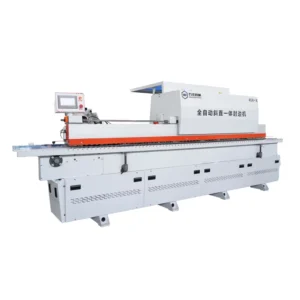
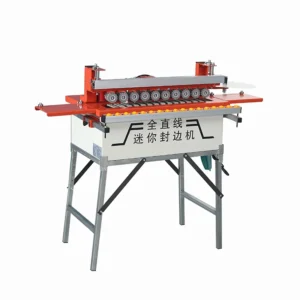
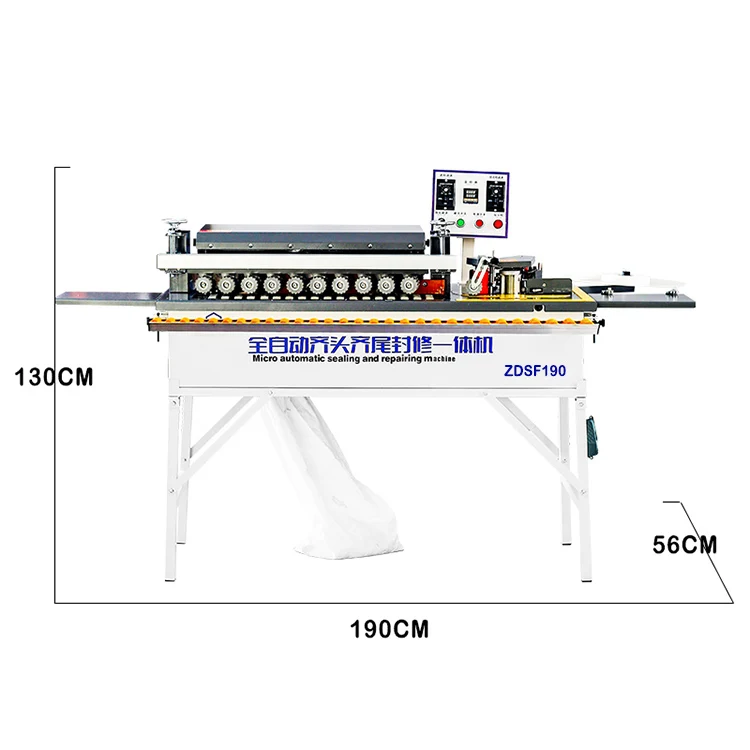
Compact Footprint, Full Automation — the WFS190 delivers automatic plate feeding, double-sided gluing, and head/tail trimming within a 1900×560mm footprint, serving as the entry point in a scalable edge banding machine family for workshops building toward higher throughput.
Technical Specifications
| Parameter | Value |
|---|---|
| Model | WFS190 |
| Product Type | Small Automatic Edge Banding Machine |
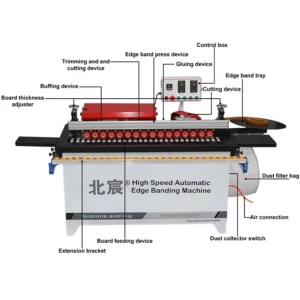
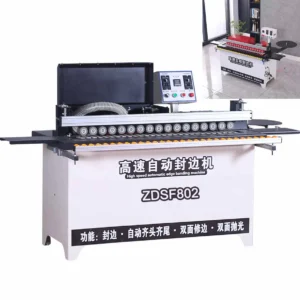
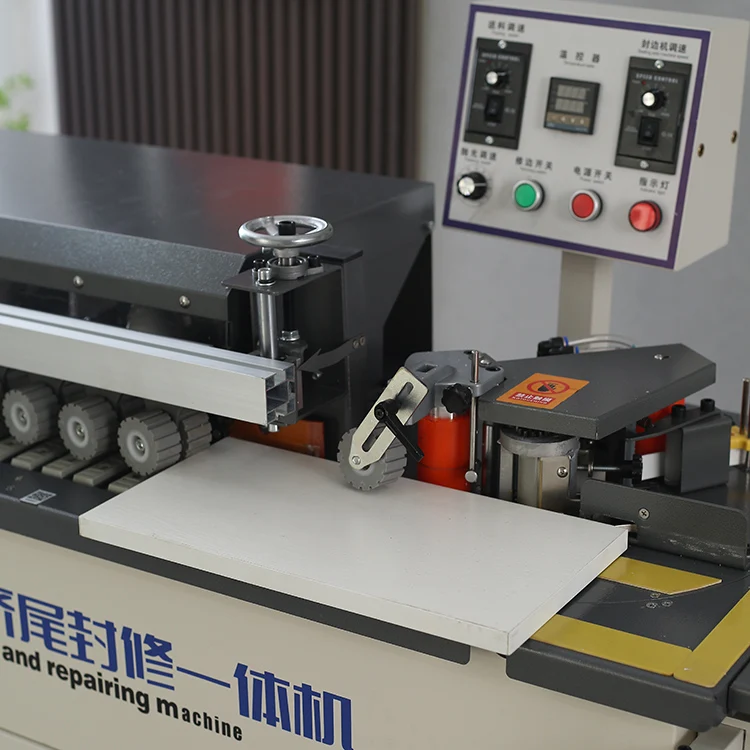
| Function | Automatic plate feeding, double-sided gluing, upper and lower polishing, automatic head and tail trimming, bending and straightening |
| Edge Type | Both curved and straight lines |
| Voltage & Frequency | 220V 50Hz (configurable from 110V to 440V) |
| Rated Power | 4kW |
| Heating Power | 800W |
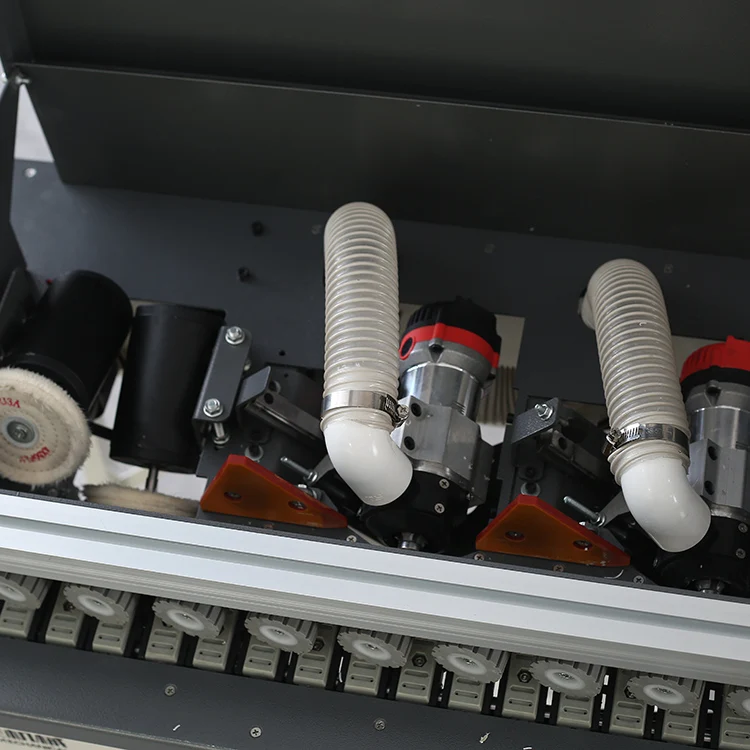
| Trimming Power | 800W × 2 |
| Polishing Power | 180W × 2 |
| Suction Power | 1200W |
| Belt Power | 25W |
| Transmission Power | 120W |
| Rated Air Pressure | 0.4–0.6 MPa |
| Conveyor Belt Speed | 0–14 m/min |
| Feed Speed | 0–14 m/min |
| Sheet Thickness Range | 10–50 mm |
| Strip Thickness Range | 0.5–2.5 mm |
| Glue Capacity | 1000 ml |
| Overall Dimensions (L×W×H) | 1900 × 560 × 1300 mm |
| Net Weight | 140 kg |
Application Suitability
| Application | Material or Output |
|---|---|
| Custom cabinet door edge banding | MDF and particleboard with PVC edge banding on straight edges |
| Curved panel finishing for furniture | Plywood and shaped MDF with veneer or PVC strips on curved contours |
| Small-batch workshop production | Solid wood panels and blockboard with 0.5–2.5 mm strip thickness |
| Joinery startup transitioning from manual | Mixed panel substrates requiring both straight and curved edge processing |
Why the Glue Temperature Question Matters More Than Feed Speed
A machine rated at 14 m/min feed speed will not deliver that throughput if the glue pot cannot maintain stable temperature on thick PVC stock.
I have seen workshops purchase entry-level edge banders based on conveyor speed alone, only to discover that when running 2 mm PVC edge banding on particleboard, the adhesive fails to bond properly at higher feed rates. The glue cools before full contact, leaving visible bubbles and weak adhesion along the panel edge. The operator then slows the feed to half speed to compensate, and the quoted throughput drops accordingly [NEED_CITE: adhesive bonding temperature requirements for PVC edge banding on wood-based panels]. The WFS190 Small Automatic Edge Banding Machine addresses this with an 800W heating element and a 1000ml glue pot, which gives operators the capacity to maintain consistent glue viscosity across a full shift of mixed panel runs.
Where the WFS190 Sits in the Full Machine Range
The Ruiqi edge banding family spans from compact single-function units to full-line pre-milling systems with multiple trimming and buffing stations. The WFS190 occupies the entry tier — it covers automatic feeding, double-sided gluing, head and tail trimming, and polishing within one compact frame. For a joinery workshop moving away from hand-held edge banders or manual iron-on methods, this Small Automatic Edge Banding Machine for sale removes the most labour-intensive steps while keeping floor space requirements manageable at under two metres in length.
Planning the Upgrade Path Before You Buy
A common mistake at the entry level is treating the first machine as an isolated purchase rather than the opening move in a phased investment. Workshops that later add a panel saw and a multi-boring machine often find their initial edge bander cannot match the upstream throughput or handle the panel thickness range their production has grown into. The WFS190 processes sheet thicknesses from 10 mm to 50 mm, which covers standard cabinet and furniture panel work today while leaving headroom for thicker solid wood stock [NEED_CITE: typical panel thickness ranges in custom furniture manufacturing]. When the time comes to step up, the control logic and feed mechanics across the Ruiqi range share common principles, reducing the retraining burden on operators.
Reading the Spec Sheet Against Your Actual Workload
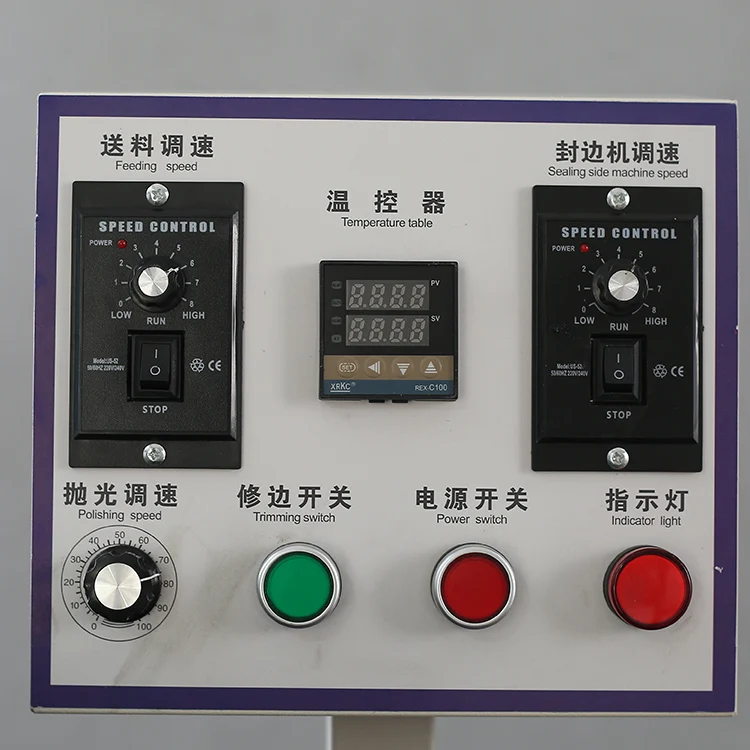
The 0–14 m/min variable feed speed lets operators dial throughput to match the material at hand — slower for curved contours in plywood where the strip must flex around a radius, faster for straight runs on flat MDF panels. The 800W × 2 trimming motors handle both head and tail cuts, which is where cheaper machines often leave ragged ends that require manual cleanup. Double-sided gluing with a 1000ml pot capacity means the adhesive covers both the panel edge and the back of the strip, improving bond strength on porous substrates like particleboard where single-sided application often starves the joint. The 0.4–0.6 MPa air pressure range is standard for pneumatic trimming and pressing actuators, and most workshop compressors will supply this without modification.
The Cost of Underspecifying at the Entry Level
Buying an edge bander without confirming the strip thickness range against your actual stock leads to a machine that simply cannot feed the material. If your supplier stocks 3 mm PVC but the machine tops out at 2.5 mm, every panel run with that strip becomes a manual workaround. Similarly, specifying a machine with only straight-edge capability and later receiving curved panel orders means either turning work away or sending it out for subcontracting [NEED_CITE: common edge banding subcontracting costs for curved panel work]. The WFS190 handles 0.5–2.5 mm strips on both curved and straight profiles, which covers the majority of furniture and cabinet edge banding materials in use.
What Manufacturing Depth Means for This Machine
Ruiqi builds the WFS190 within a product family that shares common precision-ground components and assembly processes across all tiers, so the entry-level model benefits from the same four-stage quality control applied to higher-capacity machines. Patented cutting mechanisms in the trimming stations hold tolerance at ±0.02 mm, which matters when edge quality directly affects whether a cabinet door sits flush in its frame. Voltage customization from 110V to 440V is standard across the range, so the machine ships configured for the buyer’s local electrical supply rather than arriving with an incompatible motor. Multilingual control panels are available, which eliminates the commissioning delays that occur when operators cannot read the interface. An engineer reviews every configuration against the buyer’s stated production requirement before quotation, typically within 24 hours.
Documentation & Verification
- CE declaration of conformity covering the WFS190 trimming and heating circuits
- Factory test record on your specified panel thickness and strip material before dispatch
- Electrical schematic confirming voltage and frequency match your site supply
- Operation manual in your chosen language with curved and straight edge setup procedures
- Spare parts list with trimming cutter and glue pot consumable part numbers
Installation, Commissioning & Support
- Requires a 220V dedicated circuit rated for the 4kW total draw with appropriate breaker sizing
- Overall 1900×560×1300mm footprint needs clear access on both sides for curved panel feeding
- Arrives requiring assembly; pneumatic connections must match the 0.4–0.6 MPa supply range
- First-run calibration covers feed speed, glue temperature, and trimming depth on your panel stock
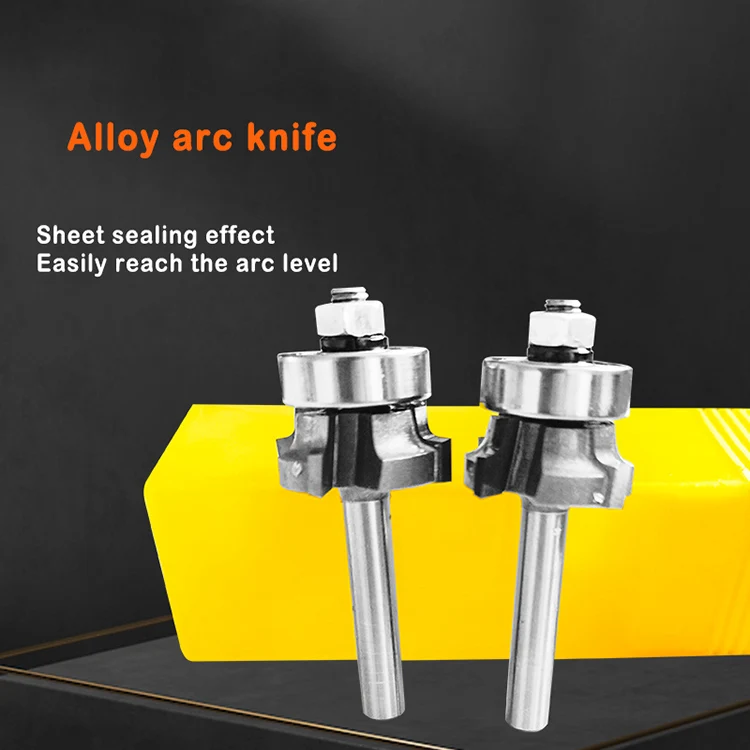
- Trimming cutters and polishing wheels are standard wear items stocked for replacement
Preparing Your Inquiry
To receive a configuration proposal matched to your workshop, share the panel substrates and edge banding materials you run most often, the typical sheet dimensions and thickness range, and your local voltage and frequency. If you are planning a phased line build-out, note any existing panel saws or boring machines so the feed height and throughput can be coordinated. Sample processing tests on your actual materials are available before order confirmation.
Frequently Asked Questions
Q: Where does the WFS190 sit in the Ruiqi range, and when should I step up?
A: The WFS190 is the entry tier, covering automatic feeding, gluing, trimming, and polishing for small to medium batch runs. Step up when your daily panel volume consistently exceeds what a 0–14 m/min feed speed delivers, or when you need pre-milling for uneven panel edges from the saw.
Q: Can the WFS190 handle both PVC and veneer on curved panels?
A: Yes, the machine processes 0.5–2.5 mm strips on both curved and straight edges. Veneer requires lower glue temperature and gentler pressing pressure than PVC, so the operator adjusts heating power and feed speed accordingly for each material changeover.
Q: What if my workshop supply is not 220V 50Hz?
A: Voltage customization from 110V to 440V is standard across the Ruiqi range. Confirm your local supply voltage and frequency during inquiry, and the machine ships with matching motor windings, heating elements, and control transformer so it runs correctly on arrival.
Q: How does the WFS190 fit into a phased production line?
A: It pairs with upstream panel saws for cut-to-size stock and downstream hinge or multi-boring machines for hardware preparation. Feed height and panel transfer between stations are reviewed during the configuration proposal to avoid bottlenecks as additional machines are added.
Q: What is the upgrade path as my workshop grows?
A: The next tier adds pre-milling for saw-mark removal and additional trimming stations for contour profiling. The WFS190 remains useful as a secondary machine for short runs and curved work even after a higher-tier model takes over main production volume.