Description
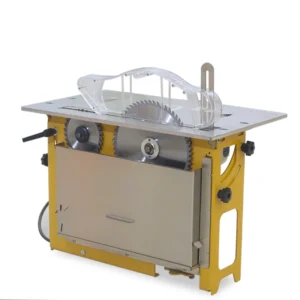
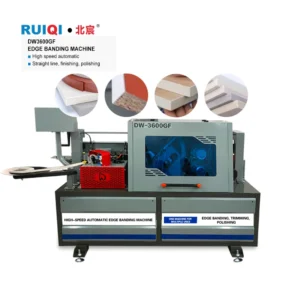
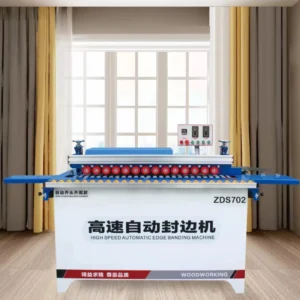
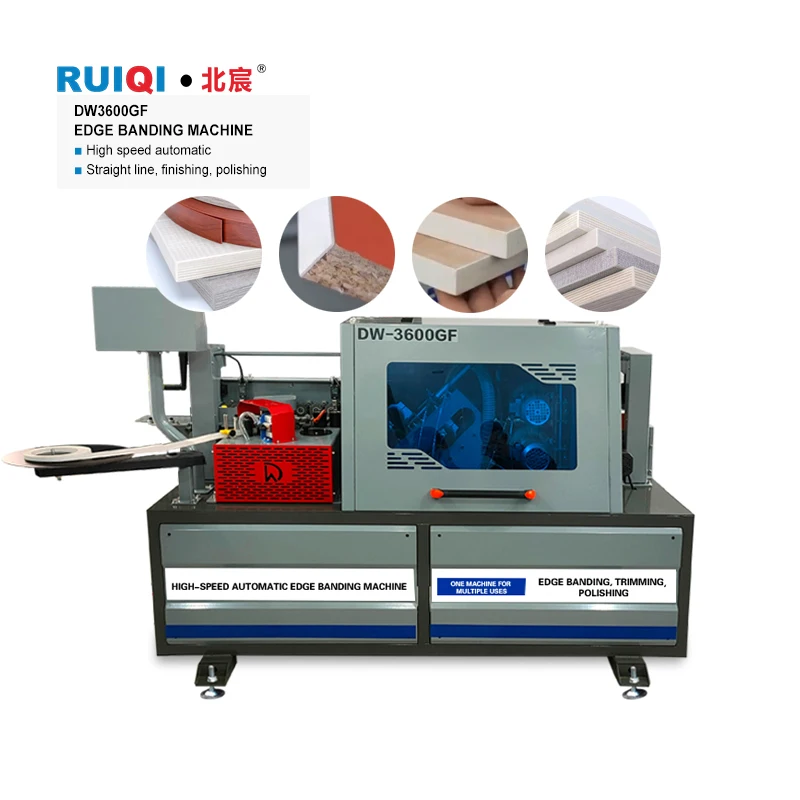
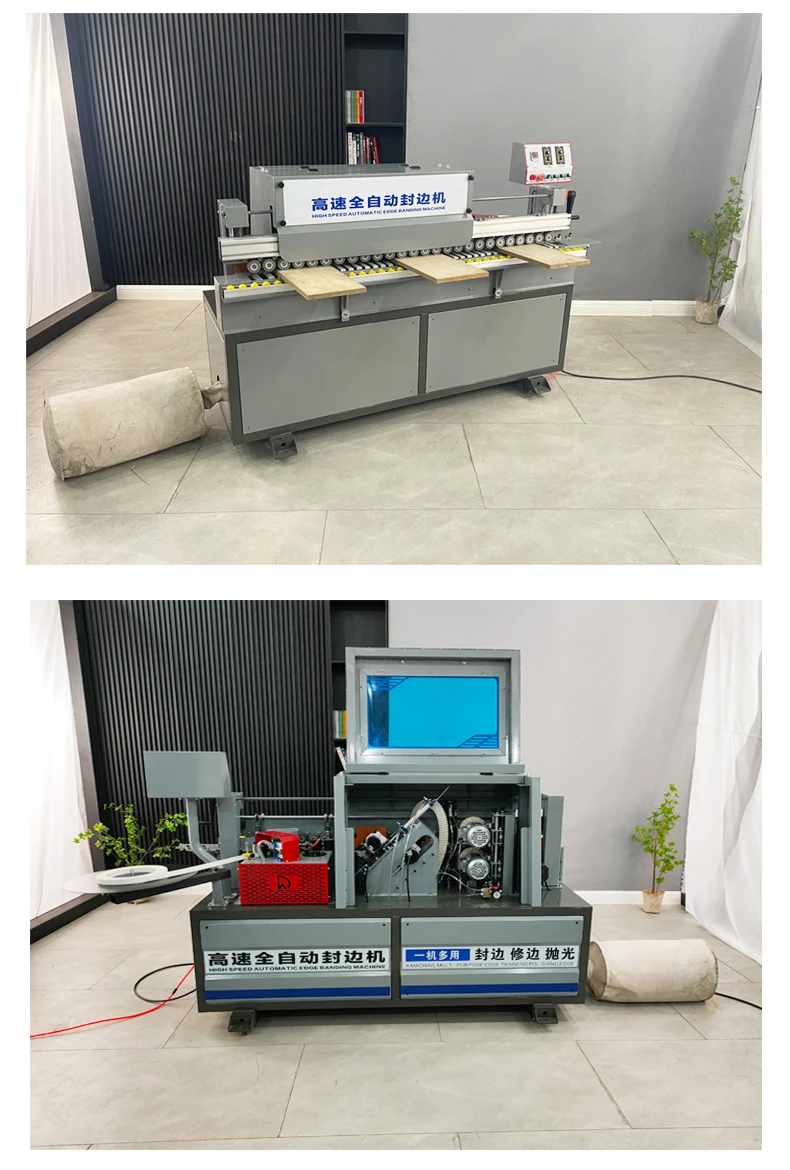
Scalable Equipment Range — The DW-3600GF sits within a complete RUIQI edge banding machine family, allowing workshops to map this 7-function model against entry-level and full-function pre-milling options before committing to a purchase.
Technical Specifications
| Parameter | Value |
|---|---|
| Model | DW-3600GF |
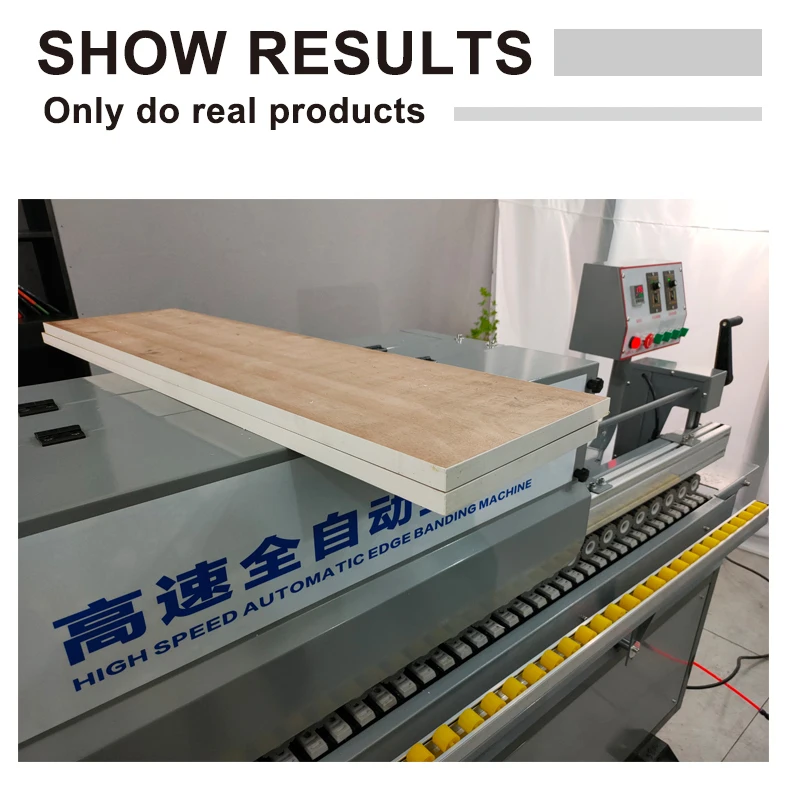
| Product Type | Fully Automatic Edge Banding Machine |
| Voltage & Frequency | 380V Three-Phase Four-Wire (frequency to be confirmed: 50Hz or 60Hz) |
| Total Power | 4.9 kW |
| Overall Dimensions (L×W×H) | 2200 × 650 × 1250 mm |
| Total Weight | 320 kg |
| Edge Banding Type | Straight Edge Banding |
| Edge Band Height Range | 0–50 mm |
| Edge Band Thickness Range | 0.3–3 mm |
| Minimum Panel Length | 200 mm |
| Feed Speed | 0–14 m/min |
| Trimming Power / Speed | 800 W × 2, 24,000 r/min |
| Polishing Power | 400 W × 2 |
| Air Pressure Requirement | 0.4–0.6 MPa |
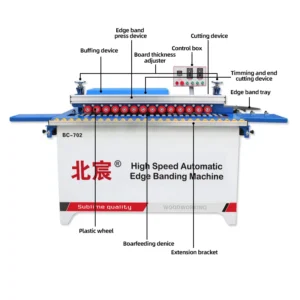
| Standard Functions | Gluing, Trimming, Front and Rear Trimming, Scraping, Polishing, Vacuuming |
| Control System | To be confirmed (PLC or manual control) |
| Language Options | Chinese and English standard; other languages customizable |
| Assembly State | Fully assembled |
| Certification | CE, ISO 9001 |
Application Suitability
| Application | Material or Output |
|---|---|
| Custom furniture panel edge finishing | MDF, particleboard, plywood straight edges |
| Cabinet door and carcass banding | PVC and melamine edge banding material |
| Solid wood panel edge treatment | Solid wood panels with veneer edge banding |
| Small-batch joinery production | Mixed panel substrates in workshop environments |
Why the Voltage Question Must Come Before the Quotation
A machine wired for the wrong frequency will stall on the shop floor before the first panel is edged.
When a Fully Automatic Edge Bander manufacturer ships equipment overseas without locking down voltage and frequency in the technical agreement, the consequences arrive the moment the electrician throws the breaker. I once watched a 380V control board fry instantly on a 440V grid in the Middle East, leaving a furniture factory idle for three weeks while replacement parts crossed two borders. That single oversight cost more than any price negotiation could have saved. The DW-3600GF is configurable across voltage ranges, but the exact configuration must be confirmed against the buyer’s local supply before production begins [NEED_CITE: voltage and frequency standards by export market]. Skipping this step turns a routine commissioning into an expensive troubleshooting exercise.
Where the DW-3600GF Fits in the RUIQI Range
The RUIQI catalogue spans from compact entry-level banders designed for low-volume joinery shops up to full-function pre-milling machines built for continuous production shifts. The DW-3600GF occupies the middle tier as a Fully Automatic Edge Bander with seven integrated stations, giving custom furniture factories a capable machine without stepping into the footprint and power draw of a pre-milling configuration. Buyers surveying the complete range can see exactly how this model bridges the gap between basic trimming setups and high-throughput line equipment, making it easier to plan a purchase that matches current volume without over-investing in unused capacity.
Planning a Workshop Line Around This Model
Purchasing a single edge bander in isolation often leads to feed-height mismatches or throughput bottlenecks when the machine meets upstream panel saws and downstream boring stations. Because RUIQI manufactures the full sequence of panel processing equipment, the DW-3600GF can be evaluated alongside compatible sliding table saws and multi-boring machines for consistent material flow. This matters for cabinet makers scaling from manual edge finishing to automated production, where panel transfer height and cycle timing need to align across every station [NEED_CITE: CE machinery directive requirements for industrial equipment]. Seeing the entire equipment family in one catalogue removes the guesswork from line planning.
How Seven Functions Translate to Edge Quality
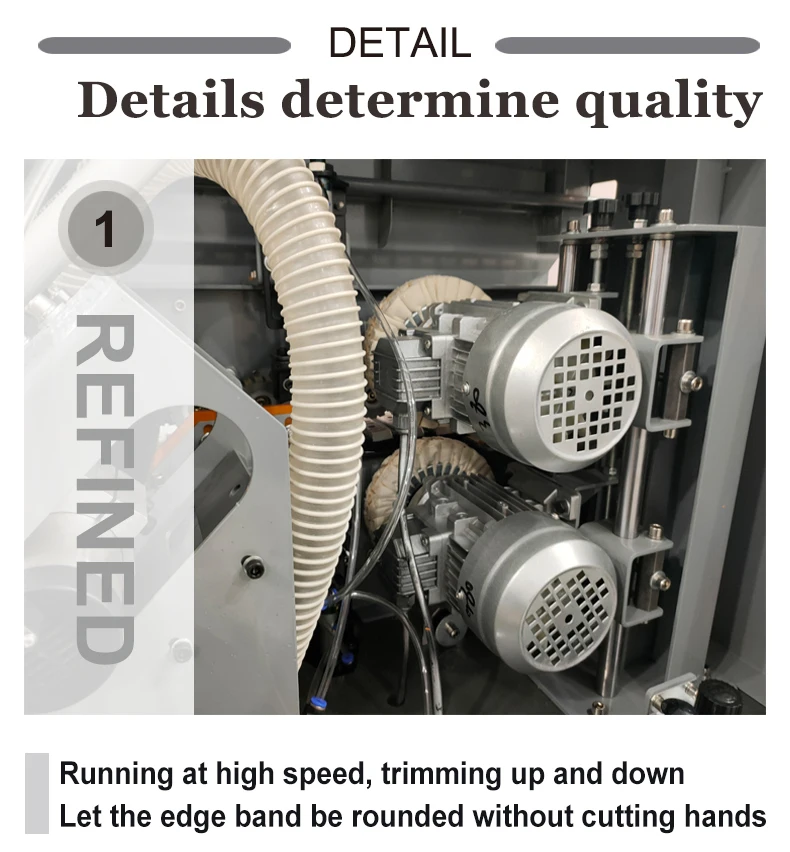
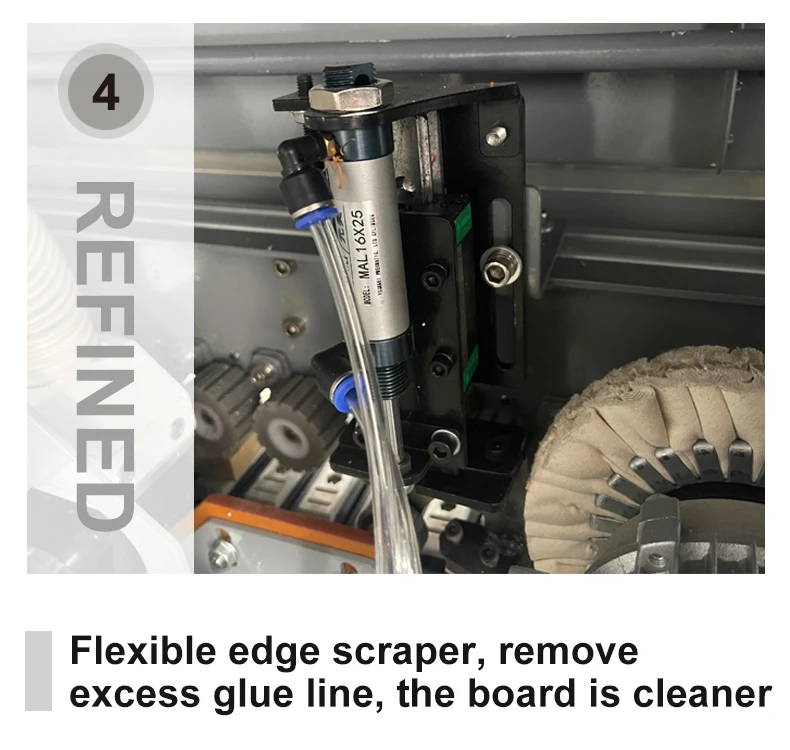
The DW-3600GF sequences gluing, trimming, front and rear trimming, scraping, polishing, and vacuuming into a single pass. Trimming stations running at 24,000 r/min remove excess banding material cleanly, reducing the visible glue line that often appears on MDF and particleboard when trimmer speeds fall short. The 0.3–3 mm edge band thickness range covers standard PVC and veneer tapes used in custom furniture, while the 0–14 m/min feed speed lets operators slow down for delicate veneer work or accelerate for high-volume PVC runs. Scraping and polishing stations that follow trimming remove micro-roughness left by the cutter, which directly affects how panels feel during final assembly and installation.
The Cost of Overlooking Configuration Details
Buyers who select an edge bander purely on function count often discover problems only after installation. A machine without confirmed voltage compatibility can damage the control system on first power-up, halting production and requiring specialist electrical repair [NEED_CITE: common causes of commissioning failures in exported woodworking machinery]. Similarly, a control panel in a language the operator cannot read delays commissioning by days or weeks while translation workarounds are arranged. Edge banding quality also suffers when the machine is asked to handle banding thickness or panel lengths outside its design window, producing visible seams that fail customer inspection. These issues are avoidable when specifications are verified during the quotation stage rather than at the factory door.
Why Procurement Teams Source This Range Here
RUIQI manufactures the DW-3600GF in-house with patented cutting mechanisms, so tolerance claims can be traced back to the tooling rather than a third-party integrator. The four-stage quality control process — incoming material, in-process, finished product, and pre-shipment verification — means the machine you receive matches the specification sheet signed off at order. Voltage, language, and panel-thickness customization are handled as standard configuration items rather than special requests. For buyers evaluating the full RUIQI catalogue, every model shares common design philosophy and spare parts architecture, simplifying maintenance across a mixed fleet. Factory visits are welcomed so procurement teams can witness assembly and testing firsthand.
Documentation & Verification
- CE declaration of conformity specific to the DW-3600GF configuration shipped
- Machine specification sheet confirming voltage, frequency, and all seven function stations
- Factory test record run on your specified panel thickness range before dispatch
- Electrical schematic with confirmed wiring diagram matching your local supply standard
- Operation and maintenance manual written in your agreed language with illustrated spare parts list
- Pre-shipment verification photographs showing powered run and edge finish quality
Installation, Commissioning & Support
- Confirm 380V three-phase four-wire supply with dedicated circuit rated for the 4.9 kW total draw
- Allow a 2200 × 650 mm clear floor area with 1250 mm overhead clearance for the fully assembled unit
- Connect compressed air at 0.4–0.6 MPa to feed the gluing and vacuuming stations
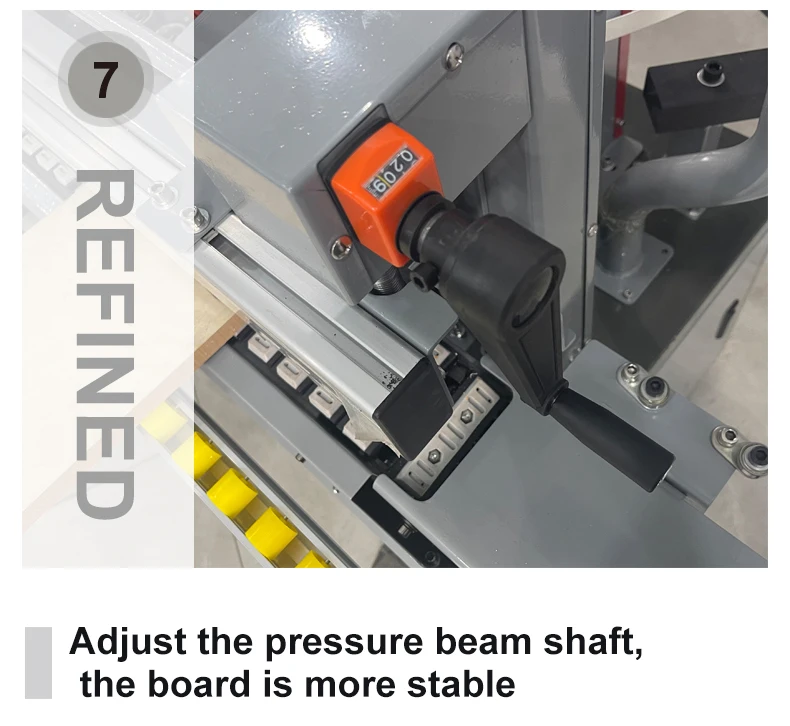
- Verify feed speed calibration and trimming alignment on your actual panel stock during first run
- Review control panel language setting and function sequence with operators before production begins
- Stock consumable trimming blades and polishing wheels matched to your primary edge band material
What to Include in Your Inquiry
To configure the DW-3600GF accurately, share the panel substrates you process most often, the edge banding materials and thickness range you use, and your local voltage and frequency standard. Let us know whether you operate existing upstream saws or downstream boring machines so the feed height and throughput can be matched. If you need a sample processing test on your own panel stock before committing, specify the material and edge profile you want evaluated.
Frequently Asked Questions
Q: Where does the DW-3600GF sit in RUIQI’s edge bander range compared to entry-level and full-function pre-milling models?
A: The DW-3600GF is the mid-range 7-function Fully Automatic Edge Bander in the RUIQI catalogue, positioned above entry-level models that cover basic trimming and below full-function pre-milling machines that add a milling station for heavy-duty panel preparation. It suits custom furniture factories needing complete straight-edge finishing without the power draw and footprint of a pre-milling configuration.
Q: What voltage and frequency configurations are available for different export markets?
A: The DW-3600GF is configurable across voltage ranges from 110V to 440V with either 50Hz or 60Hz frequency. The exact combination must be confirmed against your local supply standard and written into the technical agreement before production. This prevents the control board damage that occurs when a machine wired for one standard is connected to another.
Q: Which edge banding materials are compatible with this 7-function setup?
A: The DW-3600GF handles PVC, melamine, and veneer edge banding within a 0.3–3 mm thickness range and up to 50 mm height. The trimming stations at 24,000 r/min produce clean cuts on standard PVC tapes, while the feed speed can be reduced for delicate veneer applications where slower travel prevents tear-out.
Q: Can the control panel language be customized beyond Chinese and English?
A: Yes. Chinese and English are standard on the DW-3600GF, and additional languages can be configured based on the operator’s requirements. Confirming the language during the quotation stage ensures the machine arrives with readable controls, avoiding commissioning delays caused by untranslated menus and parameter labels.
Q: How does this model integrate with upstream panel saws and downstream boring machines in a complete RUIQI line?
A: The DW-3600GF is designed to match feed height and throughput with RUIQI sliding table saws and multi-boring machines within the same catalogue. When planning a complete line, the engineering team reviews panel transfer dimensions and cycle timing across all stations to prevent bottlenecks and ensure smooth material flow from cutting through edge banding to boring.