Description
Verified Configuration Integrity — Every DW702 automatic edge banding machine ships with voltage, plug type, and control language locked to your facility’s actual electrical supply and operator requirements before production begins.
Technical Specifications
| Parameter | Value |
|---|---|
| Model | DW702 |
| Product Type | Automatic Edge Banding Machine |
| Total Power | 3800W |
| Voltage | 220V/380V/customization |
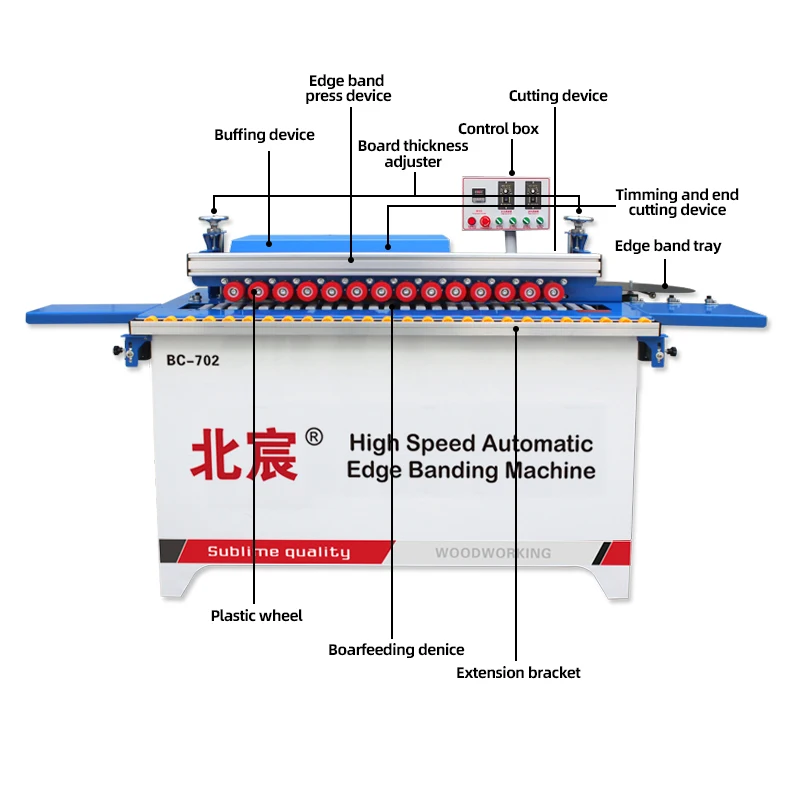
| Standard Features | Edge banding, trimming, polishing, automatic head and tail cutting, with vacuum |
| Minimum Sheet Length | 25CM |
| Minimum Sheet Width | 10CM |
| Edge Banding Height Range | 0–50MM |
| Edge Banding Thickness Range | 0.3–3MM |
| Edge Feed Power | 20W |
| Transmission Power | 140W |
| Trimming Power | 800W×2 |
| Polishing Power | 180W×2 |
| Vacuum Power | 1200W |
| Glue Pot Capacity | 1000ml |
| Air Source Pressure | 0.4–0.8Mpa |
| Product Size (L×W×H) | 120×55×110CM |
| Product Weight | 105KG |
| Language Options | Chinese and English (customizable to Spanish or other languages) |
| Plug Options | EU, USA, AU, UK |
| Certification | CE |
Application Suitability
| Application | Material or Output |
|---|---|
| Cabinet door and carcass edge finishing | MDF and particleboard with PVC or melamine edge banding |
| Custom furniture panel processing | Plywood and blockboard with veneer or polymer edges |
| Medium-volume joinery production | Solid wood panels requiring trimming and polishing stations |
| Polymer door component edge sealing | Polymer door substrates with compatible banding materials |
Why the Voltage Question Must Come Before the Quotation
An automatic edge banding machine for sale is only viable if its electrical system matches your workshop’s supply frequency and voltage exactly.
I learned this the hard way on a Middle East project. A unit arrived at a Dubai workshop wired for 380V/50Hz, but the local supply was 415V/60Hz. The control cabinet tripped immediately on startup, and the production floor sat idle for weeks while a transformer shipped overseas. That single oversight cost the client more in downtime than the machine itself. When sourcing edge processing equipment, confirming the electrical specification is the first engineering checkpoint, not the last [NEED_CITE: voltage and frequency standards by export market].
Where the DW702 Sits in the Complete Edge Banding Range
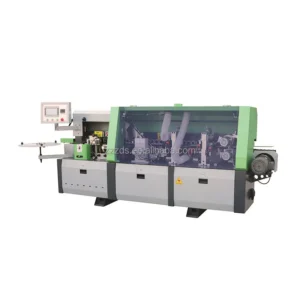
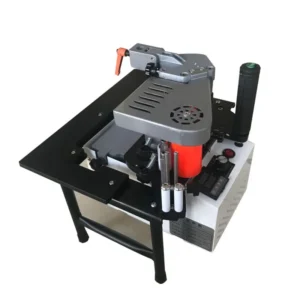
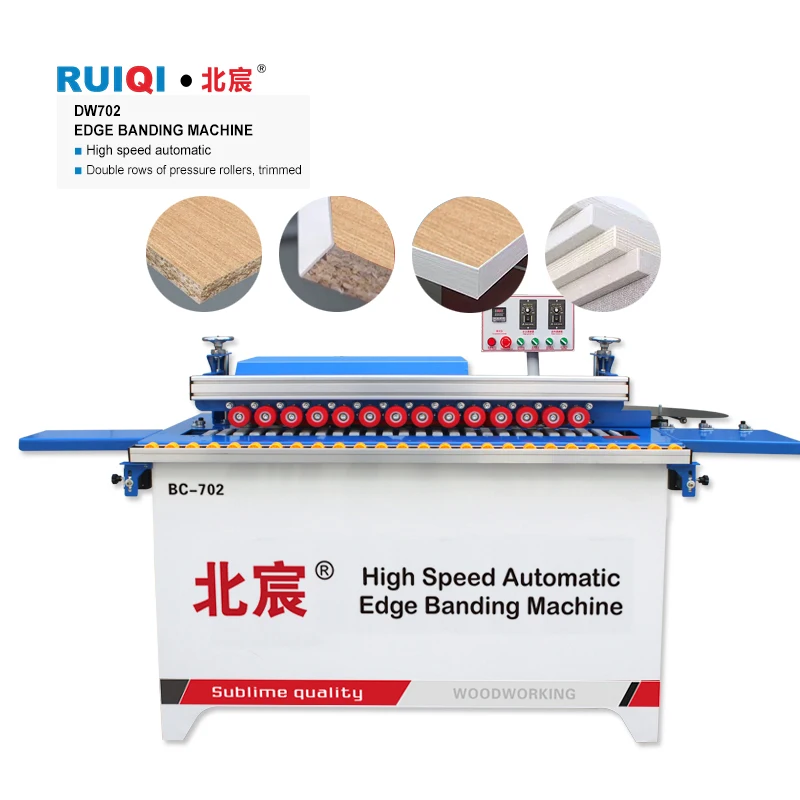
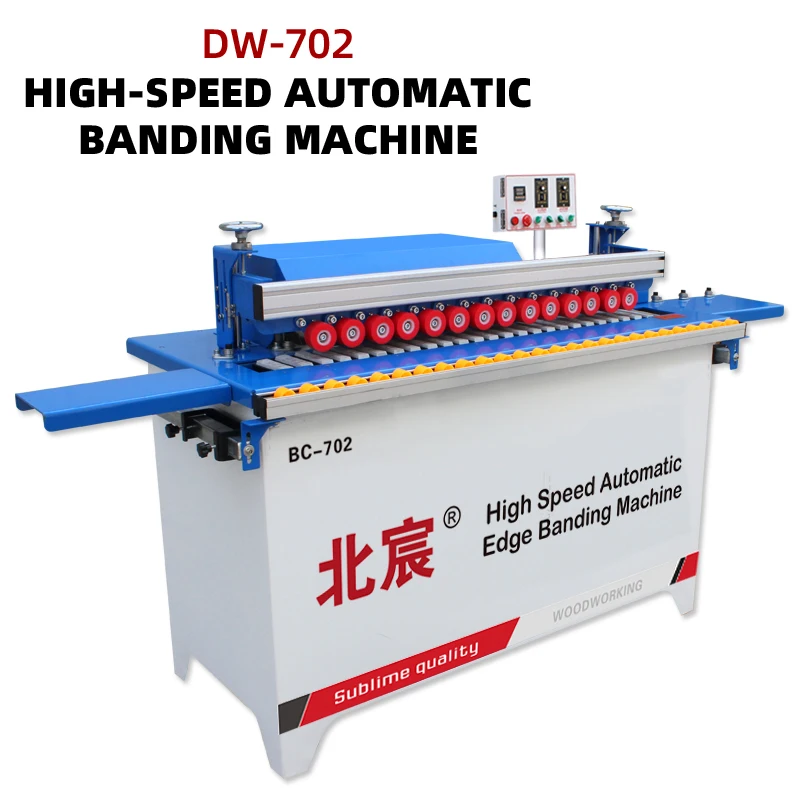
The DW702 occupies the compact full-function tier within the broader catalogue. It integrates gluing, edge banding, head and tail cutting, trimming, and polishing into a single 120×55×110CM frame. This positions it for workshops that need every station of a production-grade edge bander but operate within a limited floor plan or have not yet scaled to the throughput of a multi-machine line. Buyers surveying the range will find it bridges the gap between entry-level single-function units and the higher-capacity models designed for continuous shift operation.
Scaling from Single Machines to Matched Production Lines
One of the most common procurement errors in panel processing is buying individual machines piecemeal from different sources, only to discover that feed heights, throughput rates, and panel thickness ranges do not align across stations. The DW702 addresses this by offering a verified, internally consistent configuration where every function is engineered to work within the same mechanical envelope. For workshops planning to expand into a complete line, starting with a unit that already covers all core edge banding stations eliminates the incompatibility risk that arises from mixing suppliers [NEED_CITE: woodworking production line throughput matching principles].
How Power Distribution Across Stations Affects Edge Quality
The DW702 allocates 800W to each of its two trimming motors and 180W to each polishing motor. In edge banding, trimming power directly determines how cleanly the machine shears excess banding material from the panel edge, particularly when processing 3mm PVC on dense MDF substrates. Insufficient trimming power leaves ridges that require manual rework downstream. The separate 1200W vacuum motor maintains consistent suction at the glue application point, pulling dust and debris away before the banding material contacts the adhesive. This station-level power allocation is what allows the unit to handle the full 0.3–3mm thickness range without sacrificing finish quality on either end of the spectrum.
The Hidden Cost of Overlooking Operator Language and Plug Configuration
An edge banding machine that arrives with a control panel in a language the operator cannot read effectively stalls commissioning until reprogramming or label replacement is arranged. Similarly, shipping a unit with the wrong plug standard means the client’s electrician must source adapters or rewire the connection before the machine can power on. These delays compound when they occur across multiple machines in a workshop rollout. The DW702 addresses both variables as configurable parameters at the order stage, with English as standard and other languages available on request, and plug options spanning EU, USA, AU, and UK standards.
Why Procurement Through the Full Catalogue Works
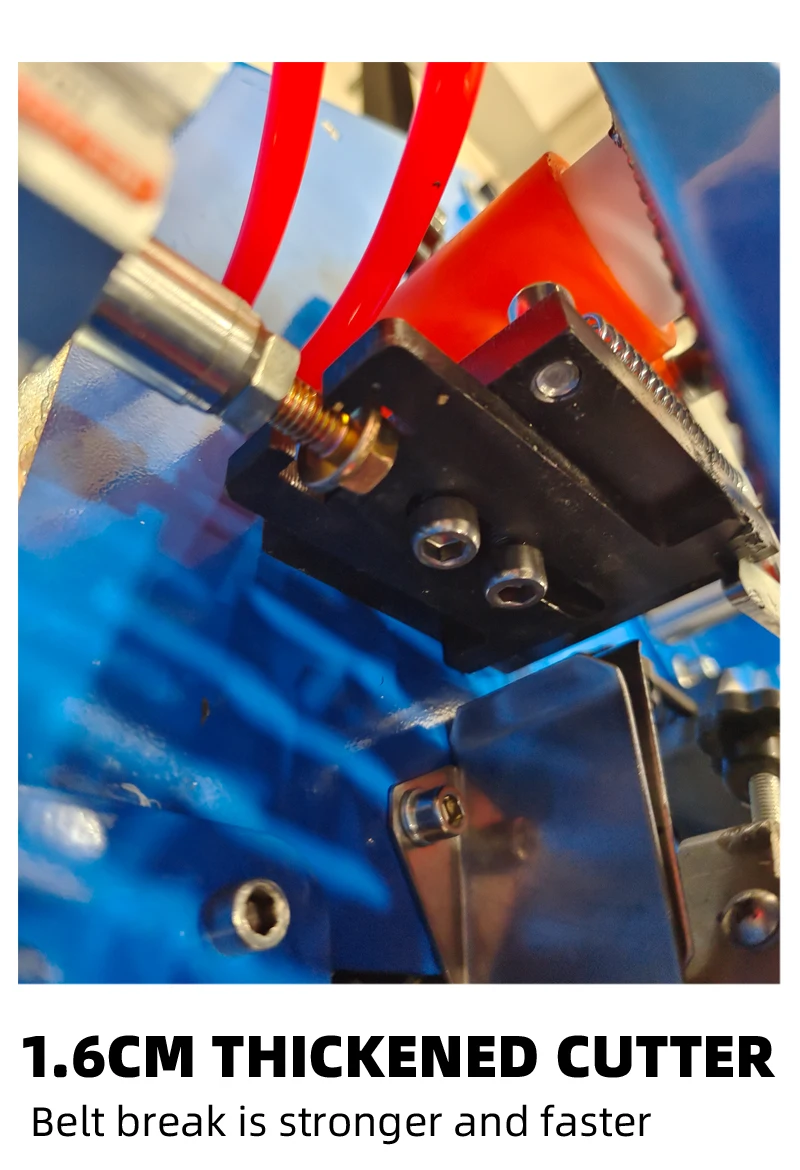
The DW702 is manufactured in-house with patented cutting mechanisms, meaning tolerance and station alignment are controlled under one quality system rather than assembled from third-party sub-components. The four-stage QC process covers incoming material, in-process assembly, finished product testing, and pre-shipment verification, so the unit you receive has been run on actual panel stock before packing. Voltage customization from 220V to 380V is treated as a standard configuration step, not a special request. Engineer-led configuration recommendations ensure the model you select matches your panel dimensions, edge material, and production volume rather than overselling you into a higher tier you do not yet need. Factory visits are available for live sample processing tests on your own materials before you commit.
Documentation & Verification
- CE declaration of conformity specific to the DW702 configuration shipped
- Electrical schematic confirming your ordered voltage, frequency, and plug type
- Factory test record run on panel thicknesses matching your specification range
- Machine specification sheet detailing all station powers and air pressure requirements
- Operation and maintenance manual produced in your confirmed operator language
- Spare parts list with part numbers for trimming blades, polishing wheels, and vacuum filters
Installation, Commissioning & Support
- Requires a dedicated circuit matching the confirmed 220V or 380V supply with appropriate breaker rating for the 3800W total draw
- Floor space allocation of at least 150×80CM around the 120×55×110CM frame for operator access and panel feed clearance
- Air compressor connection required at 0.4–0.8Mpa to feed pneumatic trimming and polishing actuators
- Initial commissioning includes glue pot temperature calibration for your specific edge banding material type
- Trimming and polishing station alignment verified against your sample panels during first production run
- Routine maintenance schedule covers glue pot cleaning, vacuum filter inspection, and trimming blade rotation intervals
Preparing Your Inquiry for Accurate Configuration
To receive a specification-confirmed quotation, provide your primary panel material type, the edge banding material and thickness you plan to run, and your local electrical supply voltage and frequency. Include the language your operators will need on the control panel, and note whether your workshop uses single-phase or three-phase power. If you have existing upstream cutting or downstream boring equipment, share the model details so feed height and throughput compatibility can be verified against the DW702’s operating range.
Frequently Asked Questions
Q: How does the DW702 compare to higher-throughput edge banding models in the range?
A: The DW702 integrates all core stations — gluing, trimming, polishing, and head/tail cutting — into a compact footprint suited for small-to-medium workshops. Higher-throughput models in the catalogue add increased feed speeds and larger panel capacity for continuous production environments. The DW702 serves as the entry point into the full-function tier, with a clear upgrade path within the same product family as your volume grows.
Q: How do I confirm the correct voltage and plug configuration for my country?
A: During the inquiry stage, provide your workshop’s supply voltage, frequency, and whether the system is single-phase or three-phase. The DW702 is configurable from 220V to 380V, and plug options include EU, USA, AU, and UK standards. An electrical schematic confirming the exact configuration is issued with the quotation for your electrician to verify before production begins.
Q: What panel materials and edge banding types is the DW702 compatible with?
A: The DW702 processes MDF, particleboard, plywood, blockboard, and polymer door substrates. It handles edge banding materials from 0.3mm to 3mm thickness, including PVC, melamine, and veneer. The trimming and polishing stations are calibrated to deliver clean edge finishes across this full material range without manual rework.
Q: Can the control panel language be customized for my operators?
A: Yes. Chinese and English are available as standard options. Additional languages, including Spanish and others, can be configured at the order stage. Confirming the required language during the quotation process ensures the control panel arrives ready for immediate operator use without post-delivery reprogramming delays.
Q: What documentation ships with the DW702?
A: Each unit includes a CE declaration of conformity, machine specification sheet, electrical schematic matching your confirmed voltage, factory test record, operation manual in your specified language, and a spare parts list. Packing photographs and customs documentation support are provided to facilitate smooth import clearance at your destination port.