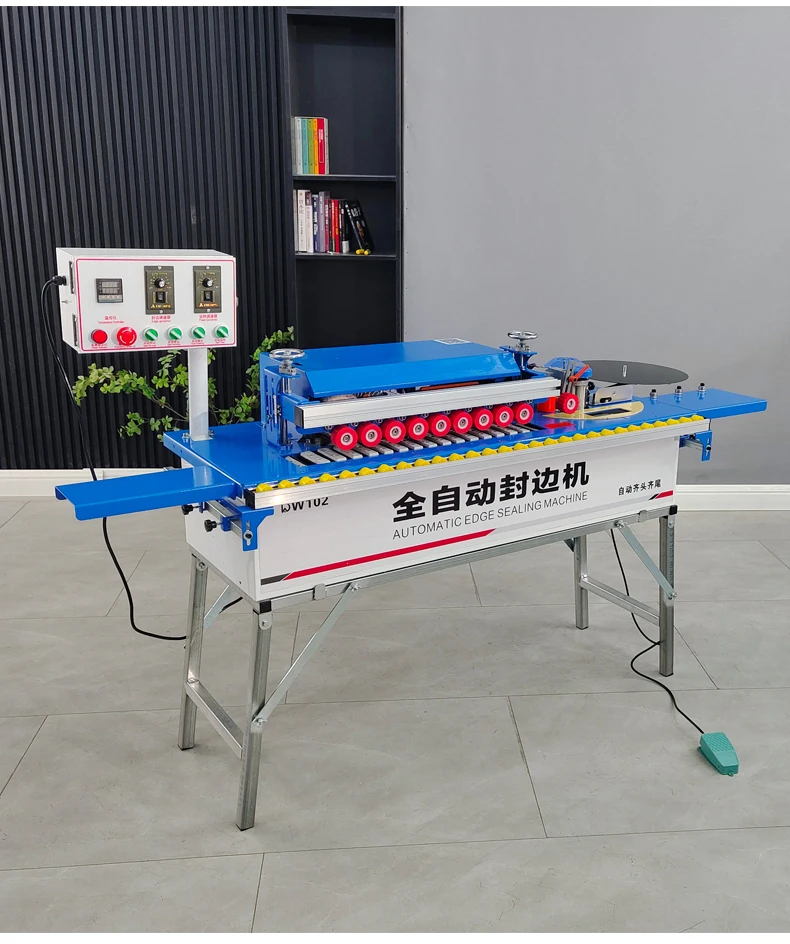
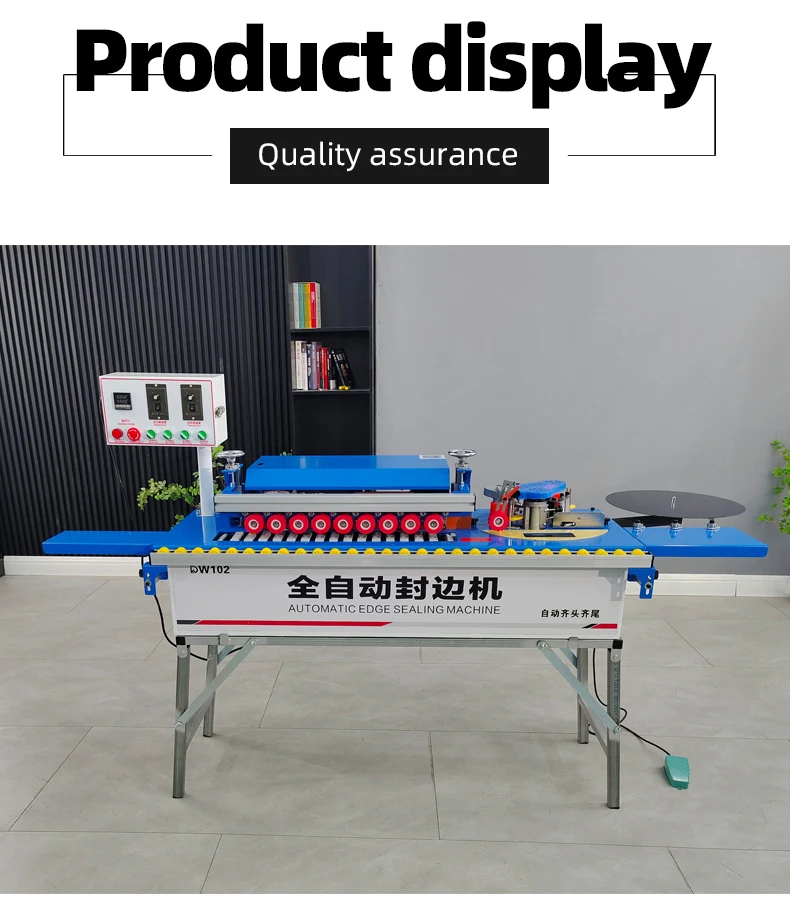
Description
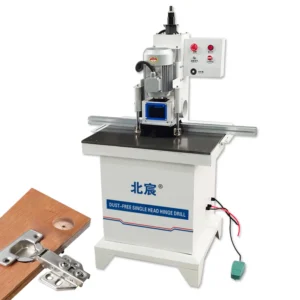
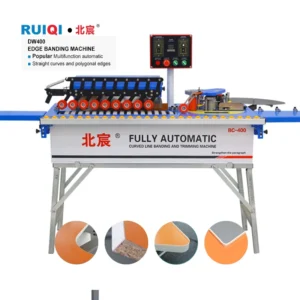
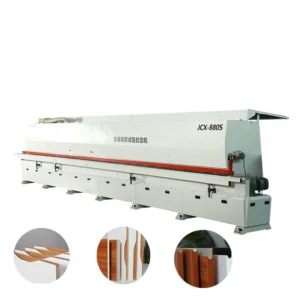
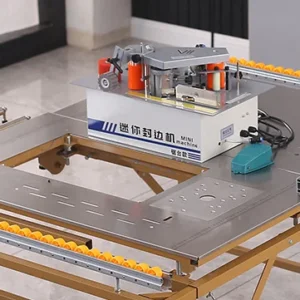
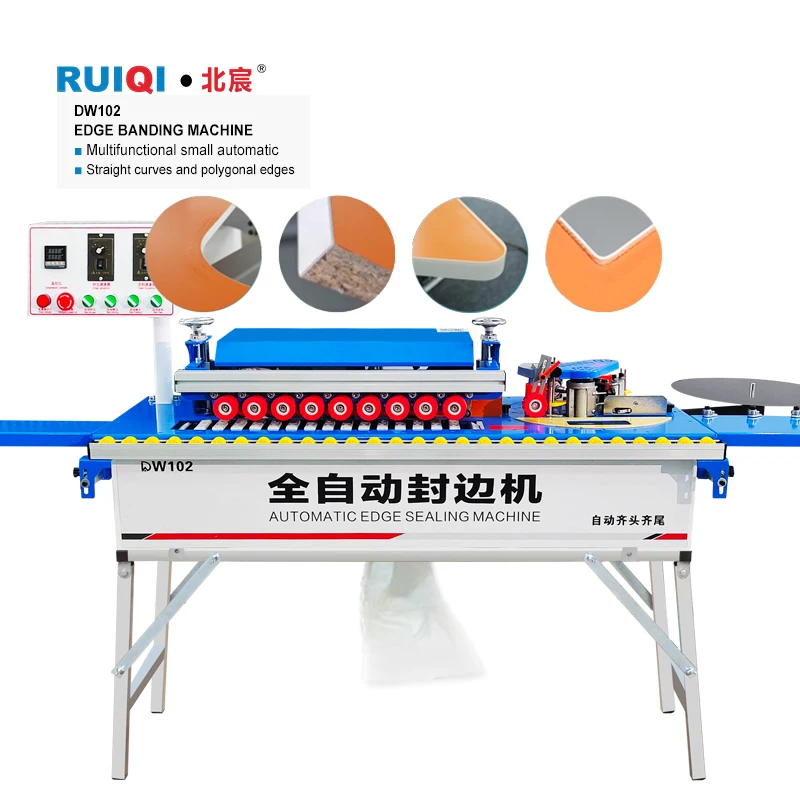
Full product family coverage — the DW102 sits within a complete edge banding machine range that lets workshops scale from single-unit curved-edge work to higher-volume production without switching suppliers.
Technical Specifications
| Parameter | Value |
|---|---|
| Model | DW102 |
| Product Type | Automatic Edge Banding Machine |
| Total Power | 3800W |
| Voltage | 220V / 380V / customization available |
| Edge Banding Thickness Range | 0.3–3 mm |
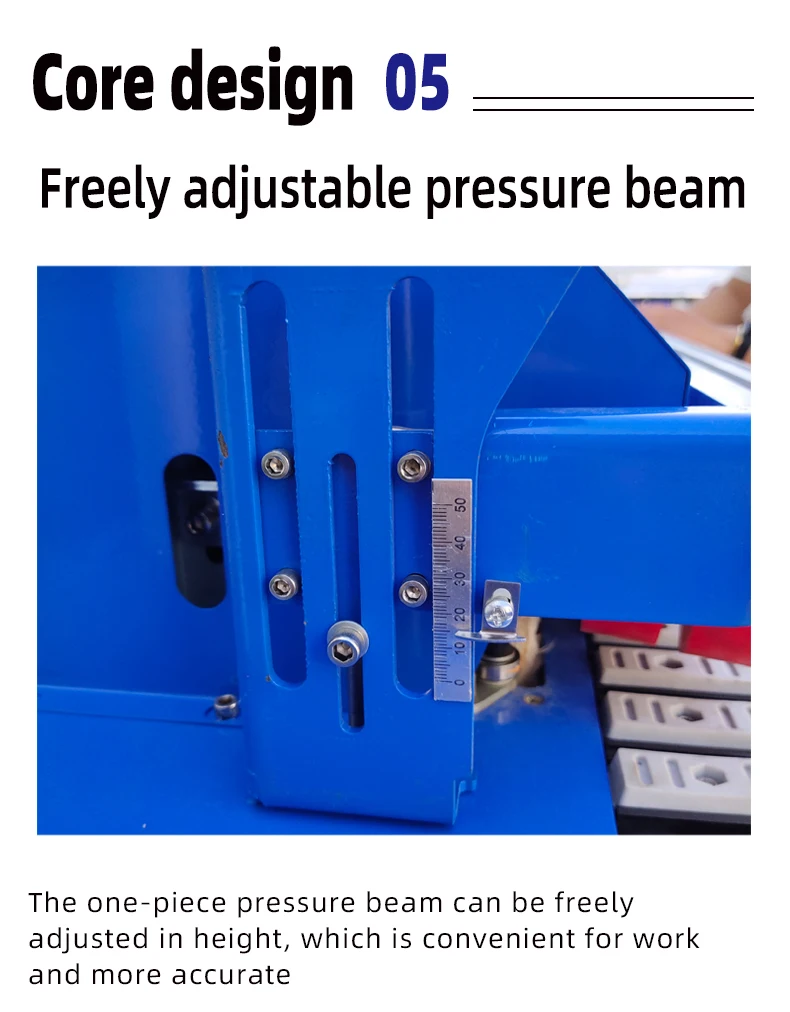
| Edge Banding Height Range | 0–50 mm |
| Minimum Sheet Length | 25 cm |
| Minimum Sheet Width | 5 cm |
| Glue Pot Capacity | 1000 ml |
| Trimming Power | 650W × 2 |
| Polishing Power | 180W × 2 |
| Vacuum Power | 1200W |
| Edge Power | 20W |
| Transmission Power | 60W |
| Air Source Pressure | 0.5–0.8 MPa |
| Overall Dimensions (L×W×H) | 128 × 47 × 69 cm |
| Net Weight | 75 kg |
| Feed Speed | (basis to be confirmed) |
| Control Panel Language | Chinese and English standard; Spanish, French, and other languages customizable |
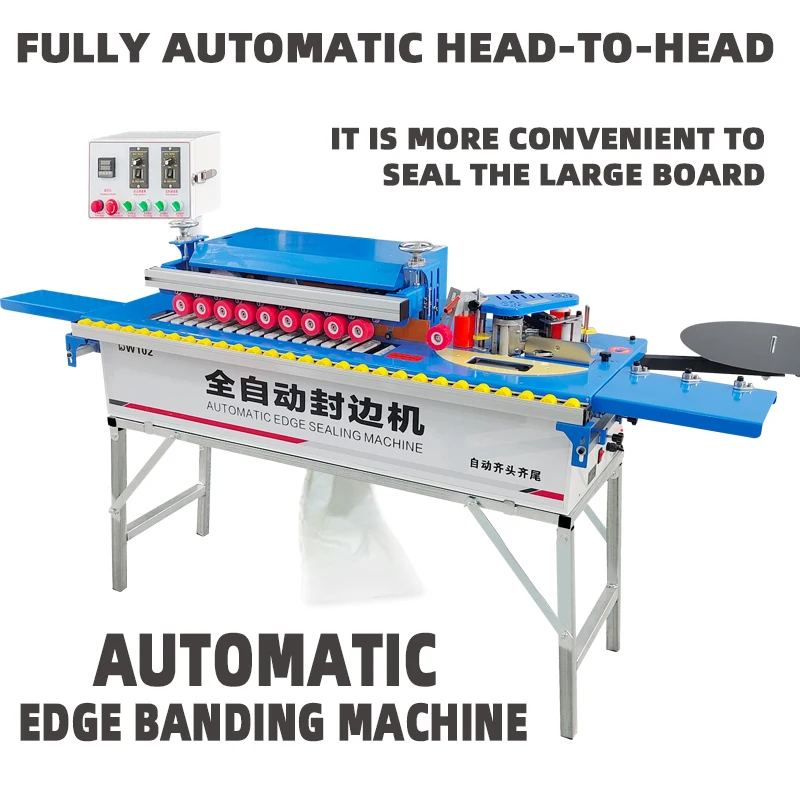
| Key Features | Curved and straight edge banding, edge trimming, polishing, automatic head and tail cutting, integrated vacuum hold |
Application Suitability
| Application | Material or Output |
|---|---|
| Custom cabinet door edge finishing | MDF and particleboard with PVC or veneer banding |
| Curved-profile furniture components | Plywood and blockboard with shaped edges |
| Polymer door panel trimming | Polymer substrates with compatible edge materials |
| Small-batch bespoke joinery | Solid wood panels with veneer edge banding |
| Medium-volume furniture production | MDF and plywood panels up to 50 mm edge height |
Why Voltage Confirmation Must Happen Before the Quotation
An Edge Banding Machine manufacturer that does not verify your local supply before quoting is handing you a three-week delay before production even starts.
I once shipped a unit to a cabinet shop in Jeddah without confirming their 220V/60Hz supply. The machine sat idle on the floor while they sourced a transformer, and the operator spent those weeks doubting the purchase. That single oversight cost more in goodwill than any discount could recover. Every export market carries its own voltage and frequency standard [NEED_CITE: voltage and frequency standards by export market], and the DW102 is configurable from 220V to 380V with custom winding on request. Confirming plug type, phase, and cycle rate before a formal quotation leaves my desk is now a fixed step, not an afterthought.
Mapping the DW102 Within the Full Catalogue
The DW102 is positioned as a versatile mid-range entry in our complete edge banding machine lineup. It handles both curved and straight profiles in a single pass, which makes it suitable for workshops that produce custom cabinet doors alongside standard rectangular panels. Buyers surveying the range will find that stepping up to a higher-tier model adds pre-milling and additional finishing stations, while stepping down to an entry-level unit removes the automatic head-and-tail cutting that the DW102 includes as standard.
What Curved-Edge Capability Means for Panel Variety
Workshops that only run rectangular MDF sheets rarely need curved-edge functionality, but cabinet makers producing radius-corner doors or shaped shelving depend on it daily. The DW102 transitions between curved and straight profiles without a tooling changeover, keeping downtime low when a batch switches from standard carcase panels to feature doors. This flexibility is what separates a machine that serves one product line from one that serves an entire catalogue [NEED_CITE: CE machinery directive requirements for woodworking equipment safety].
Reading the Spec Sheet Against Your Actual Workload
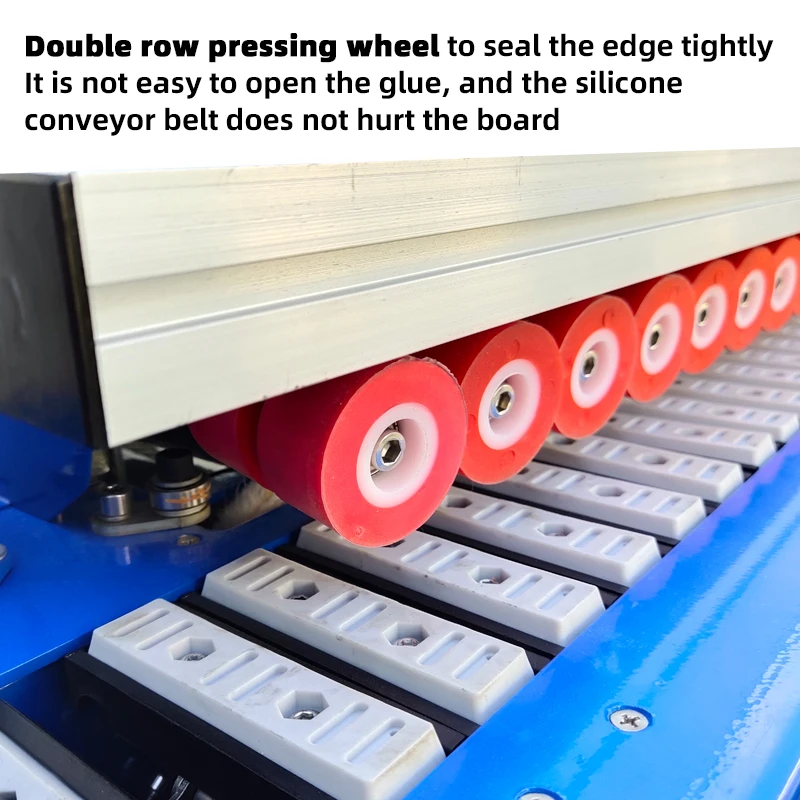
The dual trimming motors at 650W each are sized to cut cleanly through PVC banding up to 3 mm thick without stalling on dense substrates like high-density particleboard. The 180W × 2 polishing motors follow immediately, buffing the trimmed edge to a sealed finish in the same pass. Panel thickness capacity ties directly to the 0–50 mm edge banding height range — boards thicker than 50 mm will exceed the trimming station’s vertical travel. The 1200W vacuum system holds lighter sheets firmly on the feed bed, which matters when you are running 5 mm plywood that tends to lift at the trailing edge. Air pressure at 0.5–0.8 MPa drives the pneumatic actuators for head-and-tail cutting; a compressor that cannot sustain 0.6 MPa continuously will cause intermittent mis-cuts at the panel ends.
The Cost of Buying a Machine That Cannot Scale With You
A workshop that purchases an entry-level edge bander for occasional curved work often discovers, within months, that the machine was never designed for daily production volumes. Glue pots that are too small require constant refilling mid-shift, and single-motor trimming stations leave visible witness marks on thicker PVC. The result is rework, rejected panels, and eventually a second machine purchase that doubles the capital outlay. Buyers who start with a model that covers their foreseeable volume and material range avoid this cycle entirely [NEED_CITE: typical failure modes in undersized edge banding equipment].
What Sets This Purchase Path Apart
Every DW102 leaves the factory with a voltage confirmation document matched to the buyer’s declared supply, so the machine is wired correctly before crating. Language on the control panel is set to the operator’s working language — Spanish, French, or any other requested option — so commissioning does not stall on mistranslated menus. The four-stage quality check includes a pre-shipment test run on the buyer’s specified panel material, with photographs and a signed test record included in the shipping documents. Factory visits are welcomed at any stage, and sample processing on your own stock can be arranged before an order is placed. Engineer-led configuration recommendations arrive as a formal quotation within 24 hours of an inquiry, not weeks later.
Documentation & Verification
- CE declaration of conformity covering the DW102 edge banding machine and all safety circuits
- Machine specification sheet confirming voltage, frequency, and plug type for the destination market
- Factory test record showing edge finish quality on the buyer’s own panel material and thickness
- Electrical schematic with confirmed wiring diagram matching the agreed voltage configuration
- Operation and maintenance manual printed in the buyer’s selected control panel language
- Spare parts list with part numbers cross-referenced to the DW102 bill of materials
Installation, Commissioning & Support
- Requires a dedicated circuit rated for the DW102’s 3800W total draw plus compressor load
- Overall footprint of 128 × 47 cm fits standard workshop bays; allow clearance on the infeed side for full-length panels
- Arrives partially assembled; feed bed and vacuum hood require on-site mounting and alignment
- First-run calibration includes trimming depth adjustment for the buyer’s specified 0.3–3 mm banding thickness
- Operator training covers glue pot temperature settings for PVC versus veneer edge materials
- Pneumatic line connection requires 0.5–0.8 MPa clean dry air at the machine inlet
What to Include in Your Inquiry
To receive an accurate configuration proposal, share your primary panel materials and their typical thickness range, the edge banding materials you run most often, and your local voltage, phase, and frequency. Let us know whether curved-edge work is occasional or daily, and specify the control panel language your operators need. If you have existing upstream saws or downstream boring machines, mention their feed height so we can confirm compatibility across the line.
Frequently Asked Questions
Q: Where does the DW102 sit in the full edge banding machine range, and when should I step up to a higher-tier model?
A: The DW102 covers curved and straight edge banding with automatic head-and-tail cutting and vacuum hold. Step up when your daily volume demands pre-milling for panel edge preparation or additional finishing stations such as corner rounding and scraping. Step down only if curved-edge work is absent from your production mix entirely and volume is very low.
Q: What panel and edge banding materials can the DW102 handle, and where are its limits?
A: It processes MDF, particleboard, plywood, blockboard, and polymer panels with PVC or veneer edge banding from 0.3 to 3 mm thick. Edge height coverage runs from 0 to 50 mm. Panels exceeding 50 mm thickness or edge banding beyond 3 mm fall outside the machine’s rated capacity and require a higher-tier model.
Q: How do you confirm voltage and plug configuration for my export market?
A: Before any quotation is issued, we request your site voltage, phase, frequency, and plug type. The DW102 is configurable from 220V to 380V with custom winding available. A voltage confirmation document is generated and signed off before the machine enters final assembly and crating.
Q: Can the control panel language and documentation be customized for my operators?
A: Yes. Chinese and English are standard, with Spanish, French, and other languages available on request. The operation manual, maintenance guide, and spare parts list are all produced in the agreed language and ship with the machine inside the crate.
Q: Can I visit the factory or send my own panel stock for a test run before ordering?
A: Factory visits are welcomed at any production stage. You can also ship sample panels to the facility for a processing test on the DW102, with trimmed and polished samples returned alongside the test record and photographs for your evaluation before committing to an order.