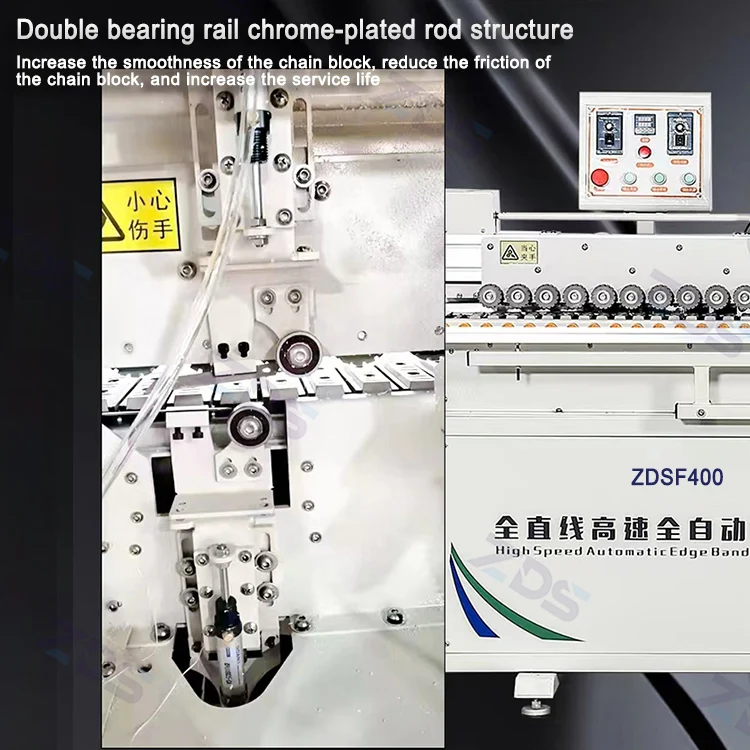
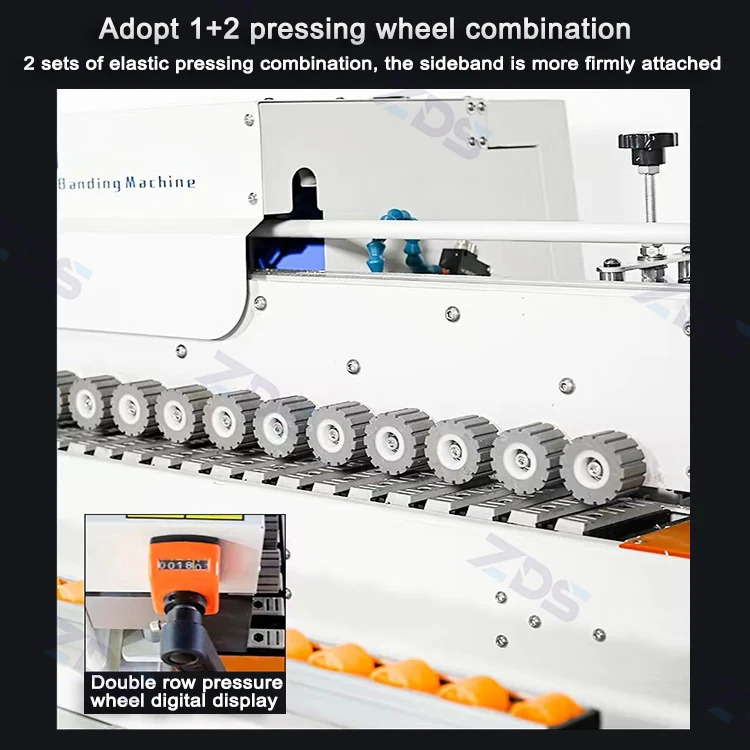
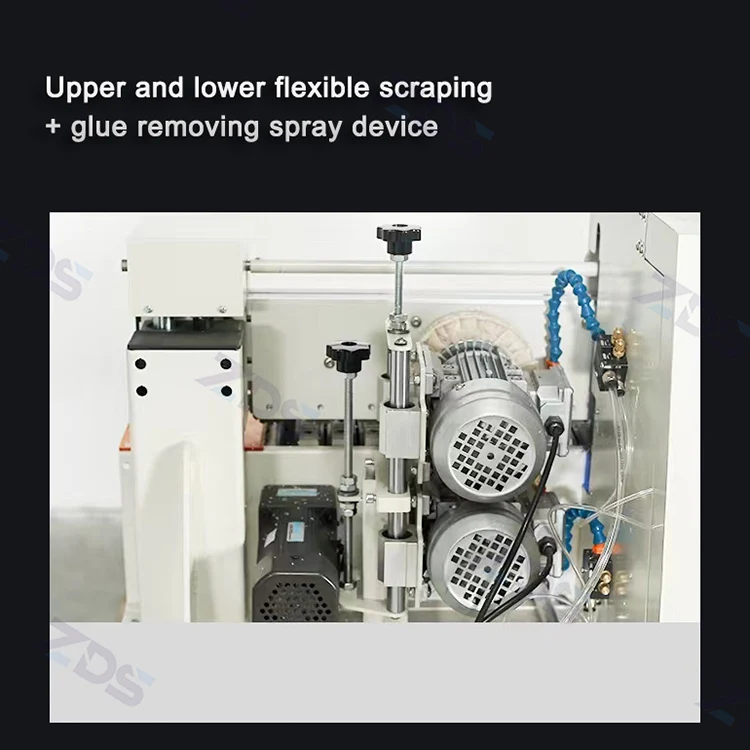
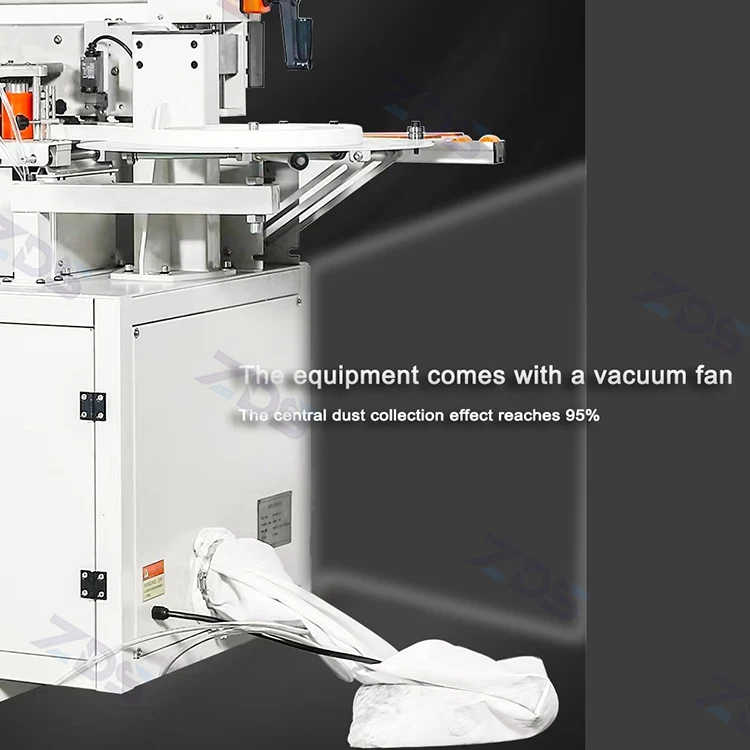
Description
Precision Tolerance Verification — Every ZDSF400 unit undergoes four-stage quality control with pre-shipment testing, ensuring ±0.02mm edge banding accuracy is measured and documented before the machine leaves the factory floor.
Technical Specifications
| Parameter | Value |
|---|---|
| Model | ZDSF400 |
| Product Type | Automatic Edge Banding Machine |
| Function Sequence | Gluing, end cutting, trimming, scraping, polishing, vacuuming |
| Edge Processing Type | Straight line |
| Rated Voltage | 220V (configurable 110V–440V on request) |
| Rated Power | 3 kW |
| Rated Air Pressure | 0.4–0.6 MPa |
| Strip Thickness Range | 1–3 mm |
| Panel Thickness Range | 10–55 mm |
| Feed Speed | 0–14 m/min |
| Conveyor Belt Speed | 0–14 m/min |
| Glue Pot Capacity | 1000 ml |
| Heating Power | 800 W (5–10 min warm-up) |
| Trimming Power | 800 W × 2 (24,000 RPM) |
| Polishing Power | 180 W × 2 (5,500 RPM) |
| Suction Power | 550 W |
| Overall Dimensions | 240 × 70 × 120 cm |
| Machine Weight | 370 kg |
| Warranty | One year |
Application Suitability
| Application | Material or Output |
|---|---|
| Custom cabinet door production | MDF and particleboard with PVC edge banding |
| Wardrobe and shelving panel edging | Plywood panels up to 55 mm thickness |
| Joinery workshop batch runs | Melamine-faced chipboard with 1–3 mm strips |
| Furniture component finishing | Solid wood veneer banding on straight edges |
| Small-batch bespoke furniture | Mixed substrate runs requiring frequent changeover |
Why "Entry-Level" Does Not Mean Compromise on Edge Finish
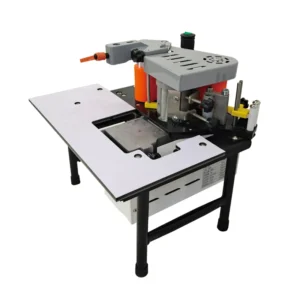
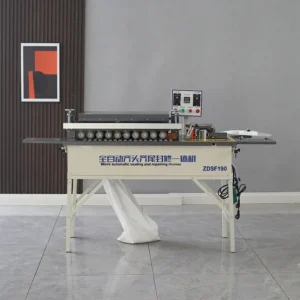
The ZDSF400 delivers full-function edge processing — gluing through polishing — at a footprint that fits a single-car garage.
I have walked into workshops where the edge banding machine could handle PVC perfectly but left visible glue lines the moment the operator loaded real wood veneer. The problem was never the machine’s ambition; it was the gap between what the spec sheet promised and what the glue pot and trimming stations could actually sustain at production feed rates [NEED_CITE: common edge banding defects by substrate type]. With this automatic edge banding machine manufacturer range, the ZDSF400 sits at the accessible end of a family that scales upward without changing supplier, so a workshop can start here and move to higher-throughput models as volume grows.
Where This Model Sits in the Full Catalogue
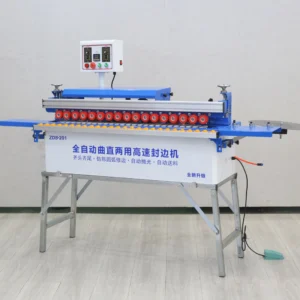
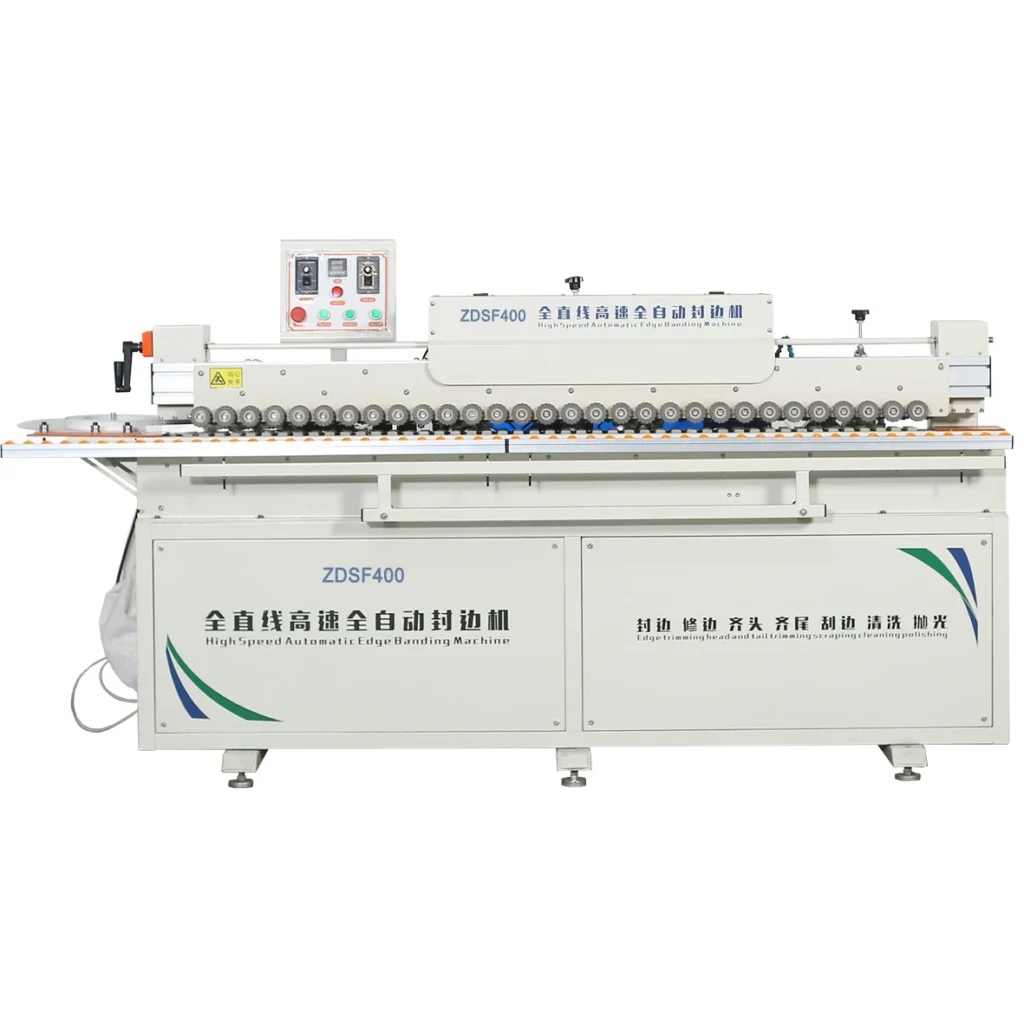
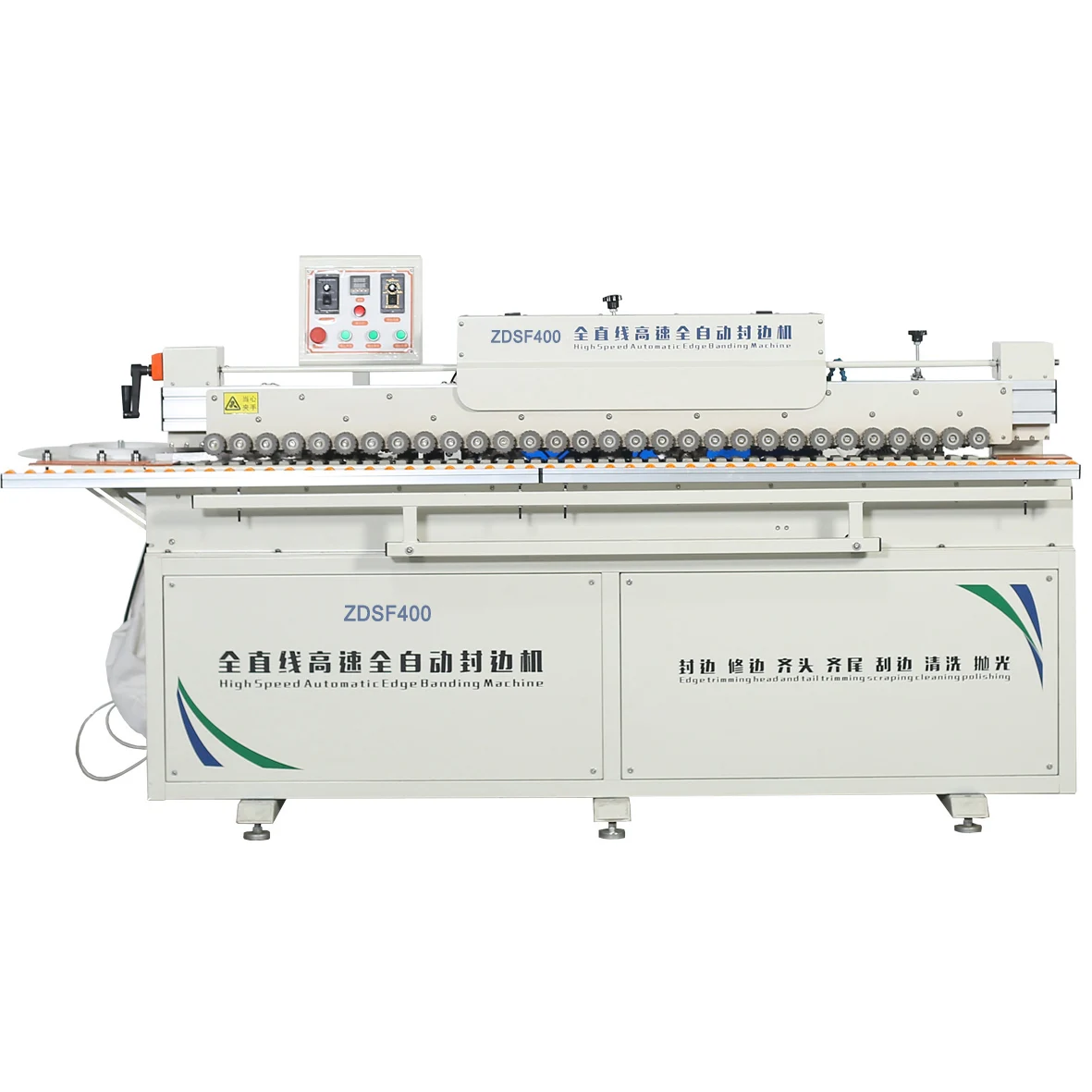
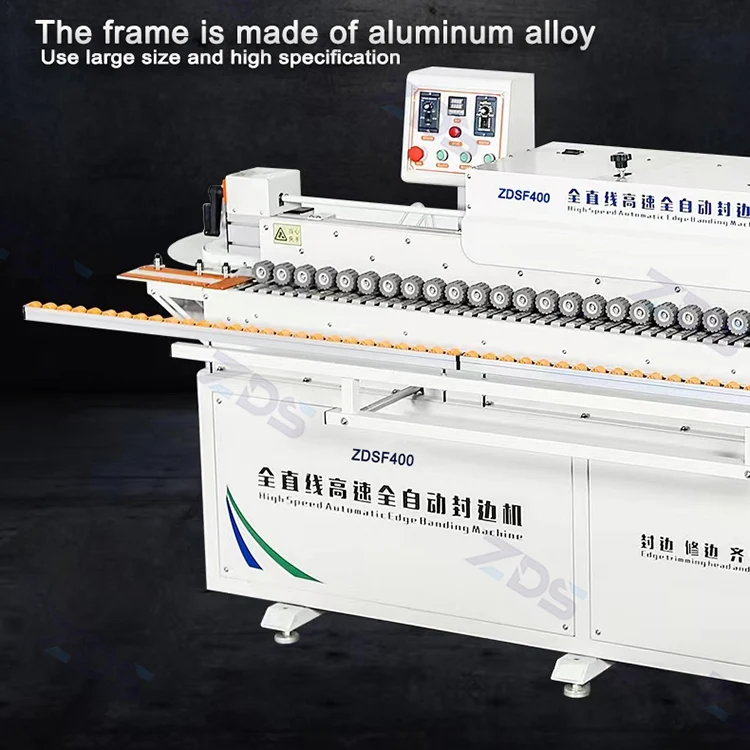
The ZDSF400 occupies the entry-to-mid tier of the automatic edge banding machine family. It covers the six core stations — gluing, end cutting, rough trimming, fine scraping, polishing, and vacuuming — that a furniture factory needs for assembly-ready panels. Workshops running straight-line edges on MDF, particleboard, or plywood will find this model handles daily production without requiring the pre-milling or corner-rounding stations found on higher-tier units. The catalogue above this model adds functions like pre-milling for uneven panel edges and buffing stations for high-gloss PVC, but the ZDSF400 provides the foundation those models build upon.
Scaling Without Switching Supplier
One of the most disruptive costs a growing workshop faces is relearning a new control panel, recalibrating feed heights, and sourcing spare parts from a different vendor. Because the ZDSF400 shares its control logic and component architecture with the rest of the product family, an operator trained on this unit can transition to a full-function pre-milling model with minimal retraining [NEED_CITE: operator training requirements for woodworking machinery upgrades]. The conveyor belt synchronization and feed speed range of 0–14 m/min are consistent design principles across the range, meaning throughput planning remains predictable as you add stations or move to a dual-track line.
Panel Thickness, Feed Speed, and Trimming Precision
The 10–55 mm panel thickness range means the ZDSF400 handles everything from thin shelving stock to thick worktop cores without mechanical adjustment beyond the standard handwheel. Feed speed at 0–14 m/min is managed by the conveyor belt system, and the relationship between speed and edge quality is direct: slower feed allows the 800 W trimming motors at 24,000 RPM to produce a cleaner cut on dense substrates like MDF, while lighter particleboard can run at the upper range without tear-out. The dual polishing motors at 5,500 RPM remove residual adhesive and leave a finish ready for immediate assembly. The 1000 ml glue pot with 800 W heating element reaches working temperature in 5–10 minutes, reducing idle time at shift start.
The Cost of Underspecifying Your First Machine
I have seen cabinet makers buy a compact edge bander that handled their initial MDF orders, only to discover the glue pot could not maintain temperature when they switched to thicker veneer strips in winter. The machine was not defective; it was simply specified for a lower duty cycle than production demanded [NEED_CITE: thermal stability of edge banding glue pots in variable ambient conditions]. Panels came back from assembly with visible seams, and the workshop had to invest in a second machine within the year. Matching the glue capacity, motor power, and feed range to your actual material mix and daily volume avoids this cycle entirely.
Why Procurement Teams Source This Range Here
The ZDSF400 is built on a manufacturing line that holds ISO 9001 certification and applies four-stage quality control — incoming material inspection, in-process checks, finished product verification, and pre-shipment testing. Voltage is confirmed against your local grid before the machine ships, so a 220V unit does not arrive at a 380V facility. The trimming and polishing stations use proprietary cutting mechanisms covered by patent, and tolerance is measured and recorded rather than claimed in a brochure. Custom control panel language is available so your operators can read the interface on day one. The complete product family means your next machine comes from the same engineering team, with compatible spare parts and consistent documentation standards.
Documentation & Verification
- CE declaration of conformity specific to the ZDSF400 automatic edge banding machine configuration
- ISO 9001 certificate covering the manufacturing and quality control process
- Electrical schematic with confirmed voltage and frequency for your installation site
- Factory test record showing trimming tolerance on your specified panel material and thickness
- Operation and maintenance manual written in your agreed language with illustrated spare parts list
- Packing photographs and customs documentation support for export clearance
Installation, Commissioning & Support
- Requires a level concrete floor with minimum 250 × 80 cm clear footprint for the 240 × 70 × 120 cm machine body
- Dedicated 220V circuit with appropriate breaker rating for the 3 kW total rated power draw
- Arrives fully assembled; requires conveyor belt tensioning and air line connection at 0.4–0.6 MPa
- First-run commissioning includes glue pot temperature calibration and trimming station alignment on your panel stock
- Operator training covers feed speed adjustment, strip loading for 1–3 mm thickness, and daily vacuum system clearing
- Spare parts list identifies wear items including trimming blades, polishing wheels, and conveyor belt segments
What to Share When Requesting a Quotation
Tell us the panel materials you run most often — MDF, particleboard, plywood, or solid wood — and the edge banding strip type and thickness you plan to use. Share your local voltage and frequency so the electrical system is built to match. If you have existing upstream saws or downstream boring machines, note their feed heights and throughput so the ZDSF400 integrates without bottleneck.
Frequently Asked Questions
Q: What is the complete edge banding machine range and where does the ZDSF400 sit?
A: The ZDSF400 is the entry-to-mid tier in a product family that extends to full-function pre-milling models. It covers gluing, end cutting, trimming, scraping, polishing, and vacuuming for straight-line edges. Higher-tier models add pre-milling, corner rounding, and buffing stations for high-gloss finishes, all sharing the same control architecture.
Q: How do I choose between entry-level and full-function models for my workshop?
A: Start with the materials you run and the edge quality your assembly process demands. If you process MDF and particleboard with PVC or veneer strips for standard furniture, the ZDSF400 covers your needs. Pre-milling and additional finishing stations become necessary when panel edges are uneven or when high-gloss substrates require flawless finishing.
Q: What panel thickness and material range does this model cover?
A: The ZDSF400 handles panels from 10 to 55 mm thick with edge banding strips from 1 to 3 mm. Materials include MDF, particleboard, plywood, and solid wood panels. The 1000 ml glue pot and dual trimming motors at 24,000 RPM are calibrated for consistent performance across these substrates.
Q: Can I scale my production line without changing supplier?
A: Yes. The ZDSF400 shares its control logic, conveyor design, and component architecture with higher-tier models in the same family. When your volume or finish requirements grow, you can add a pre-milling or multi-station model from the same range without retraining operators or switching spare parts sources.
Q: How is machine tolerance verified and documented before shipment?
A: Every ZDSF400 undergoes four-stage quality control including pre-shipment testing on actual panel material. Trimming accuracy is measured and recorded in the factory test report, which ships with the machine. The ±0.02 mm tolerance is verified through this process, not estimated from design specifications alone.