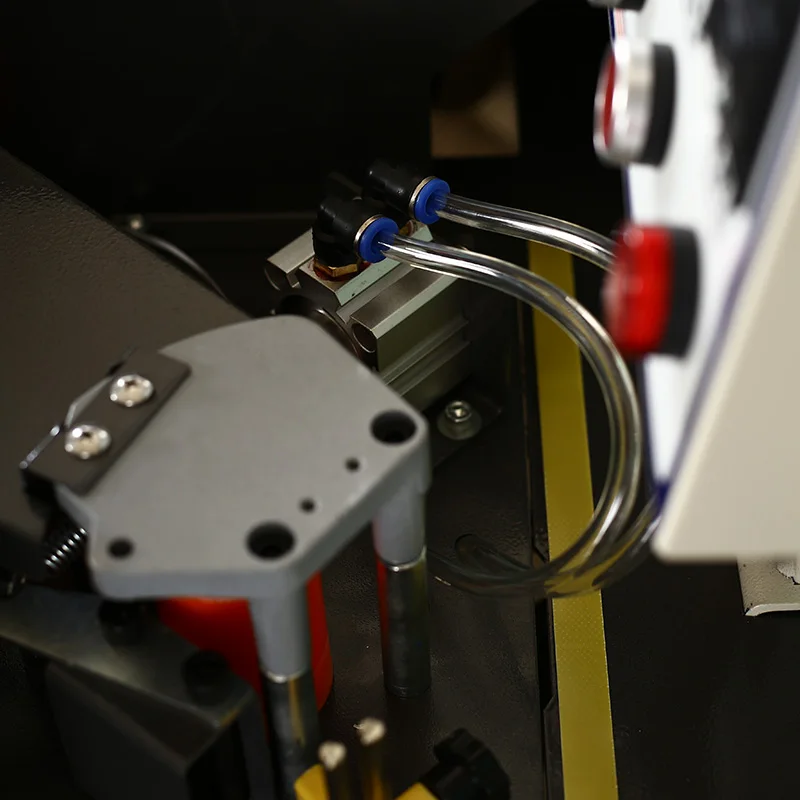
Description
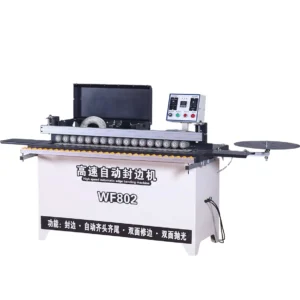
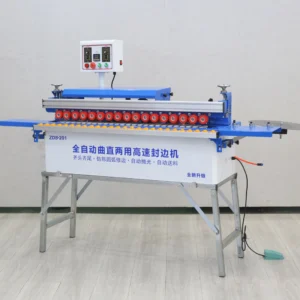
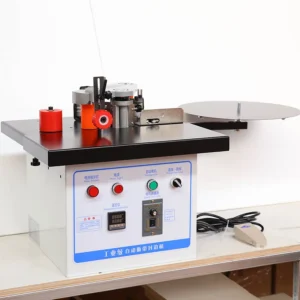
Dual-Purpose Edge Banding Range — The 910H anchors a complete family of automatic edge banding machines, letting workshops scale from curved and straight entry configurations to full pre-milling lines under one manufacturer.
Technical Specifications
| Parameter | Value |
|---|---|
| Model | 910H |
| Product Type | Automatic Curved and Straight Edge Banding Machine |
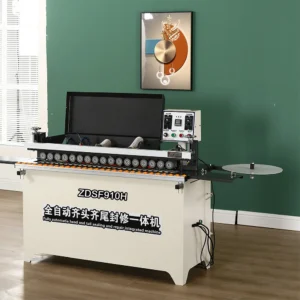
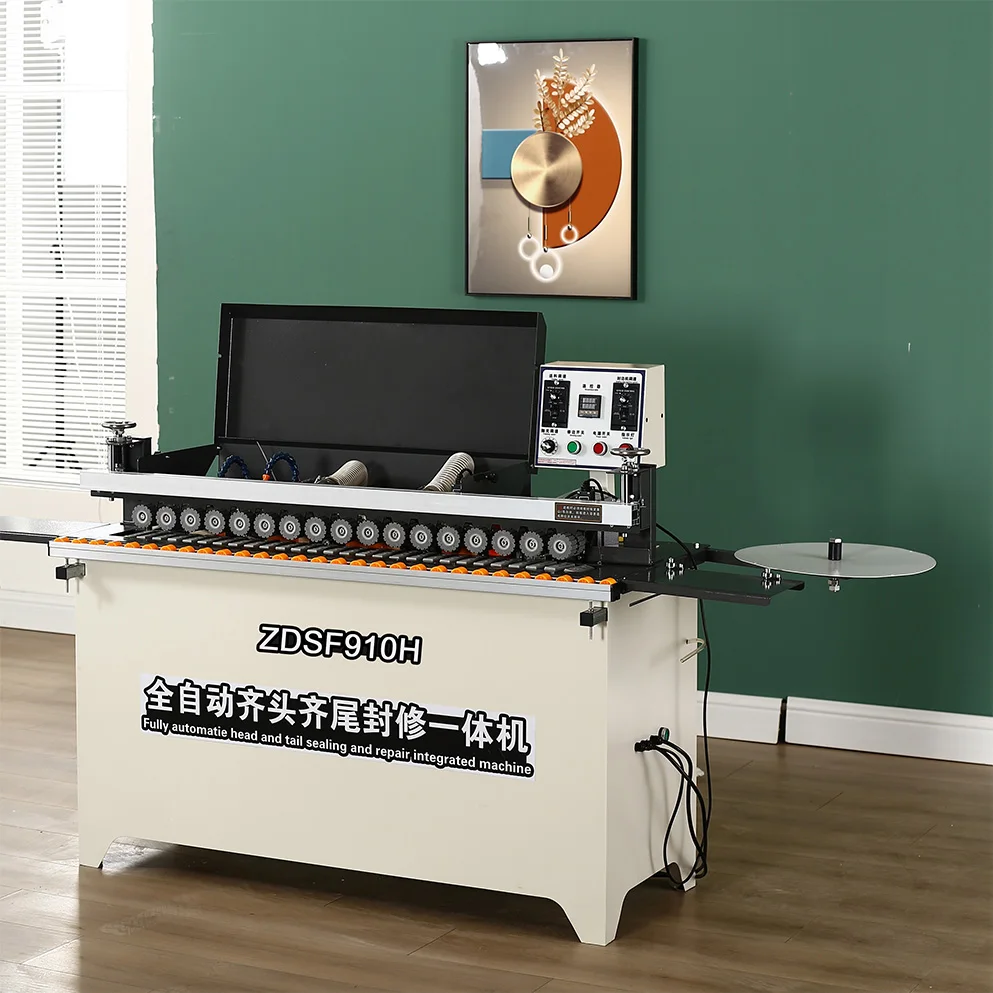
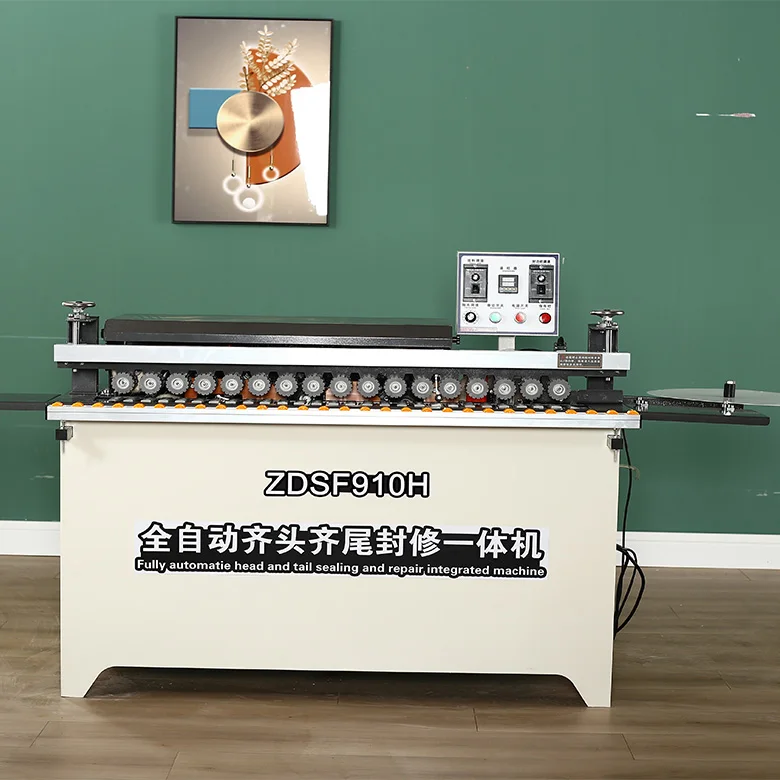
| Function | Automatic plate feeding, double-sided gluing, upper and lower polishing, head and tail trimming, curved and straight edgebanding |
| Edge Type | Curved and straight lines |
| Voltage & Frequency | 220V 50Hz (configurable from 110V to 440V) |
| Rated Power | 4 kW |
| Heating Power | 800 W |
| Trimming Power | 800 W × 2 |
| Polishing Power | 180 W × 2 |
| Suction Power | 1200 W |
| Belt Power | 25 W |
| Transmission Power | 120 W |
| Rated Air Pressure | 0.4–0.6 MPa |
| Sheet Thickness Range | 10–50 mm |
| Strip Thickness Range | 0.5–2.5 mm |
| Minimum Board Width | 2.5 cm |
| Glue Capacity | 1000 ml |
| Transmission Type | Crawler transmission with steel rod slide rails |
| Trimming Mechanism | 4-blade alloy arc knife |
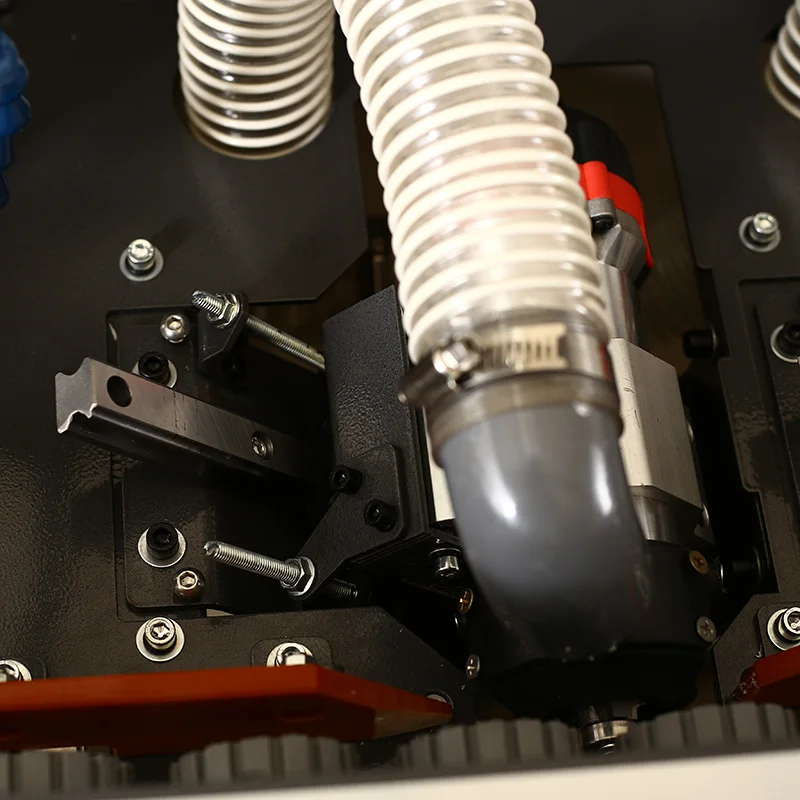
| Dust Collection | Two large-diameter dust collectors, close-fit design |
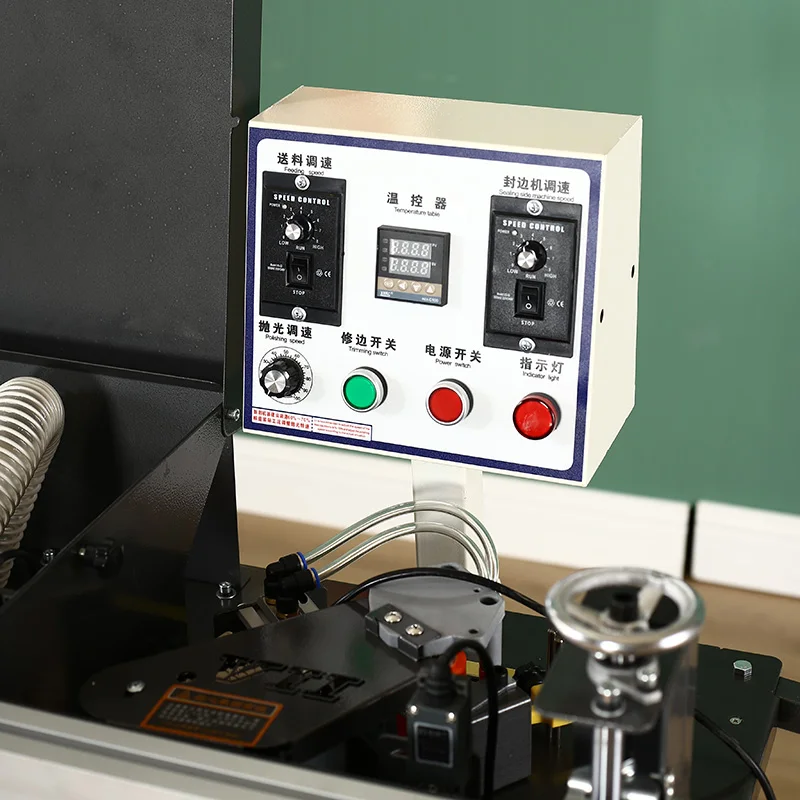
| Control Panel | Multi-function button operation |
| Curved/Straight Conversion | Rotatable 180° |
| Pressure Beam | Adjustable aluminum alloy |
| Feed Mechanism | Double-row rubber pressure wheels |
| Overall Dimensions (L×W×H) | 1300 × 560 × 1090 mm |
| Net Weight | 140 kg |
Application Suitability
| Application | Material or Output |
|---|---|
| Custom cabinet door profiling | MDF and plywood panels with PVC or veneer edge banding (0.5–2.5 mm strip) |
| Small-batch curved furniture components | Solid wood panels and particleboard with shaped edges |
| Joinery workshop automation | Mixed straight and curved panel runs replacing manual banding |
| Prototyping and sample production | Panel thicknesses from 10 mm to 50 mm on a single station |
Why Voltage Confirmation Must Precede Every Edge Bander Order
An edge banding machine for sale at the right price is worthless if it cannot power on at your facility.
I learned this the hard way. A Middle East client received a high-speed edge bander last year, and we had not locked down the local frequency specification. The machine sat on the factory floor for three weeks while a transformer was sourced. The entire production line waited. Since then, every quotation I prepare lists the exact voltage and frequency for the destination country before any signature goes on paper [NEED_CITE: voltage and frequency standards by export market]. Buyers evaluating an automatic edge banding machine manufacturer should treat electrical compatibility as the first technical gate, not an afterthought handled during shipping documentation.
Where the 910H Fits in the Full Catalogue
The 910H occupies the compact, dual-purpose tier within the complete Ruiqi edge banding range. It handles both curved and straight edge profiles through a 180° rotatable frame, making it a practical starting point for workshops that encounter mixed panel geometries. As production volume grows, the same product family extends to higher-feed-speed models and full-function pre-milling configurations, so a workshop can move up without switching to a different automatic edge banding machine manufacturer.
Catalogue Depth and Tier Progression
Every model in the range shares a common engineering approach to glue application, trimming, and polishing, which means operators trained on the 910H will find the control logic familiar when moving to larger machines. The catalogue spans from this 4 kW entry point through to multi-station lines with automated return conveyors. For buyers surveying the full range, the 910H demonstrates the baseline capability that every subsequent tier builds upon — double-sided gluing, pneumatic strip cutting, and cross polishing — rather than representing a separate product category [NEED_CITE: CE machinery directive requirements for industrial woodworking equipment].
How Core Parameters Shape Edge Quality
The 10–50 mm sheet thickness range covers the majority of furniture-grade MDF, particleboard, and plywood stock. Panels below 10 mm require a lighter pressure beam setting to avoid deflection, while boards approaching 50 mm demand careful adjustment of the double-row rubber pressure wheels to maintain consistent feed contact. The 4-blade alloy arc knife trimming mechanism addresses the geometry challenge of curved edges: a standard straight trimming blade leaves witness marks on radii, whereas an arc-profiled cutter follows the contour. The 800 W heating element brings the glue pot to operating temperature for standard EVA hot-melt adhesives, and the adjustable glue roller lets operators dial in coverage based on strip porosity — veneer absorbs more adhesive than PVC, so a single setting does not suit all materials.
What Happens When Machines Are Sourced Without a Supplier Path
Piecemeal purchasing often leads to feed-height mismatches between a newly acquired edge bander and existing panel saws or boring machines. Workshops discover that throughput bottlenecks simply shift from one station to another rather than being resolved. When the first machine comes from one vendor and the next from another, technical support fragments across time zones and spare part inventories become incompatible [NEED_CITE: typical causes of production line incompatibility in small furniture workshops]. An automatic edge banding machine manufacturer that offers a complete catalogue lets buyers plan a phased investment with known mechanical and electrical continuity between stations.
Why Procurement From a Full-Range Manufacturer Matters
Voltage and frequency customization from 110V to 440V is specified and confirmed before production begins, eliminating the transformer scenario I described earlier. The 910H ships with a factory test record verifying performance on your panel thickness range, not a generic bench test. Operation and maintenance manuals are produced in the language your operators read, specified at the inquiry stage rather than assumed. Four-stage quality control covers incoming materials, in-process assembly, finished unit inspection, and pre-shipment verification. Engineer-led configuration recommendations arrive within 24 hours of inquiry, matching the 910H or a higher-tier model to your actual panel mix and daily throughput.
Documentation & Verification
- CE declaration of conformity covering the 910H curved and straight edge banding configuration
- Electrical schematic confirming voltage and frequency matched to your facility supply
- Factory test record on your specific panel thickness and strip material before dispatch
- Operation and maintenance manual translated into the agreed operator language
- Spare parts list with part numbers for trimming knives, glue rollers, and pressure wheels
Installation, Commissioning & Support
- The 1300 × 560 mm footprint fits standard workshop layouts; confirm floor levelness within 2 mm for crawler rail alignment
- Dedicated 4 kW circuit required; verify local supply matches the confirmed 220V or customized voltage specification
- Machine ships assembled with removable pressure beam; reconnect dust collection hoses and pneumatic supply on arrival
- First-run calibration covers glue temperature, roller pressure, and trimming depth across your actual panel and strip materials
- Two large-diameter dust collection ports require minimum 1200 W extraction capacity for effective chip removal
- Replacement arc knives and rubber pressure wheels stocked for dispatch with standard lead times
What to Include With Your Inquiry
Provide your typical panel material, thickness range, and the edge banding strip type you run most often — PVC, ABS, or veneer — so the configuration can be matched before quotation. Confirm your facility voltage and frequency, and specify the language required for the control panel and documentation. If you are evaluating this edge banding machine for sale alongside other stations, note your existing saw and boring equipment so feed height and throughput can be coordinated.
Frequently Asked Questions
Q: How does the 910H fit within the broader catalogue, and what is the upgrade path?
A: The 910H sits at the compact dual-purpose tier, handling both curved and straight edges in one machine. As volume increases, the range extends to higher-feed-speed models with additional workstations such as pre-milling and buffing. Because all models share common engineering principles, operators transition between tiers without retraining, and spare part compatibility carries across the family.
Q: What voltage options are available, and how is the correct configuration confirmed?
A: Voltage is configurable from 110V to 440V depending on local supply. Before order confirmation, you provide your facility voltage, phase, and frequency. The electrical schematic is then issued reflecting those exact parameters, and the machine is built and tested to that specification before dispatch.
Q: Can I request a sample edge banding test on my own panel material before ordering?
A: Yes. You can send representative panel samples and your preferred edge banding strip to the factory for a processing test. The resulting edge quality, glue adhesion, and trimming finish are documented and shared before you commit to the order, and factory visits are also welcomed.
Q: What documentation ships with the machine for customs and commissioning?
A: Shipment includes the CE declaration, ISO 9001 certificate, machine specification sheet, confirmed electrical schematic, factory test record, operation manual in your chosen language, spare parts list, packing photographs, and customs documentation support to assist with import clearance.
Q: How do I match the sheet and strip thickness ranges to my materials?
A: The 910H handles sheet thickness from 10 to 50 mm and strip thickness from 0.5 to 2.5 mm. For thinner veneer strips, glue roller pressure and temperature settings are adjusted downward. For thicker PVC or ABS, trimming depth and polishing pass counts are configured accordingly during commissioning based on your actual stock.