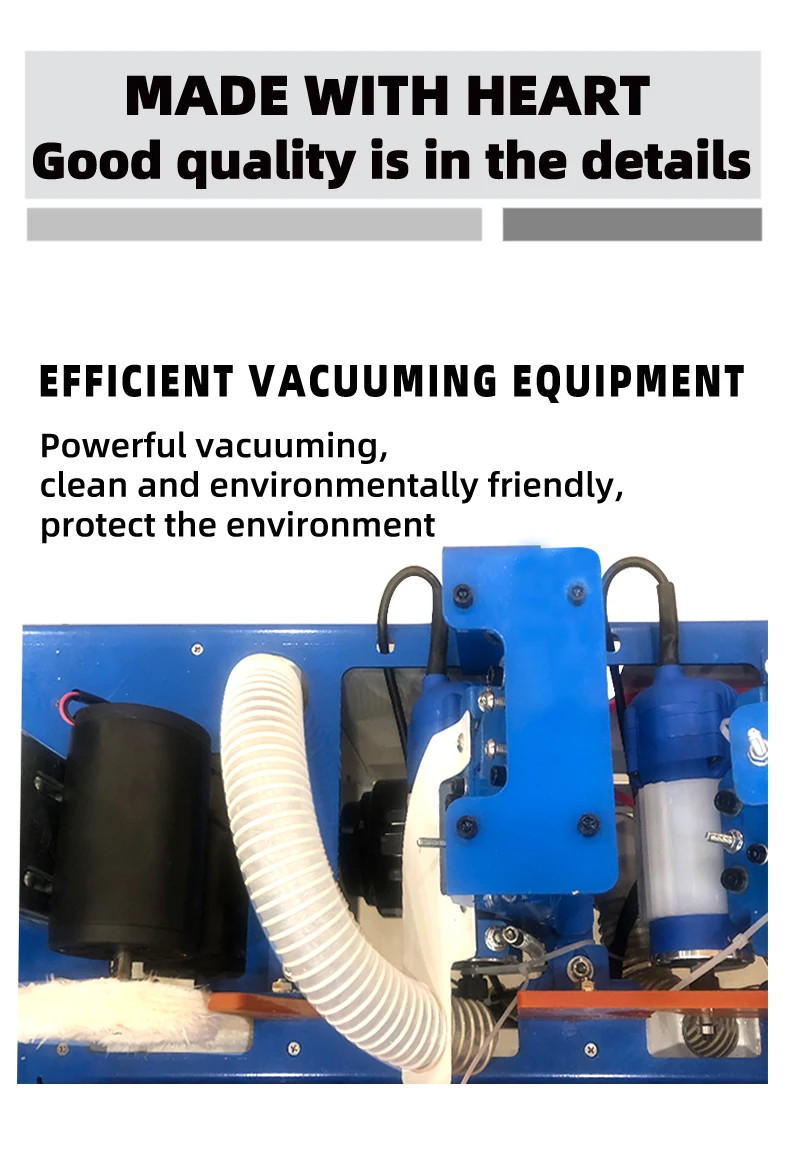
Description
Compact Machine Range — The DW602 anchors the portable tier of a complete edge banding family, letting workshops scale from curved profiles to full-line automation under one supplier.
Technical Specifications
| Parameter | Value |
|---|---|
| Model | DW602 |
| Product Type | Portable Curved Edge Banding Machine |
| Total Power | 3800W |
| Voltage | 220V/380V/customization |
| Edge Banding Thickness Range | 0.3–3 mm |
| Edge Banding Height | 0–50 mm |
| Minimum Sheet Length | 25 cm |
| Minimum Sheet Width | 5 cm |
| Trimming Power | 650W × 2 |
| Polishing Power | 180W × 2 |
| Vacuum Power | 1200W |
| Edge Power | 20W |
| Transmission Power | 60W |
| Glue Pot Capacity | 1000 ml |
| Air Source Pressure | 0.5–0.8 MPa |
| Product Size | 128 × 47 × 69 cm |
| Product Weight | 90 kg |
| Assembly State | Portable / Tabletop |
| Key Features | Edge banding, trimming, polishing, automatic head and tail, vacuum hold-down, multilingual control panel |
Application Suitability
| Application | Material or Output |
|---|---|
| Custom cabinet door edge finishing | MDF and particleboard panels with PVC or melamine banding |
| Curved furniture component banding | Plywood and blockboard with veneer or polymer strips |
| Small-batch joinery production | Solid wood panels with 0.3–3 mm edge material |
| Polymer door profile banding | Polymer substrates with matching edge strips |
| On-site installation and repair work | Pre-cut panels requiring portable edge finishing |
What Happens When Voltage Is Confirmed After the Machine Arrives
A machine that cannot plug into your local grid is dead weight on the factory floor.
I once watched a cabinet workshop in Eastern Europe take delivery of an edge bander specified for 380V three-phase — only to find their facility ran a 220V single-phase supply with no transformer capacity to spare. The machine sat in its crate for weeks while they sourced a voltage converter, delaying the entire production schedule [NEED_CITE: voltage and frequency standards by export market]. The DW602 portable curved edge banding machine is configurable across 220V and 380V with customization available, but that configuration only matters if it is confirmed before production begins. Buyers who treat voltage as a detail to sort out later routinely discover that control boards, motor windings, and heater elements are all matched to the wrong electrical standard.
Where the DW602 Fits Inside the Full Catalogue
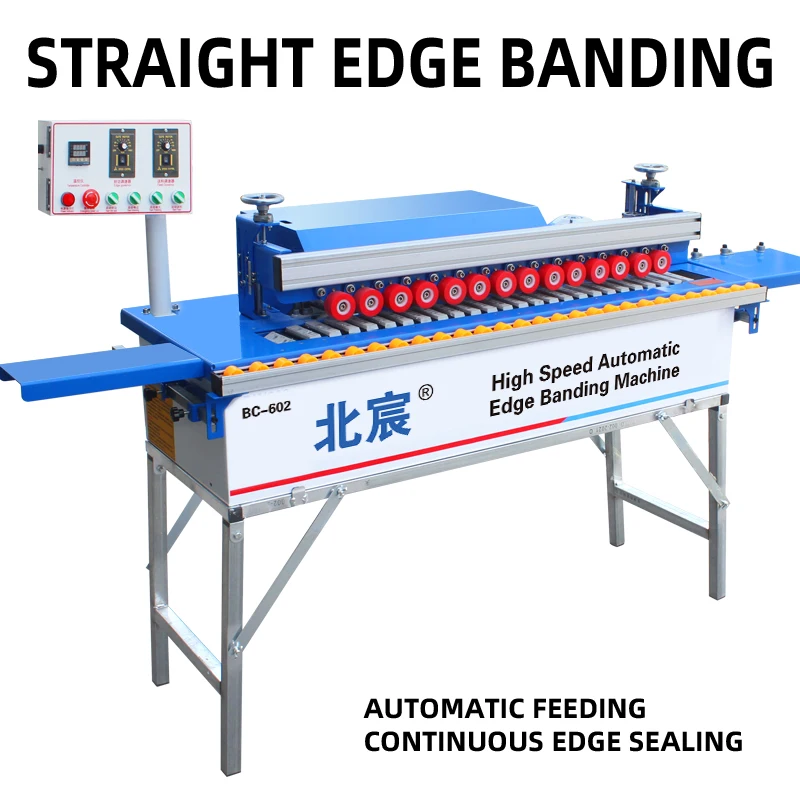
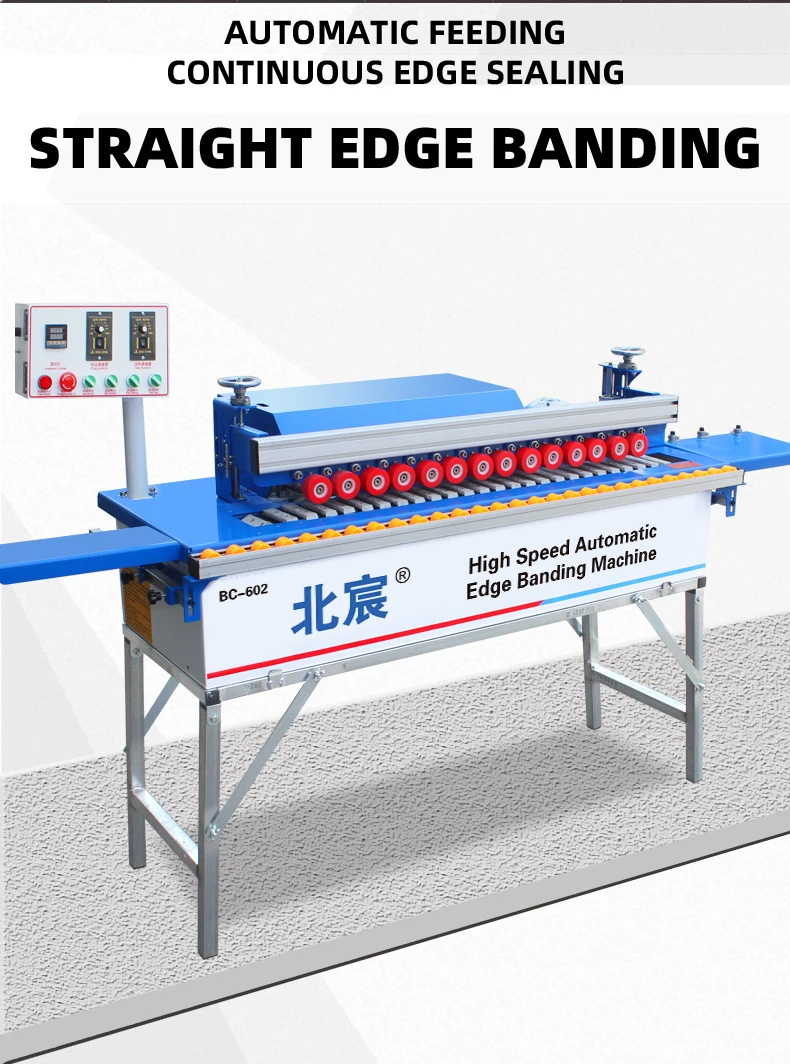
The DW602 occupies the compact, portable tier of Ruiqi’s edge banding machine range, positioned below mid-range straight-line models and full-function pre-milling units. Workshops that produce curved cabinet doors, radius panels, or custom joinery components start here because no larger machine handles tight radii as effectively. When production volume grows and straight-edge throughput becomes the priority, stepping up to a higher-tier model within the same product family preserves operator familiarity and parts commonality. A portable curved edge banding machine manufacturer that covers the full range eliminates the risk of incompatibility between stations.
Matching the Machine to Your Actual Material Stack
Edge banding quality depends on the interaction between glue temperature, feed pressure, and the specific banding material being applied. PVC at 0.3 mm behaves differently from veneer at 3 mm, and the DW602’s 1000 ml glue pot must be dialed to match whichever material you run most often. I have seen operators blame the machine when glue lines appear on melamine stock, only to discover the pot temperature was set for PVC [NEED_CITE: substrate behaviour and glue temperature interaction in edge banding]. Confirming your material list before the machine ships ensures the control panel language and default parameter presets match your production reality rather than generic factory settings.
Reading the Specification Sheet Against Your Production Requirements
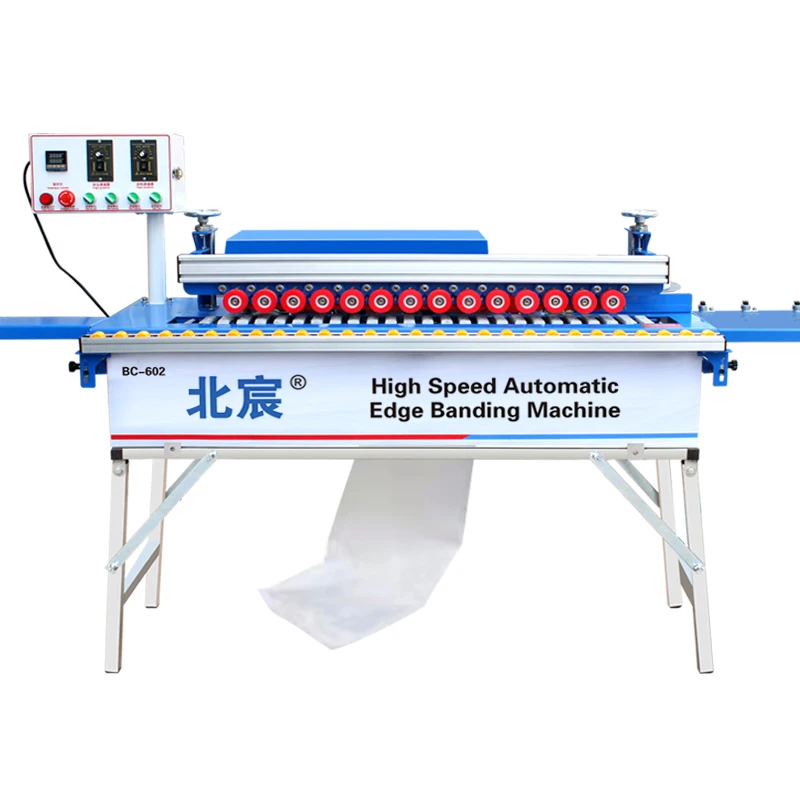
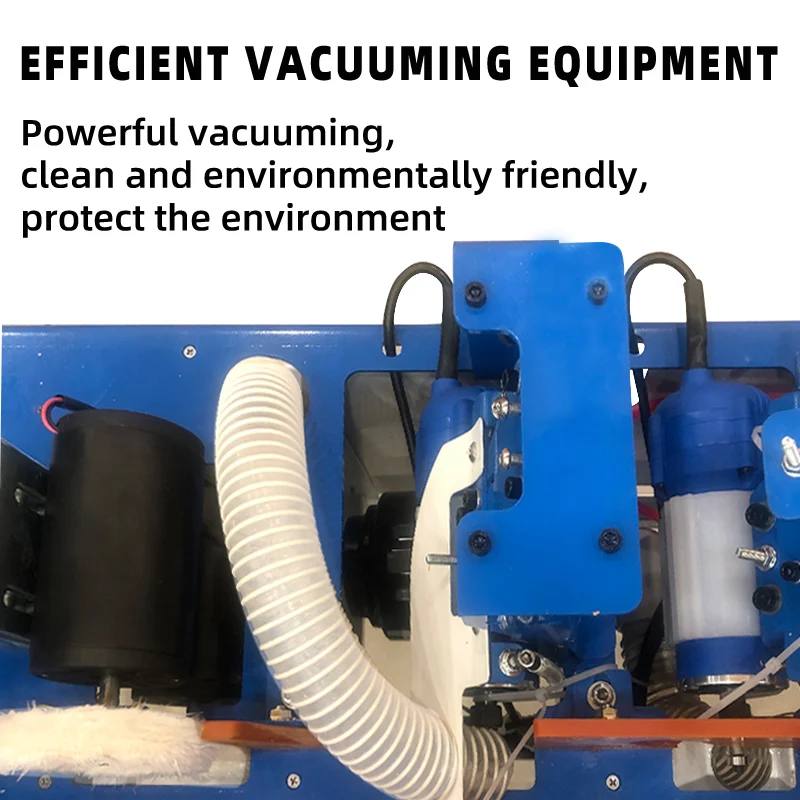
The dual trimming stations at 650W each provide enough torque for clean cuts on PVC and melamine up to 3 mm thick, while the 180W × 2 polishing wheels deliver a finished edge in a single pass. The vacuum hold-down system at 1200W stabilizes workpieces on curved profiles where gravity alone cannot prevent drift — a critical feature when banding radius cabinet doors or arched panels. Edge banding height spans 0–50 mm, covering standard panel thicknesses used in furniture and cabinet production. The 0.5–0.8 MPa air pressure requirement means your workshop compressor must deliver consistent pressure to keep the trimming and polishing cylinders engaged throughout the cycle.
The Cost of Skipping Configuration Verification
Workshops that order without confirming local voltage, air supply capacity, and predominant banding material frequently face days of rework once the machine arrives. Control panels printed in a language the operator cannot read stall commissioning while translation and retraining take place. Machines quoted without verifying feed height and throughput against existing upstream saws and downstream assembly stations create bottlenecks that no amount of operator skill can resolve [NEED_CITE: production line throughput mismatch consequences]. A single mismatched parameter cascades through the entire workflow.
Why Source This Model Through Ruiqi
In-house manufacturing with patented cutting mechanisms ensures the trimming stations on the DW602 are built to verified tolerances rather than assembled from generic components. Voltage, language, and plug configuration — EU, USA, AU, or UK — are confirmed as standard before production begins, not treated as afterthoughts. Four-stage quality control covers incoming material inspection through pre-shipment verification, so the machine you receive matches the specification sheet exactly. The full product family from entry-level to full-function pre-milling models means your workshop can scale without changing supplier or retraining operators. An engineer-led configuration recommendation arrives as a formal quotation within 24 hours, addressing your actual material list and production volume rather than a generic catalog entry.
Documentation & Verification
- CE declaration of conformity matched to the DW602 portable curved edge banding machine configuration
- Machine specification sheet confirming voltage, plug type, and control language before shipment
- Electrical schematic with circuit diagram for your local voltage standard
- Factory test record using your specified banding material and panel substrate
- Operation and maintenance manual printed in your agreed language
- Spare parts list with part numbers for trimming blades, polishing wheels, and glue pot components
Installation, Commissioning & Support
- Tabletop assembly requires a stable bench rated for 90 kg plus dynamic vibration loads
- Dedicated circuit matching your confirmed 220V or 380V supply with appropriate breaker rating
- Portable footprint at 128 × 47 × 69 cm fits through standard doorways for workshop placement
- First-run parameter setup covering glue pot temperature, feed speed, and trimming depth for your material
- Operator training on vacuum hold-down engagement and curved profile feed technique
- Spare trimming blades and polishing wheels included for initial production runs
What to Include in Your Inquiry
Provide your primary panel substrates — MDF, particleboard, plywood, or solid wood — along with the edge banding materials and thicknesses you run most frequently. Confirm your workshop voltage and frequency, available air compressor pressure, and the control panel language your operators require. If you are integrating the DW602 into an existing line, share your upstream cutting equipment and downstream assembly workflow so throughput compatibility can be verified before quotation.
Frequently Asked Questions
Q: Where does the DW602 sit within the full Ruiqi edge banding range, and when should I step up to a higher-tier model?
A: The DW602 serves as the portable, curved-profile entry point. Step up when straight-edge throughput becomes your primary requirement or when panel volume justifies a full-function pre-milling model. All tiers share the same supplier ecosystem, so upgrading later does not mean changing vendors or retraining operators from scratch.
Q: What voltage configurations are available, and how is grid compatibility confirmed before shipment?
A: The machine is configurable at 220V or 380V with custom options available. Your local voltage and frequency are confirmed during the quotation stage, and the electrical schematic ships with the machine reflecting your exact grid standard — EU, USA, AU, or UK plug types included.
Q: Which edge banding materials and panel substrates does the 0.3–3 mm range support?
A: The range covers PVC, melamine, and veneer banding applied to MDF, particleboard, plywood, blockboard, and polymer substrates. Glue pot temperature and feed pressure are adjusted to match your predominant material combination, confirmed during the pre-shipment factory test.
Q: Can I upgrade to a larger Ruiqi model later without changing supplier?
A: Yes. The full catalogue spans from the DW602 portable tier through mid-range straight-line and full-function pre-milling models. Operator training, spare parts channels, and service support carry over, so scaling production does not require onboarding a new manufacturer.
Q: What documentation ships with the machine?
A: The package includes a CE declaration of conformity, machine specification sheet, electrical schematic matching your voltage, factory test record on your substrate, operation manual in your language, spare parts list, and packing photographs for customs clearance.