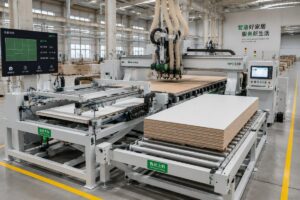
Secure your OEM Combi Woodworking Machine Wholesale Russia supply with precise 380V/50Hz localization and Cyrillic PLC interfaces. Avoid costly customs detentions by ensuring CE documentation matches serial numbers. This guide details the technical adjustments needed for seamless imports and operational stability.
OEM Combi Woodworking Machine Wholesale Supplier for Russia
Standard export settings do not work in Russia.
Successful wholesale of combi woodworking machines to Russia requires strict technical localization, specifically confirming 380V/50Hz three-phase power compatibility and pre-installing Cyrillic PLC interfaces, alongside ensuring CE documentation matches serial numbers to prevent customs detention.
I still remember the silence on the factory floor in Novosibirsk. It was not the quiet of efficiency, but the heavy, expensive silence of a halted production line. A distributor had imported a container of panel processing equipment, assuming that "international standard" voltage meant plug-and-play readiness. The machines arrived with 220V single-phase motors and Chinese-only control panels. The local electricians spent days rewiring circuits, and the operators stood helpless before screens they could not read. That downtime cost more than the freight. Since then, I have learned that exporting to this market is not about moving boxes; it is about engineering compatibility before the crate is sealed. [NEED_CITE: common electrical mismatch issues in CIS imports]
This guide breaks down the specific technical and documentation hurdles that cause delays for importers. It focuses on the precise adjustments needed when sourcing from an OEM Combi Woodworking Machine Wholesale Supplier for Russia.
Why Standard Chinese Machines Fail in the Russian Market?
The assumption that industrial machinery is universally compatible is the most costly mistake buyers make. China’s domestic grid and many Southeast Asian markets operate on different standards than the Commonwealth of Independent States (CIS). When a machine is built for the domestic market or general export without specific localization, it arrives as a collection of parts rather than a functional tool.
The primary failure point is electrical infrastructure. While some smaller workshops in Russia might use single-phase power, industrial panel furniture production relies heavily on three-phase systems. A standard export machine might be labeled "220-440V," suggesting flexibility. However, without internal transformer adjustments or specific motor windings, connecting a machine designed for a different frequency or phase configuration can lead to immediate motor burnout or erratic CNC behavior. [NEED_CITE: impact of frequency mismatch on induction motors]
Another critical failure is the human-machine interface. An operator in Dezhou might navigate a Chinese PLC effortlessly, but a craftsman in Yekaterinburg needs Cyrillic support. Without it, training time extends from days to weeks, and error rates spike. This is not just a convenience issue; it is a safety and productivity bottleneck.
| Feature | Standard Export Configuration | Localized Russian Configuration | Risk Level if Mismatched |
|---|---|---|---|
| Voltage Input | Generic 220V/380V range | Specific 380V/50Hz 3-Phase verified | High (Motor damage) |
| PLC Language | Chinese or English only | Bilingual English/Cyrillic HMI | Medium (Operational errors) |
| Control Components | Domestic brand relays | CE-certified international brands | Medium (Maintenance difficulty) |
| Documentation | Chinese manual PDF | Translated Russian technical manual | Low (Training delay) |
When engaging an OEM Combi Woodworking Machine Wholesale Supplier for Russia, the first question should not be about price, but about their protocol for voltage verification. Do they test the machine under load with the specific voltage requested? Or do they simply ship a standard unit and hope for the best? The difference defines whether you receive a production asset or a project liability.
Critical Technical Specs for the Russian Market
Technical specifications are not just numbers on a datasheet; they are the blueprint for operational stability. For the Russian market, two specs dominate: power integrity and control logic.
First, power integrity. The Russian industrial standard is predominantly 380V at 50Hz. However, voltage fluctuations can occur in remote industrial zones. A robust machine must include surge protection and stable power supply units for sensitive CNC components. Simply having a motor that can run on 380V is insufficient. The entire control cabinet, including drives, inverters, and sensors, must be rated for this specific input. [NEED_CITE: industrial voltage stability standards in CIS region]
Second, control logic localization. The PLC (Programmable Logic Controller) is the brain of the combi machine. If the HMI (Human-Machine Interface) does not support Cyrillic characters, operators cannot diagnose alarms or adjust parameters accurately. They may ignore warning signs because they cannot read them, leading to premature wear or catastrophic failure. A professional OEM Combi Woodworking Machine Wholesale Supplier for Russia will offer pre-installed bilingual software. This is not a post-shipment patch; it is integrated into the firmware before assembly.
Consider the case of a cabinet manufacturer in Kazan. They initially purchased a beam saw with an English-only interface. Their senior operators struggled with technical terms like "servo alarm" or "vacuum pressure low." After switching to a supplier who provided a customized Cyrillic interface, their setup time for new batches dropped noticeably. The machine did not change, but the interaction did.
Furthermore, component selection matters. Using CE-certified components such as Schneider or Siemens for critical electrical parts ensures that spare parts are available locally in Russia. If a machine uses obscure domestic components, a simple relay failure can halt production for weeks while waiting for air freight from China.
Essential Documentation for Smooth Customs Clearance
Even a perfectly engineered machine can sit in a port for months if the paperwork is flawed. Russian customs authorities are meticulous. Discrepancies between the physical goods and the documents trigger inspections, fines, and storage fees.
The cornerstone of compliant documentation is the CE Certificate. It is not enough to have a generic CE document. The certificate must explicitly list the model numbers and serial numbers of the machines being shipped. If the CE cert covers "Model X" but the invoice lists "Model X-Plus," customs will flag it. [NEED_CITE: Eurasian Economic Union customs documentation requirements]
Additionally, the HS Code classification must be precise. Woodworking machinery falls under specific headings, but misclassifying a combi machine as a simple saw or a separate edge bander can lead to incorrect duty assessments. A detailed packing list is equally vital. It should break down the machine into its major components if shipped disassembled, matching the assembly manual.
A common pitfall is the lack of translated technical manuals. While not always a strict customs requirement, having a Russian-language manual available during inspection demonstrates compliance with local safety regulations. It shows that the importer has taken steps to ensure safe operation, which can facilitate smoother clearance processes.
When working with an OEM Combi Woodworking Machine Wholesale Supplier for Russia, request a draft of all documents before shipment. Verify that the serial numbers on the CE certificate match the nameplates on the machines. Check that the HS codes align with your broker’s advice. This pre-shipment audit prevents post-arrival headaches.
How to Verify OEM Supplier Capability?
Not all manufacturers claim to offer customization actually deliver it. Verifying capability requires moving beyond brochures and into practical validation.
Start with the pre-shipment video test. Do not accept a generic video of a machine running. Request a live video call where the supplier demonstrates the specific machine ordered. Ask them to switch the PLC language to Russian in real-time. Watch for lag or errors. Ask them to show the nameplate and confirm the voltage rating matches your order. This simple step filters out suppliers who rely on stock units.
Next, inquire about their R&D process. A capable supplier has engineers who understand electrical diagrams, not just assembly workers. Ask how they handle voltage conversions. Do they use external transformers, or do they rewind motors? Rewinding or using specifically wound motors is superior for long-term reliability. External transformers add bulk and potential failure points. [NEED_CITE: best practices for industrial motor voltage adaptation]
Finally, check their after-sales support structure. Do they have remote diagnostic capabilities? Can they provide video guidance for installation? A supplier who offers structured remote support reduces the risk of installation errors. This is particularly important for complex combi machines that integrate multiple functions like sawing, drilling, and edge banding.
An experienced OEM Combi Woodworking Machine Wholesale Supplier for Russia will welcome these questions. They will have protocols in place for voltage testing, language customization, and document verification. They understand that their reputation depends on your machine running smoothly thousands of kilometers away.
Conclusion
Localization is the key to successful imports.
Exporting woodworking machinery to Russia demands more than competitive pricing; it requires precise technical adaptation and rigorous documentation. By specifying 380V/50Hz power, insisting on Cyrillic PLC interfaces, and verifying CE compliance, buyers can avoid costly delays. Partnering with a knowledgeable OEM Combi Woodworking Machine Wholesale Supplier for Russia ensures that these critical details are handled professionally, turning potential risks into reliable production assets.
Tags

Written by
author
Editor covering global sourcing, supplier verification, and industrial product knowledge. Content is compiled from manufacturer specifications, industry standards, and hands-on experience with international B2B buyers. Every article is fact-checked before publishing to help procurement professionals make informed decisions.
View all posts