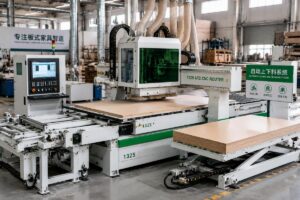
Edge bander cost in Jordan is driven by configuration choices like pre-milling and PUR glue systems, not just brand origin. This guide breaks down 2026 price tiers from manual to fully-automatic lines and reveals hidden import duties. Compare quotes accurately to avoid costly under-specification and rework issues.
Edge Bander Cost in Jordan: 2026 Factory Price Guide
Most buyers think brand name drives edge bander cost in Jordan. The real driver is configuration — and missing one unit can cost you more in rework than the machine itself.
Edge bander cost in Jordan ranges from entry-level manual units to fully-automatic PUR lines, with configuration choices — pre-milling, gluing system type, polishing stations — creating price variance that most procurement managers overlook until the machine is already on the shop floor.
I still remember standing in a furniture workshop in Amman, watching a cabinet maker peel edge banding off a melamine board with his thumbnail. He had just spent a significant amount on a semi-automatic edge bander, and the glue adhesion was failing on nearly every panel. When I looked at the machine’s spec sheet, the pre-milling unit was missing — a cost-saving option the supplier had quietly removed from the base configuration. That single omission was responsible for the majority of his adhesion failures, and the rework labor was eating into margins far faster than the equipment savings.
Understanding edge bander cost in Jordan requires looking past the headline FOB price and breaking down what each configuration component actually does, what it costs, and what happens when you skip it. [NEED_CITE: Jordan customs tariff schedule for woodworking machinery import duties]
Let me walk you through exactly where your money goes, what the real landed cost looks like, and how to compare quotes without getting trapped by incomplete specifications.
What Determines Edge Bander Cost in Jordan?
The single largest factor behind edge bander cost in Jordan is not brand origin — it is the configuration package, specifically whether pre-milling, the correct gluing system, and multi-station polishing are included.
When a Jordanian buyer receives two quotes — one from a European brand and one from a Chinese factory — the European quote often looks significantly higher. What the buyer rarely sees is that the European machine comes fully loaded: pre-milling unit, EVA or PUR glue system depending on specification, dual trimming stations, corner rounding, and buffing. The cheaper quote, by contrast, often strips these out to hit a lower price point.
From my time adjusting cutter heads and swapping glue pots on production lines, I can tell you that pre-milling alone changes the entire adhesion dynamic. It removes the microscopic layer of contaminated or uneven material from the board edge before glue application. Without it, the glue sits on a surface that may have dust, moisture residue, or slight compression damage from the panel saw. In Jordan’s climate — where workshop humidity fluctuates significantly between Amman’s dry summers and more humid coastal areas near Aqaba — this matters enormously.
Here is what typically drives the price tiers:
| Configuration Element | Impact on Edge Bander Cost in Jordan |
|---|---|
| Pre-milling unit | Substantially increases cost; essential for melamine and high-gloss boards |
| Glue system type (EVA vs PUR) | PUR systems carry a noticeably higher price due to temperature-controlled glue pots |
| Trimming and corner rounding stations | Multiple stations add incrementally to cost |
| Polishing and buffing stations | Final finish quality depends on these; budget machines often omit them |
| Feed speed and automation level | Fully-automatic lines with servo-driven feed cost significantly more than semi-auto |
[NEED_CITE: woodworking machinery configuration standards and component classification per international trade specifications]
A cabinet factory I worked with in the Zarqa industrial area upgraded from a manual setup to a semi-automatic line. Their daily output went from a modest number of boards to several times that figure. The investment was in the mid-four-figure range, and they recovered it within less than a year and a half through reduced labor costs and fewer customer complaints about edge delamination.
The key lesson: do not compare edge bander cost in Jordan by total price alone. Compare what each machine actually includes.
2026 Edge Bander Price Range by Type
Edge bander cost in Jordan falls into three clear tiers — manual, semi-automatic, and fully-automatic — with PUR-capable machines commanding a meaningful premium over standard EVA models.
Manual edge banders sit at the entry level. These are handheld or bench-mounted units suitable for very small workshops doing low-volume custom work. They require significant operator skill and produce inconsistent results on melamine or acrylic edge banding. For anyone producing more than a handful of cabinets per week, a manual unit becomes a bottleneck almost immediately.
Semi-automatic edge banders represent the most common upgrade path for growing Jordanian furniture businesses. These machines handle glue application, edge band feeding, and trimming in a single pass, though they typically require manual loading and unloading. The price range here is broad because configuration options vary dramatically — a semi-auto with pre-milling and corner rounding costs noticeably more than a basic glue-and-trim model.
Fully-automatic edge banders are the standard for production-oriented panel furniture factories. These machines integrate pre-milling, glue application, end trimming, flush trimming, corner rounding, scraping, and buffing into one continuous operation. Feed speeds reach levels that support high-volume kitchen cabinet and wardrobe production. PUR-capable fully-automatic lines sit at the top of this range because the glue pot system requires precise temperature control and specialized cleaning protocols.
| Machine Type | Typical Configuration | Edge Bander Cost in Jordan Range |
|---|---|---|
| Manual | Handheld or bench-mounted, no pre-milling | Entry-level pricing |
| Semi-automatic | Glue application, trimming, optional pre-milling | Mid-range pricing |
| Fully-automatic (EVA) | Pre-milling through buffing, standard glue system | Upper-mid pricing |
| Fully-automatic (PUR) | Full suite with temperature-controlled PUR glue pot | Premium pricing |
[NEED_CITE: global edge banding machinery market segmentation and pricing tiers for 2026]
A custom furniture workshop in Amman needed a PUR machine because their clients demanded moisture-resistant edge bonding — Jordan’s climate, particularly in the Jordan Valley where temperatures and humidity spike, makes standard EVA glue a liability for certain applications. They received quotes that varied by a substantial margin. The difference was not brand markup; it was whether the supplier included a precision temperature-controlled glue pot and a robust pre-milling unit. The cheaper quote would have left them with the same adhesion problems they were trying to solve.
Configuration Cost Breakdown: Where Does Your Money Go?
The three most expensive configuration elements in any edge bander are the pre-milling unit, the glue system, and the multi-axis finishing stations — and skipping any one of them creates hidden costs that far exceed the initial savings.
Let me break this down from the shop floor perspective.
Pre-milling unit. This component uses a dedicated cutter head to clean the board edge before glue application. It removes saw marks, dust embedded in the edge, and minor compression damage from the panel saw blade. In my experience running production lines across the Middle East, workshops that skip pre-milling consistently report higher edge delamination rates — particularly on melamine boards where the decorative surface can trap microscopic debris. The pre-milling unit adds a meaningful amount to the machine’s cost, but it eliminates an entire category of quality failures.
Glue system. Standard EVA glue pots are relatively straightforward. PUR systems, however, require sealed, temperature-controlled glue pots that maintain the adhesive at precise operating temperatures to prevent premature curing. PUR glue itself is more expensive per kilogram, and the machine’s glue pot must be cleaned and maintained according to strict protocols. The PUR-capable glue system adds a substantial premium to the machine cost, but for applications requiring moisture resistance, heat resistance, or bonding to difficult substrates, there is no substitute.
Finishing stations. A basic edge bander trims the excess edge band material flush with the board surface. A fully-configured machine adds corner rounding, scraping, and buffing stations that produce a finished edge ready for packaging without secondary operations. Each additional station adds to the machine’s length, complexity, and cost. Workshops that skip corner rounding and buffing end up with visible sharp edges and glue residue — defects that customers notice immediately in kitchen cabinets and wardrobes.
| Configuration Component | Function | Cost Impact |
|---|---|---|
| Pre-milling unit | Cleans board edge before glue application | Noticeable cost increase |
| EVA glue pot | Standard thermoplastic adhesive application | Baseline cost |
| PUR glue pot | Temperature-controlled hot-melt adhesive system | Substantial cost increase |
| Corner rounding station | Rounds sharp edges for safety and finish | Moderate cost increase |
| Scraping and buffing stations | Removes glue residue, polishes edge | Moderate cost increase |
[NEED_CITE: edge banding machine component specifications and functional requirements per woodworking machinery standards]
When I was setting up a production line for a distributor who was importing multiple machines in a single container, we spent considerable time configuring each unit to match the end customer’s actual production needs. The workshop that needed PUR got PUR. The shop doing basic particleboard cabinet boxes got EVA with corner rounding but skipped the buffing station to stay within budget. The mistake would have been buying identical machines for both — one would have been over-specified, the other under-specified.
Jordan Import Costs: Beyond the Machine Price
The FOB price you see on a proforma invoice is not your final edge bander cost in Jordan — import duties, value-added tax, customs clearance fees, and inland transport add a significant layer to the total landed cost.
Jordan’s customs framework applies import duties on woodworking machinery, and these duties are calculated on the CIF value — cost, insurance, and freight — not just the machine’s FOB price. On top of the customs duty, Jordan applies standard value-added tax on imported goods. Customs clearance requires documentation including the commercial invoice, packing list, bill of lading, and certificate of origin, and most importers work through a licensed customs broker whose fees add to the total.
[NEED_CITE: Jordan customs tariff classification and duty rates for woodworking machinery imports]
Here is how the cost structure typically builds:
| Cost Component | Basis |
|---|---|
| FOB machine price | Quoted by supplier |
| Freight and insurance | CIF calculation basis |
| Customs import duty | Applied on CIF value |
| Value-added tax | Applied on CIF plus duty |
| Customs clearance agent fee | Fixed or variable per shipment |
| Inland transport | Port to workshop delivery |
For buyers importing a single machine, these additional costs represent a meaningful percentage increase over the FOB price. For buyers importing multiple machines in a full container, the per-unit impact of freight, clearance, and transport costs drops noticeably — which is why distributors who buy in container-load quantities can offer more competitive pricing to end users.
A furniture machinery distributor I worked with in the Amman area regularly imports full container loads of edge banders, panel saws, and boring machines. By consolidating orders, they spread the fixed costs of freight and clearance across multiple units, reducing the per-machine landed cost substantially. They then pass some of that savings to their customers while maintaining healthy margins.
The practical takeaway: when you receive a quote for edge bander cost in Jordan, ask the supplier whether it is FOB or CIF, and calculate the full landed cost including duties and clearance before making your decision. A machine that looks cheaper on paper may end up costing more once it arrives at your workshop door.
How to Compare Quotes Without Getting Tricked
The most reliable way to evaluate edge bander cost in Jordan is to demand a line-by-line configuration breakdown from every supplier — and compare specifications, not just total prices.
Suppliers quote differently. Some include pre-milling, corner rounding, and buffing in their base price. Others list a low headline figure and treat these components as optional add-ons. If you only compare the bottom line, you are comparing machines that do fundamentally different things.
Here is what I recommend asking for:
- A complete list of every processing station included: pre-milling, glue application, end trimming, flush trimming, corner rounding, scraping, buffing.
- The glue system specification: EVA standard, EVA with temperature control, or PUR with sealed glue pot.
- Feed speed at operating capacity.
- Maximum and minimum board thickness and edge band thickness the machine handles.
- Electrical specification: voltage, phase, and frequency — critical for Jordan’s power grid, which operates at specific standards.
- Control system language options — Arabic-language PLC interfaces are available from certain manufacturers and eliminate operator errors caused by language barriers.
| Comparison Factor | What to Request |
|---|---|
| Processing stations | Full list from pre-milling to buffing |
| Glue system | EVA, temperature-controlled EVA, or PUR |
| Feed speed | Operating speed in meters per minute |
| Board and edge band range | Min and max thickness specifications |
| Electrical compatibility | Voltage, phase, frequency for Jordan |
| Control panel language | Arabic or English PLC interface availability |
[NEED_CITE: international woodworking machinery specification standards for quotation comparison]
I once reviewed a case where a Jordanian workshop owner received three quotes for a semi-automatic edge bander. The lowest quote was from a supplier who had excluded pre-milling and corner rounding. The middle quote included pre-milling but not corner rounding. The highest quote included everything. The workshop owner chose the middle option, and within months was spending significant time and money on manual corner finishing and dealing with occasional edge adhesion issues on melamine boards. The cheapest option would have been worse; the most expensive option would have solved everything. The middle option was the worst outcome — enough money spent to rule out upgrading, but not enough to get a machine that actually met the production requirements.
The lesson is straightforward: request the full configuration list, understand what each station does, and match the specification to your actual production needs — not just your budget.
Conclusion
Edge bander cost in Jordan is driven by configuration, not brand — and understanding what each component does protects you from both overpaying and under-specifying. Manual, semi-automatic, and fully-automatic machines occupy distinct price tiers, with PUR systems commanding a premium for moisture-resistant applications. Import duties, VAT, and clearance fees add a meaningful layer to the landed cost, which container-load purchasing can reduce on a per-unit basis. The only reliable way to compare quotes is to demand full configuration breakdowns and match specifications to your actual production requirements.
Tags

Written by
author
Editor covering global sourcing, supplier verification, and industrial product knowledge. Content is compiled from manufacturer specifications, industry standards, and hands-on experience with international B2B buyers. Every article is fact-checked before publishing to help procurement professionals make informed decisions.
View all posts