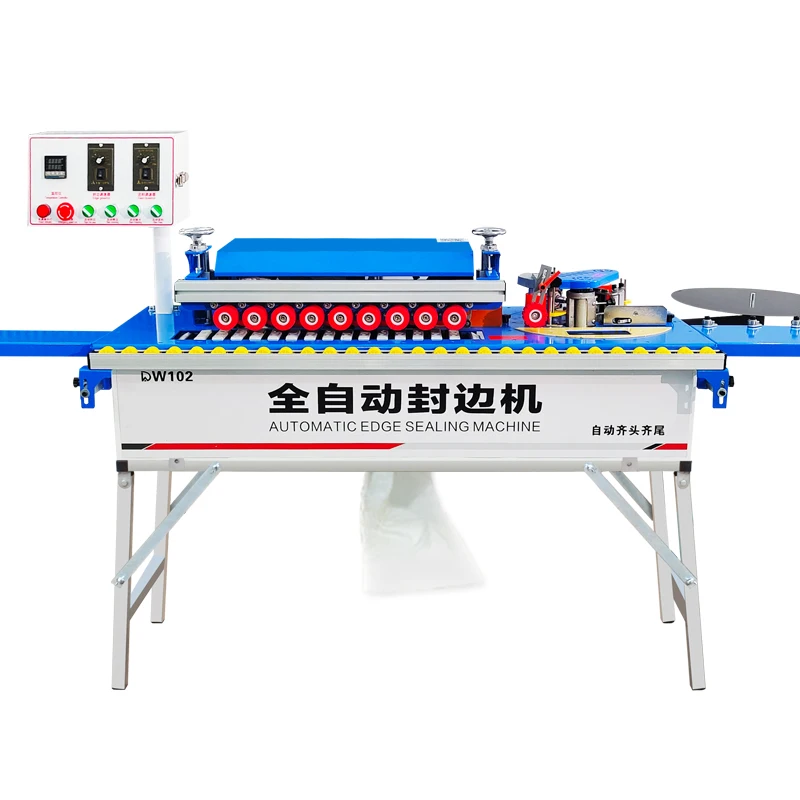
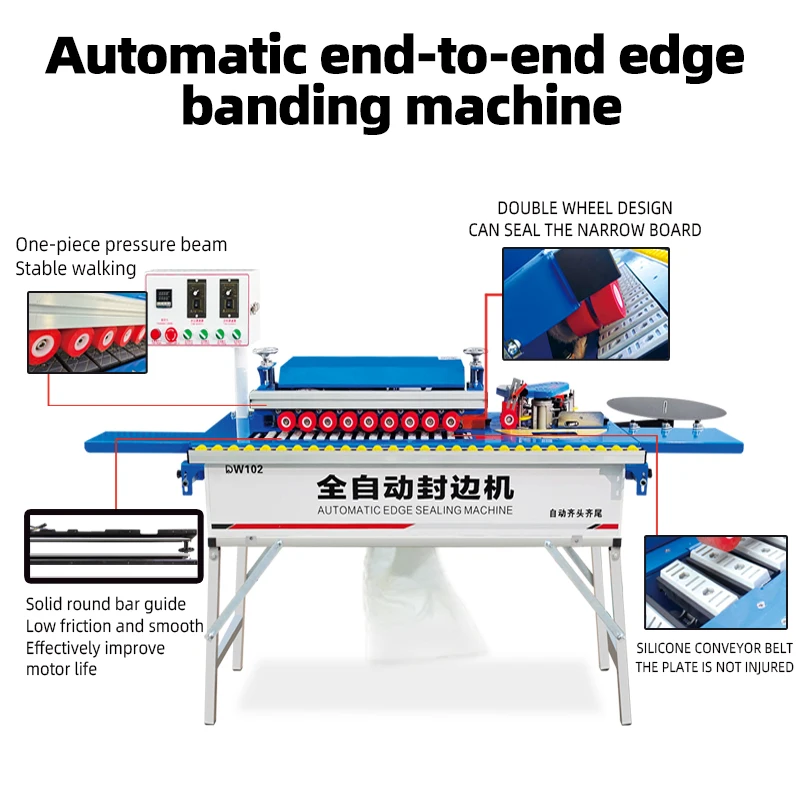
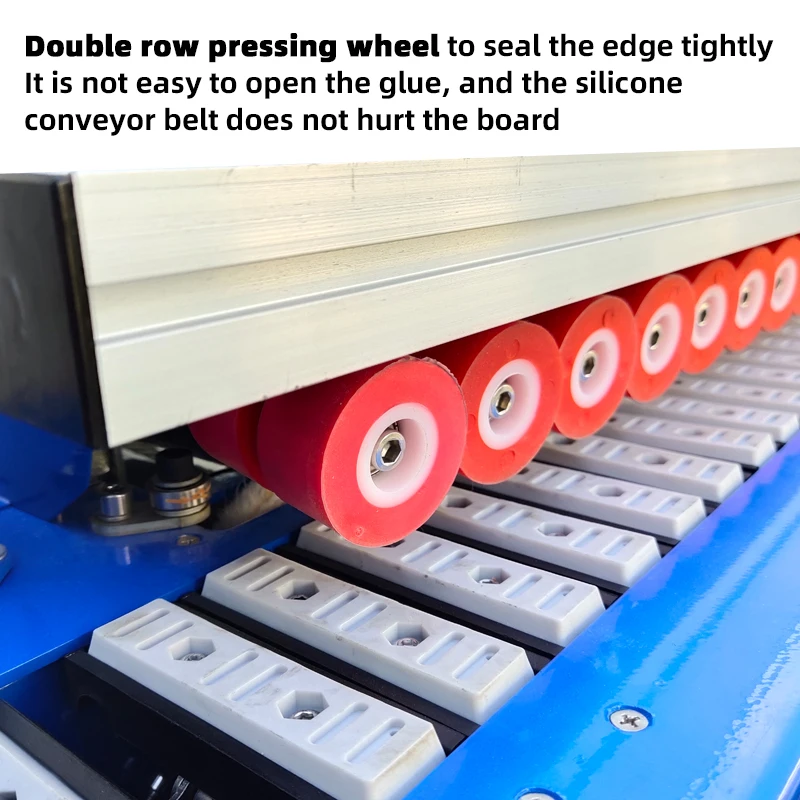
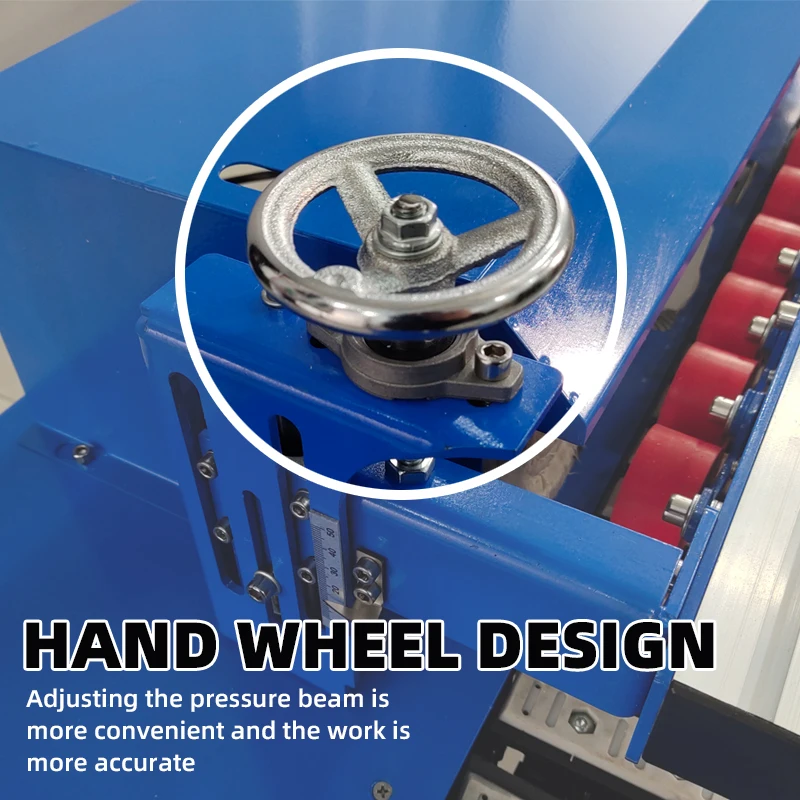
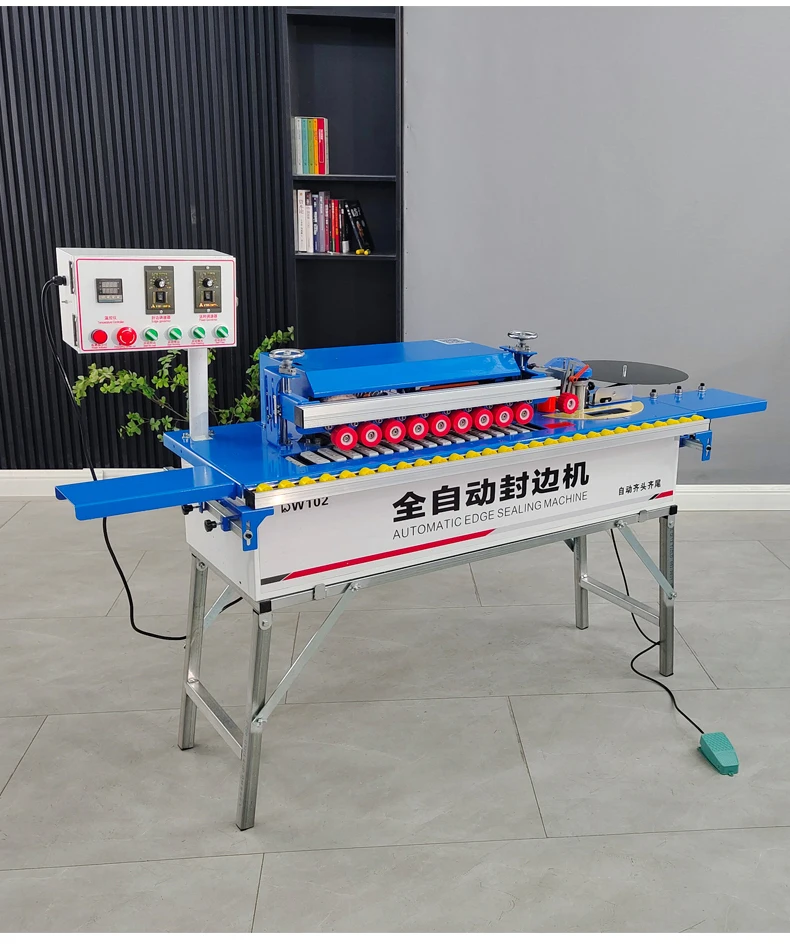
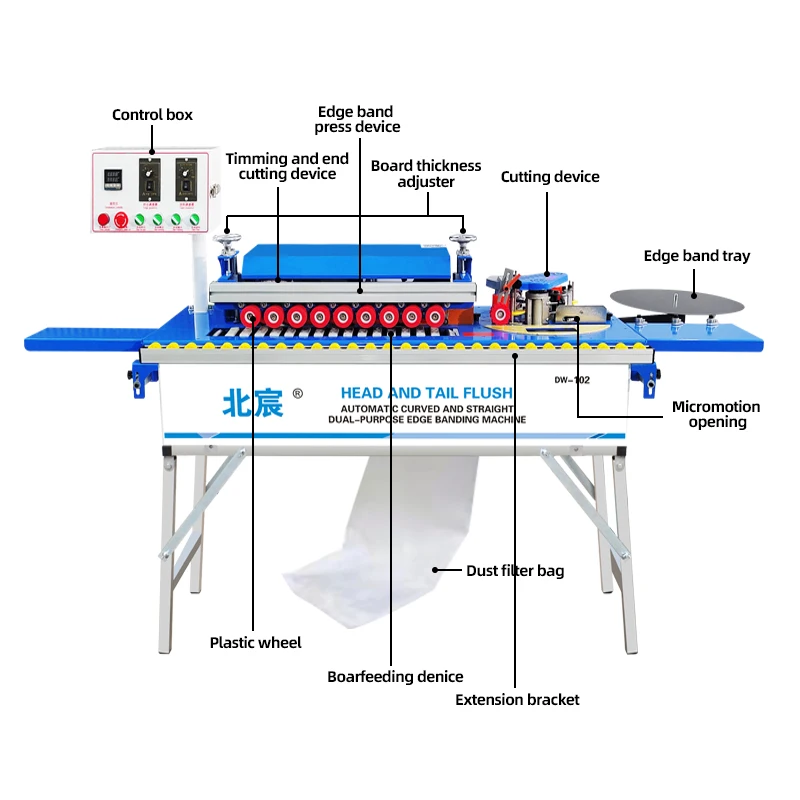
Description
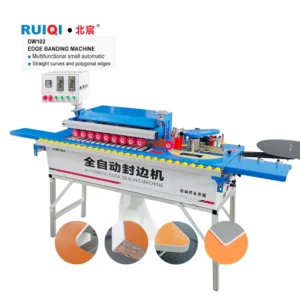
Verified Tolerance Range — DW102 holds ±0.02mm edge trimming accuracy across 0.3–3mm banding thickness, backed by proprietary cutting mechanisms and four-stage QC before dispatch.
Technical Specifications
| Parameter | Value |
|---|---|
| Model | DW102 |
| Product Type | Automatic Edge Banding Machine |
| Rated Power | 3800W (basis to be confirmed) |
| Voltage & Frequency | 220V / 380V / customization (frequency not stated in source) |
| Control System | PLC |
| Overall Dimensions (L×W×H) | 128 × 47 × 69 cm |
| Net Weight | 75 kg |
| Minimum Sheet Length | 25 cm |
| Minimum Sheet Width | 5 cm |
| Edge Banding Height | 0–50 mm |
| Edge Banding Thickness | 0.3–3 mm |
| Trimming Power | 650W × 2 |
| Polishing Power | 180W × 2 |
| Vacuum Power | 1200W |
| Transmission Power | 60W |
| Edge Power | 20W |
| Glue Pot Capacity | 1000 ml |
| Air Source Pressure | 0.5–0.8 MPa |
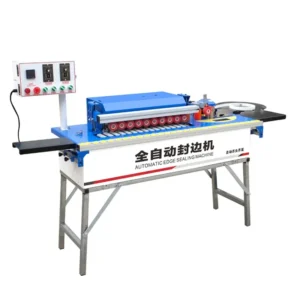
| Key Features | Curved and straight edge banding, automatic head and tail cutting, edge trimming, polishing, vacuum hold-down |
| Assembly State | Fully assembled (basis to be confirmed) |
| Language Options | Chinese and English standard; other languages customizable |
Application Suitability
| Application | Material or Output |
|---|---|
| Cabinet door panel edge finishing | MDF with melamine and PVC edge banding |
| Custom wardrobe side panel trimming | Particleboard with 0.4–2 mm veneer strips |
| Plywood shelving edge sealing | Plywood with thin PVC or ABS banding |
| Polymer door panel straight-edge banding | Polymer composite panels with matching edge strips |
| Small-batch blockboard edging | Blockboard with wood veneer or melamine banding |
Why the Voltage Question Must Precede Any Machine Decision
A machine quoted without confirmed local voltage and frequency will arrive unusable — and the fault lies with the specification process, not the workshop floor.
I once watched a three-phase edge bander sit idle for two months in a West African furniture factory because the frequency mismatch tripped the PLC on every startup cycle. The buyer had compared quotes on price, station count, and feed speed — but never confirmed whether the local grid ran 50Hz or 60Hz. [NEED_CITE: voltage and frequency standards by export market] When the DW102 is configured for your market, the motor winding, transformer tap, and PLC clock all align with your actual supply. Skipping that conversation costs far more than a few days of delayed shipment.
Positioning the DW102 Within a Scalable Machine Family
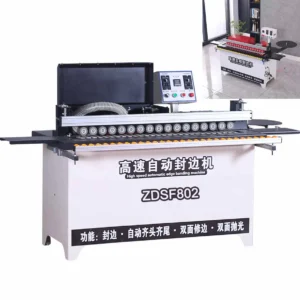
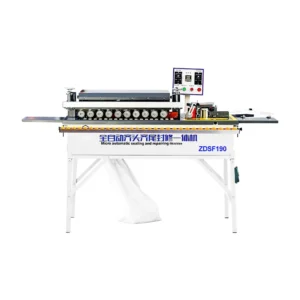
The DW102 occupies the mid-range tier of a complete automatic edge banding machine for sale lineup, bridging entry-level curved-and-straight models and full-function pre-milling configurations. A workshop that starts with this unit can later add upstream panel saws and downstream boring machines from the same product family without renegotiating service agreements or retraining operators on a different control platform. The PLC architecture and multilingual panel remain consistent across tiers, so the knowledge your team builds here carries forward.
Model Tiers and What Each Station Adds
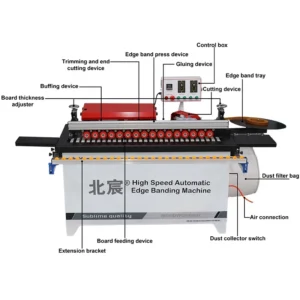
Moving up from the DW102 to a pre-milling model introduces a scoring unit that cleans the panel edge before glue application, addressing the visible glue-line issue that plagues workshops processing recycled particleboard. [NEED_CITE: edge adhesion failure causes on recycled substrates] Staying at this tier keeps the station count lean — dual 650W trimming, dual 180W polishing, auto head-and-tail cutting — which suits factories where panel variety is high but daily volume per SKU stays moderate. Knowing your current station requirement and future upgrade path within one supplier eliminates the piecemeal incompatibility trap.
How Core Parameters Translate on the Shop Floor
The 0.3–3 mm banding thickness range means one DW102 handles both thin melamine strips for cabinet interiors and thicker PVC profiles for exposed door edges, reducing the need for dedicated machines per material. Dual trimming stations at 650W each provide enough torque to flush-trim 2 mm PVC without chatter marks, while the 180W polishing wheels remove the micro-scratches left by the trimmer knives. The 1000 ml glue pot capacity supports continuous runs on standard panel sizes without mid-batch refills. A 0.5–0.8 MPa air supply drives the pneumatic pressure rollers and cutting cylinders; if your compressor cannot sustain that band, banding adhesion will vary panel to panel. The 25 cm minimum sheet length and 5 cm minimum width allow narrow drawer sides and small shelf brackets to be edged without manual jigs.
The Hidden Cost of Buying a Machine Below Its Intended Duty
A mid-range edge bander pushed into high-volume continuous production will show accelerated wear on the trimming knives and polishing wheels, and the glue pot will struggle to recover temperature between consecutive thick-PVC passes. [NEED_CITE: thermal recovery limits of small-capacity glue pots in continuous operation] When I spec’d a similar unit for a South Asian cabinet plant that doubled its order book within a year, the first sign of overload was inconsistent edge adhesion on the second shift — not a mechanical failure, but a thermal one. Matching the DW102 to medium-volume runs or using it as the first machine in a phased rollout prevents that mismatch.
Why Procurement Through This Catalogue Reduces Risk
In-house manufacturing with patented cutting mechanisms means the ±0.02 mm tolerance is built into the spindle and guide assembly, not achieved by operator compensation. Four-stage QC — incoming material, in-process, finished product, and pre-shipment verification — catches electrical and mechanical deviations before the crate leaves Shandong. Voltage and language customization is standard practice here, not an afterthought negotiated post-order. An engineer-led configuration review within 24 hours ensures the DW102 you receive matches your actual panel materials, local power grid, and operator language. Factory visits are open, so you can witness test runs on your own substrate before committing.
Documentation & Verification
- CE declaration of conformity covering the DW102 mechanical and electrical safety scope
- ISO 9001 certificate for the manufacturing quality management system
- Machine specification sheet confirming your selected voltage and language configuration
- Electrical schematic with confirmed frequency rating for your local grid
- Factory test record run on your specified panel thickness and banding material
- Operation and maintenance manual in the agreed language with spare parts list
Installation, Commissioning & Support
- The 128 × 47 × 69 cm footprint requires a level concrete pad with clearance for operator access on both long sides
- A dedicated 3800W circuit with the confirmed voltage and frequency must be in place before the machine arrives
- The unit ships fully assembled; commissioning involves pneumatic line connection, PLC parameter loading, and test panel runs
- First-run calibration covers glue temperature, feed speed, and trimming depth for your specific banding thickness
- Operator training addresses PLC navigation in the configured language, daily knife inspection, and glue pot cleaning cycles
- Spare trimming knives and polishing wheels should be ordered with the initial shipment to cover consumable replacement
What to Include in Your Inquiry
Tell us the panel materials you process most often — MDF, particleboard, plywood, or polymer — along with the banding types and thicknesses you run daily. Confirm your local voltage and frequency so the motor and PLC are wound correctly from the start. If you are planning a phased line rollout, share your upstream saw model and downstream boring setup so feed heights and throughput can be matched across stations.
Frequently Asked Questions
Q: Where does the DW102 sit within the full edge banding machine range?
A: The DW102 is positioned as the mid-range model, offering curved and straight banding with dual trimming and polishing stations. It sits above entry-level single-function units and below full-function pre-milling configurations. This placement suits workshops that need reliable edge finishing across multiple materials without the station count of a high-volume production line.
Q: How do model tiers differ in station count and automation level?
A: Entry-level models typically include basic gluing and trimming. The DW102 adds automatic head-and-tail cutting, dual polishing, and vacuum hold-down. Higher tiers introduce pre-milling and additional scraping stations. Each step up increases edge quality on difficult substrates and reduces manual intervention during material changeovers.
Q: What voltage and frequency options are available for my market?
A: The DW102 supports 220V and 380V configurations with customization available for other voltages. Frequency must be confirmed at the order stage because it affects motor winding and PLC timing. Providing your local supply details early prevents the machine from arriving with an incompatible electrical setup.
Q: Can the control panel language be set to my operator’s preference?
A: Chinese and English are standard on the PLC interface. Other languages can be configured before shipment so your operators read instructions and error codes in their working language. This eliminates commissioning delays caused by misread prompts and reduces the training burden on your floor supervisors.