Description
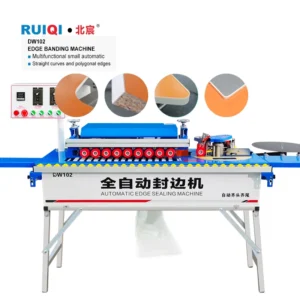
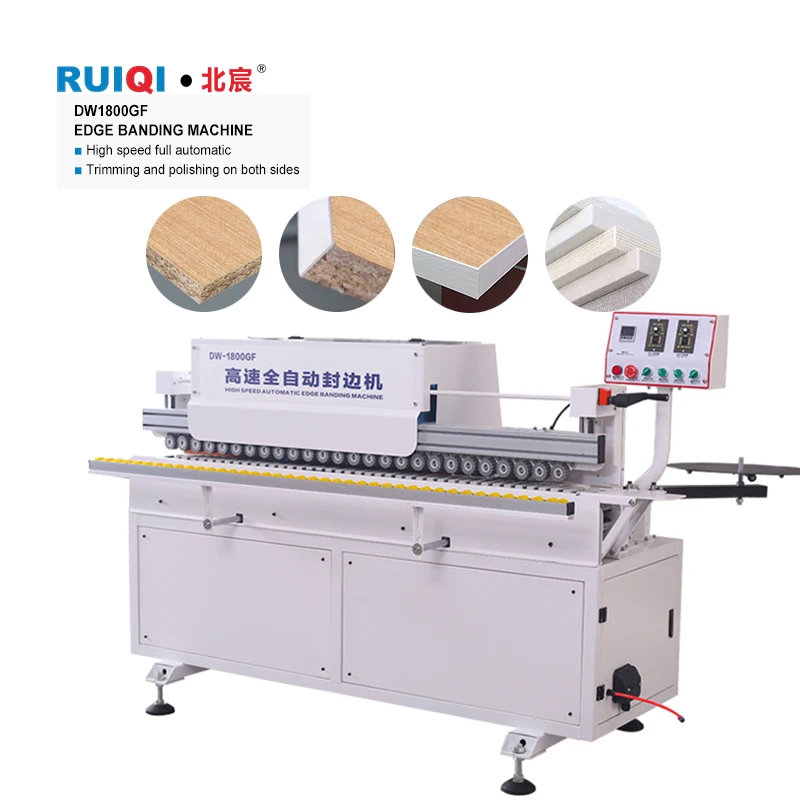
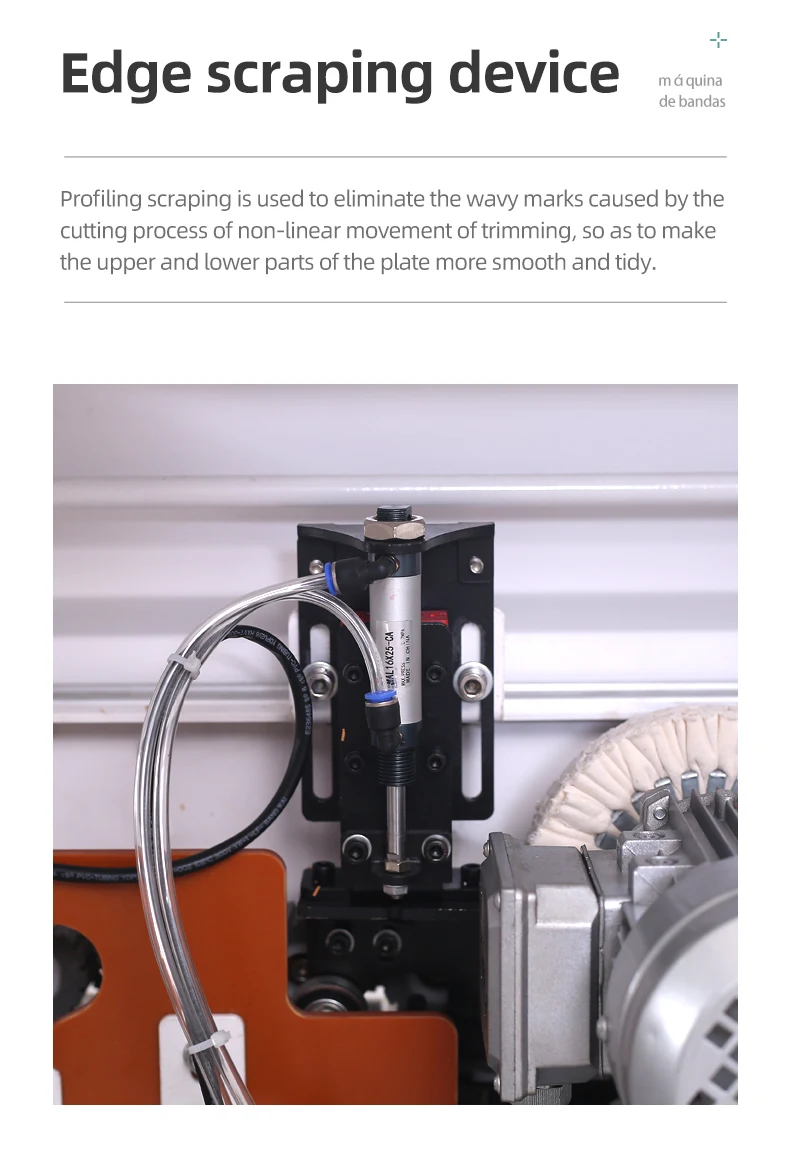
Patented Cutting Precision — Every DW1800 edge bander leaves our facility with verified tolerance on trimming and scraping stations, backed by a four-stage QC process before dispatch.
Technical Specifications
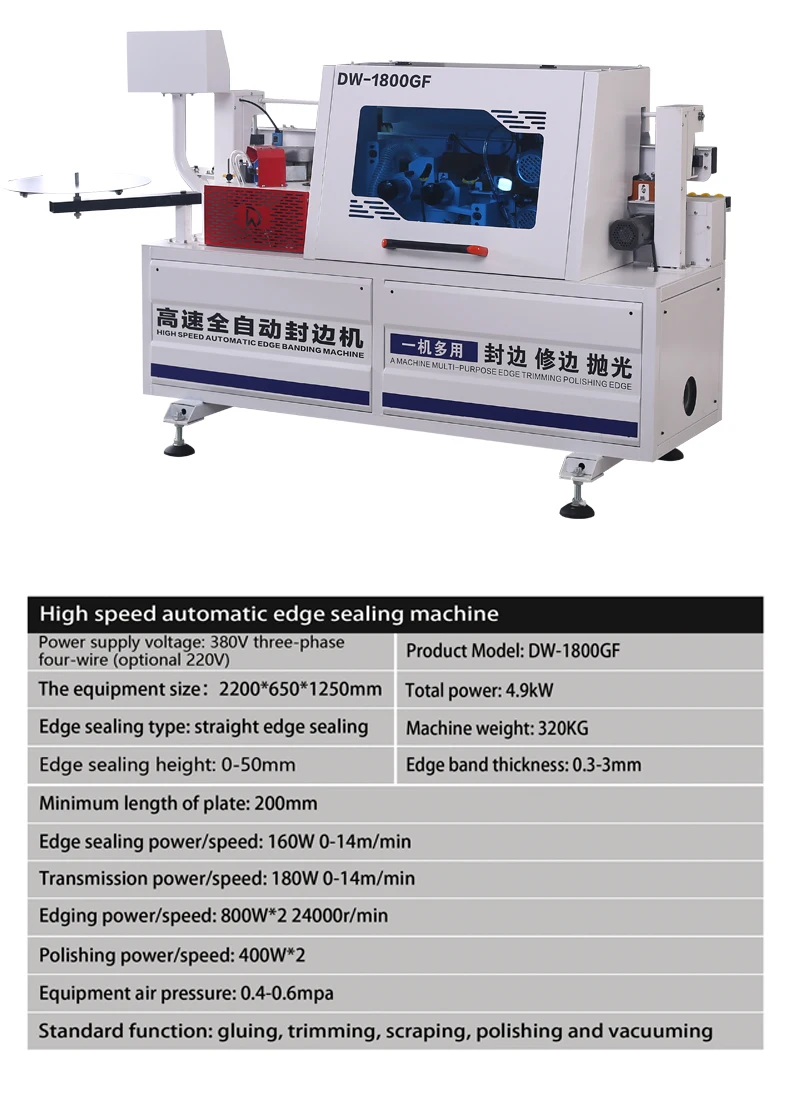
| Parameter | Value |
|---|---|
| Model | DW1800 |
| Product Type | Automatic Edge Banding Machine |
| Total Power | 4.9 kW |
| Voltage Options | 380V / 220V / 415V (frequency confirmed per destination market) |
| Feed Speed | 0–14 m/min |
| Edge Banding Thickness | 0.3–3 mm |
| Edge Banding Height | 0–50 mm |
| Minimum Sheet Dimensions | 200 mm length × 100 mm width |
| Glue Pot Capacity | 4000 ml |
| Trimming Power | 800 W × 2 motors, 24000 r/min |
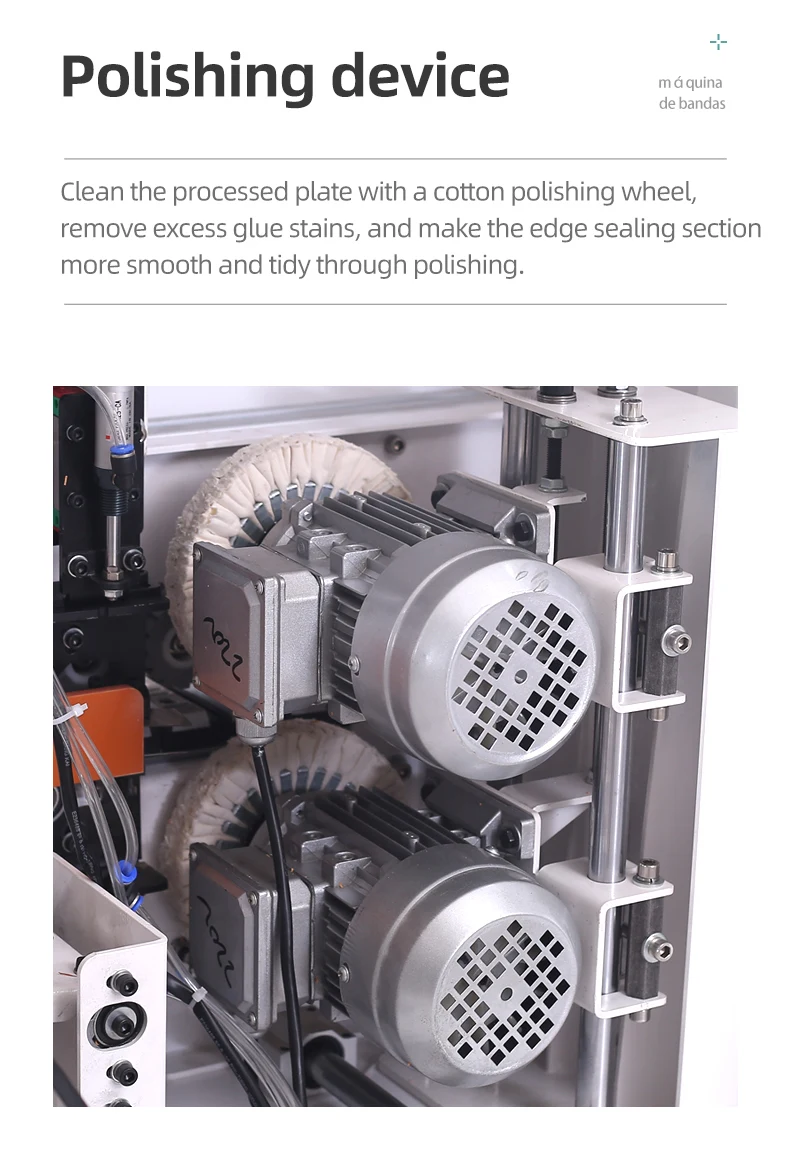
| Polishing Power | 380 W × 2 motors |
| Vacuum Power | 550 W |
| Air Source Pressure | 0.4–0.6 MPa |
| Overall Dimensions (L×W×H) | 220 × 65 × 125 cm |
| Net Weight | 320 kg |
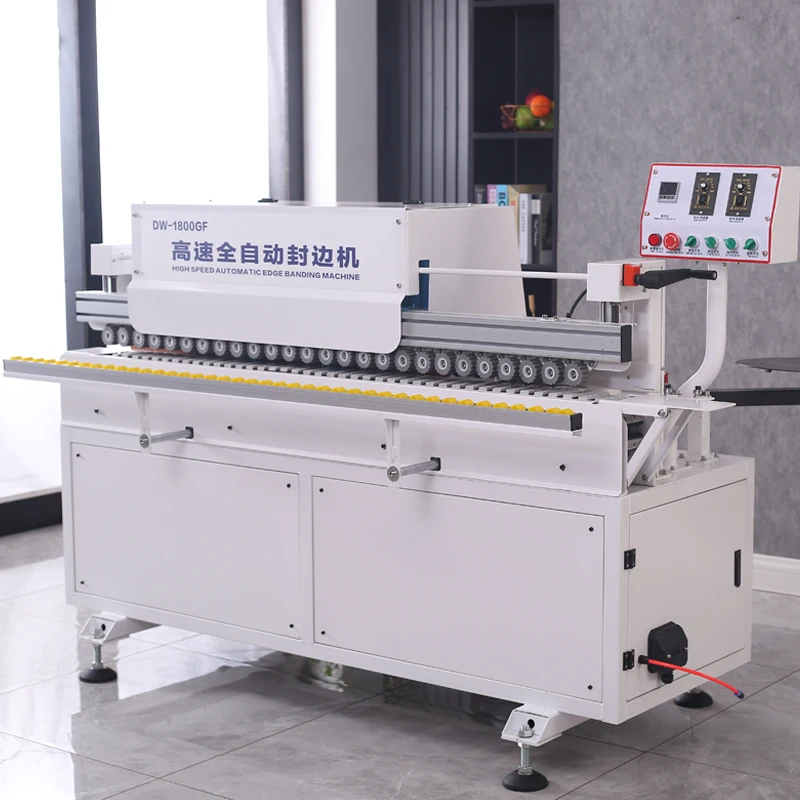
| Key Features | Double-sided gluing, end cutting, rough & fine trimming, profile tracking, scraping, polishing, integrated dust extraction |
Application Suitability
| Application | Material or Output |
|---|---|
| Cabinet and wardrobe panel production | MDF, particleboard, plywood with PVC or melamine edge banding |
| Custom furniture manufacturing | Veneered panels and ABB boards requiring clean edge finish |
| Joinery workshop edge processing | Solid wood panels and organic glass plates up to 50 mm thickness |
| Small-batch panel processing plants | Mixed substrate runs switching between PVC, ABS, and veneer banding |
Why the Control Panel Language Should Be Confirmed Before the Machine Ships
An unreadable interface stalls your entire production line on day one.
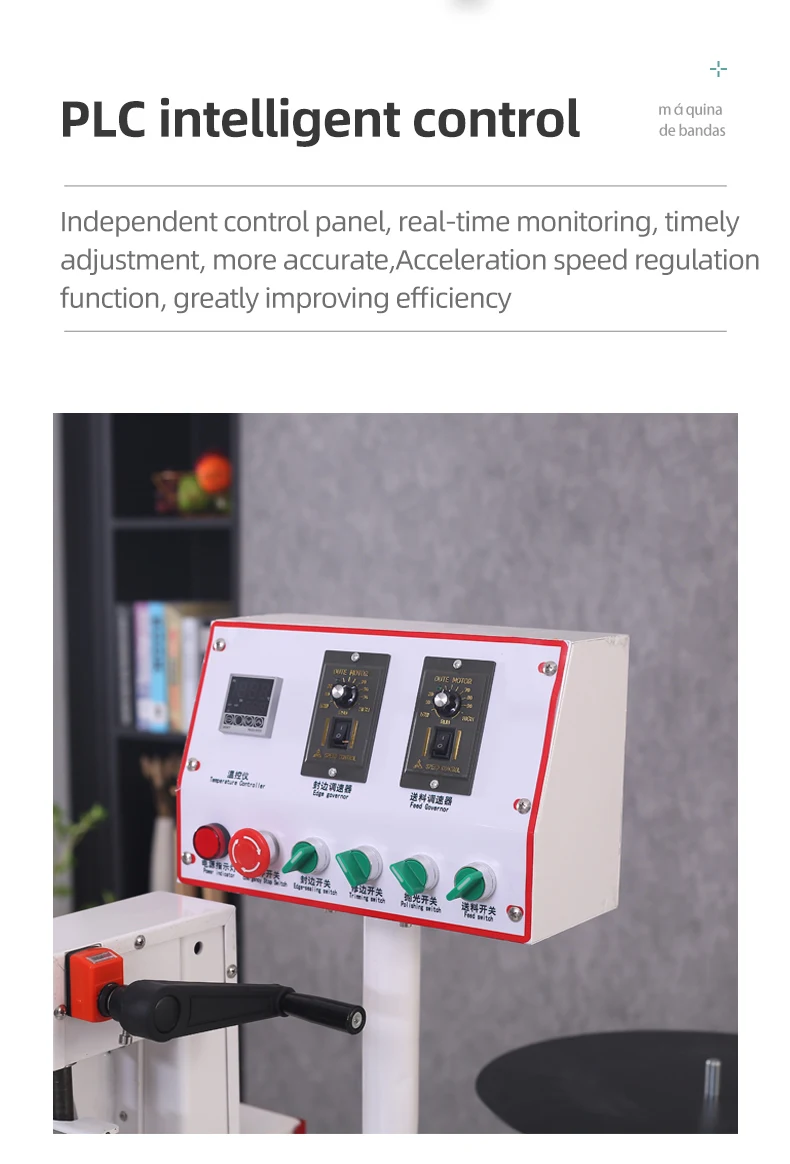
I once sent a fully automatic edge bander to a Scandinavian cabinet factory. The default control panel was in Chinese. Their technician powered it up, couldn’t find where to set the glue pot temperature, and the line sat idle for two days while we remotely switched the language pack. Since then, I verify the interface language on every automatic edge banding machine manufacturer order before it leaves the floor. A machine that can’t be operated is a machine that isn’t producing [NEED_CITE: industrial equipment localization requirements for operator interfaces].
The DW1800 Within the Ruiqi Machine Range
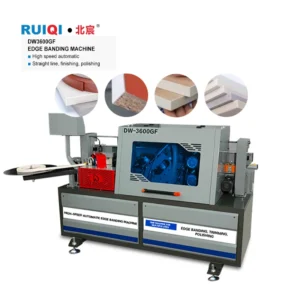
The DW1800 sits in the middle of our edge banding family, covering the full automatic cycle from gluing through polishing. Workshops that start here can move to pre-milling models within the same product line as throughput demands grow, keeping training and spare parts within one ecosystem. This continuity matters when your production manager already knows the control logic and your maintenance team already stocks the consumables.
Double-Sided Gluing and Substrate Consistency
Uneven glue application is the most common cause of visible banding lines on porous substrates like particleboard. The DW1800’s double-sided gluing system applies adhesive to both the panel edge and the banding strip simultaneously, drawn from a 4000 ml glue pot that maintains thermal stability across longer production runs. The integrated profile tracking function rounds all four corners in one pass, eliminating the sharp edges that catch during assembly and handling [NEED_CITE: edge banding adhesion failure modes across engineered wood substrates].
Reading the Numbers That Matter
The 0–14 m/min feed speed range lets operators dial in throughput based on the banding material in use — slower for thick PVC that needs more trimming time, faster for thin veneer on straight runs. The 0.3–3 mm edge thickness range covers most common banding materials without requiring mechanical changeovers between jobs. Trimming runs at 24000 r/min across two 800 W motors, which is the spindle speed needed for clean cuts on MDF and particleboard without tear-out at the panel surface. The 550 W vacuum extraction port connects directly to your workshop’s dust collection system, keeping the trimming and polishing zones clear of debris that otherwise settles into fresh glue lines.
The Cost of Skipping Voltage Confirmation
We’ve seen machines arrive at foreign workshops wired for a frequency that doesn’t match the local grid. The motors run, but the spindle speed drifts, the glue pot overheats, and the PLC throws faults that local electricians can’t diagnose. Every automatic edge banding machine manufacturer order we process starts with written voltage and frequency confirmation — 380V, 220V, or 415V matched to your facility’s supply before production begins [NEED_CITE: voltage and frequency standards by export market].
What Backs This Machine Before It Reaches You
Our in-house manufacturing means the cutting mechanisms on the DW1800 are built on our own floor, not outsourced to a trading company’s supplier. The four-stage QC process covers incoming material inspection, in-process checks during assembly, finished product testing, and pre-shipment verification on your specified panel thickness. Engineer-led configuration means you receive a formal quotation with specification and voltage confirmation, not a generic price list. Factory visits are available if you want to see the DW1800 under power before committing. Documentation ships with the machine — not after you ask for it.
Documentation & Verification
- CE declaration of conformity referencing the DW1800 model and applicable machinery directives
- ISO 9001 certificate covering our manufacturing and quality management process
- Electrical schematic with confirmed voltage and plug type for your local standard
- Factory test record running your specified panel thickness and banding material before dispatch
- Operation and maintenance manual written in your agreed language, not machine-translated
Installation, Commissioning & Support
- 220 × 65 × 125 cm footprint requires a level concrete floor with clearance on the infeed and outfeed sides
- 4.9 kW total power draw needs a dedicated circuit matching your confirmed voltage option
- Arrives as a single assembled unit; connect compressed air at 0.4–0.6 MPa and plug into confirmed supply
- First-run commissioning includes glue pot temperature calibration for your banding material type
- Spare parts list covers trimming blades, polishing wheels, and scraper inserts with part numbers
What We Need to Configure Your Machine
To recommend the right voltage, plug type, and language package, share your workshop’s electrical supply specifications and the primary control language your operators need. Tell us which substrates and banding materials you run most often, and whether you’re integrating the DW1800 into an existing line or standing it up as a standalone station. If you need a sample processing test on your own panel stock before ordering, we arrange that at the factory.
Frequently Asked Questions
Q: What panel formats and feed rates does the DW1800 handle in daily production?
A: The machine accepts panels from 200 mm length and 100 mm width upward, with edge banding heights from 0 to 50 mm. Feed speed adjusts from 0 to 14 m/min depending on banding thickness and substrate. Actual throughput depends on your panel dimensions, banding material, and the number of functions engaged per pass.
Q: How do you confirm voltage and frequency for my country’s electrical standard?
A: Before production, we require written confirmation of your facility’s voltage, phase, and frequency. The DW1800 is configurable across 380V, 220V, and 415V options, with plug types available for EU, USA, AU, and UK standards. An electrical schematic reflecting your confirmed specification ships with the machine.
Q: Can the control panel language be set to something other than Chinese or English?
A: Yes. Chinese and English are standard, but we customize the interface language before dispatch based on your operator requirements. I personally verify the language pack on every machine before it ships, because an unreadable panel stops production immediately.
Q: How does this model fit if my workshop needs to scale production later?
A: The DW1800 is part of our full edge banding range, from entry-level to full-function pre-milling models. When your volume outgrows this configuration, you can move to a higher-tier machine within the same product family without retraining operators or switching spare parts suppliers.