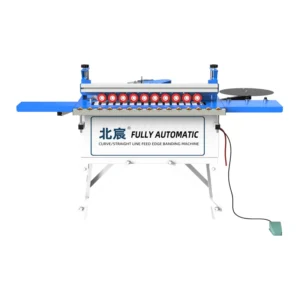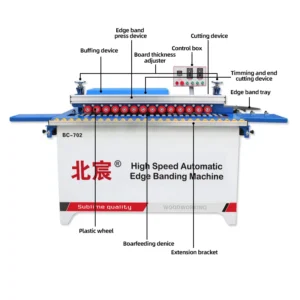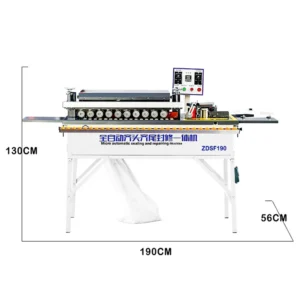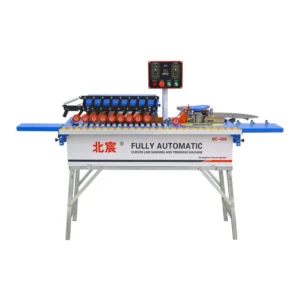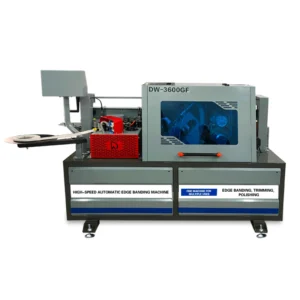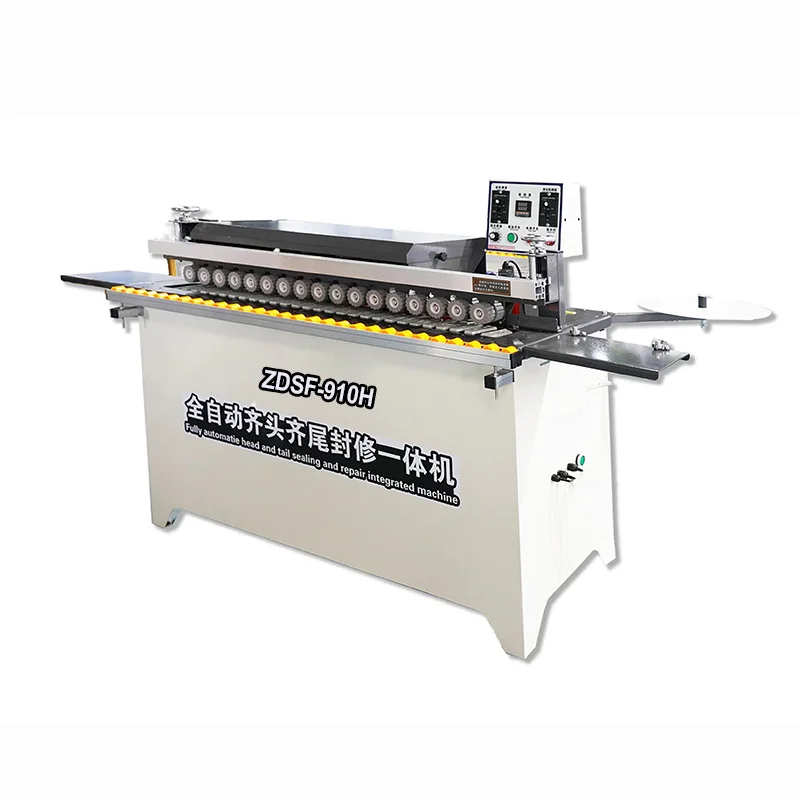
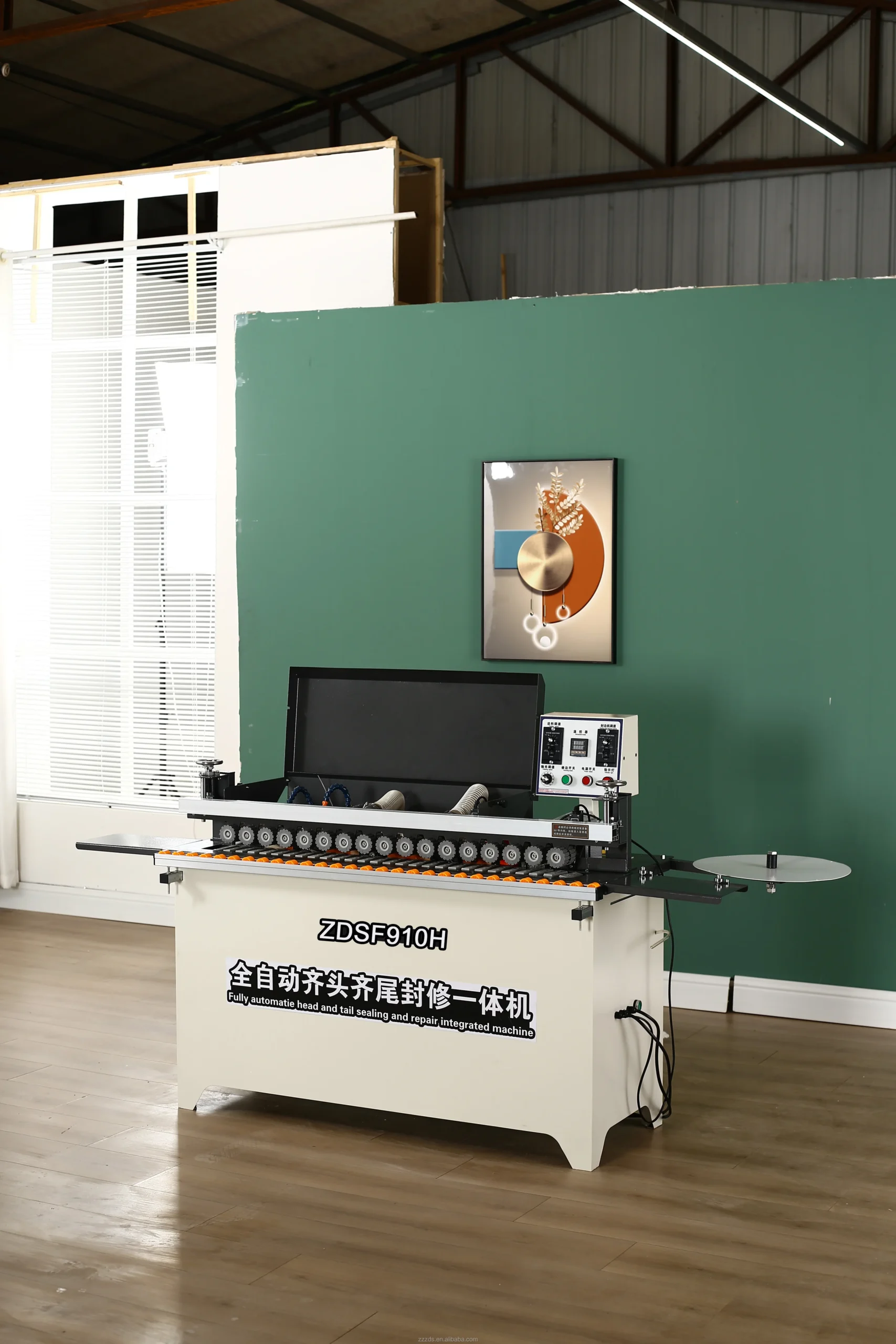
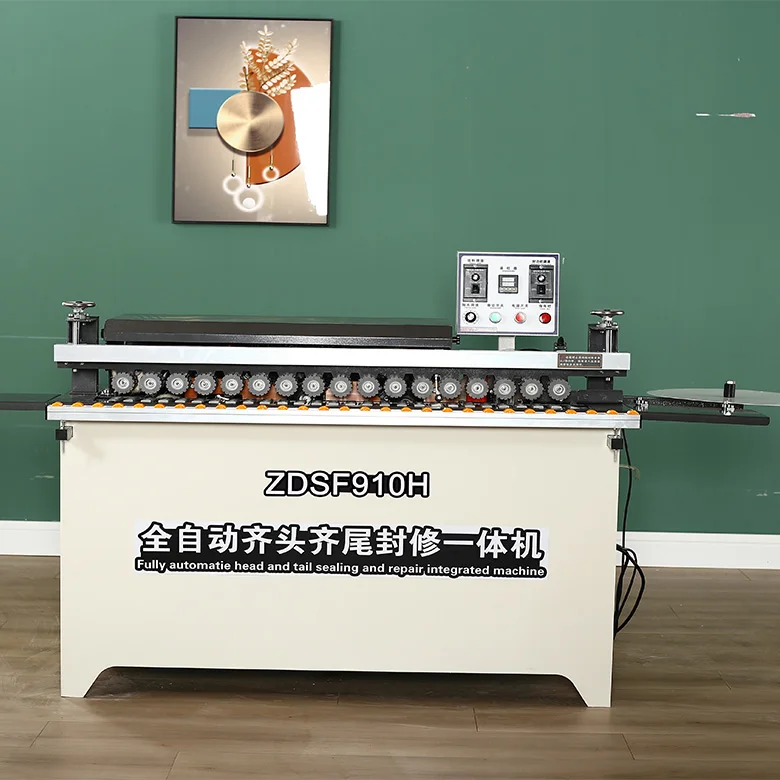
Description
Full Catalogue Scope — Ruiqi’s 910H compact edge bander anchors the entry tier of a machine family that extends through mid-range and full-function models, so a workshop can scale capacity without switching suppliers.
Technical Specifications
| Parameter | Value |
|---|---|
| Model | 910H |
| Product Type | Small Automatic Edge Banding Machine |
| Function | Automatic plate feeding, double-sided gluing, upper and lower polishing, automatic head and tail trimming, curved and straight edge banding |
| Edge Type | Both curved and straight lines |
| Voltage & Frequency | 220V 50Hz |
| Rated Power | 4 kW |
| Rated Air Pressure | 0.4–0.6 MPa |
| Suction Power | 1200 W |
| Belt Power | 25 W |
| Transmission Power | 120 W |
| Heating Power | 800 W |
| Polishing Power | 180 W × 2 |
| Trimming Power | 800 W × 2 |
| Sheet Thickness Range | 10–50 mm |
| Strip Thickness Range | 0.5–2.5 mm |
| Minimum Board Width for Edge Sealing | 2.5 cm |
| Glue Capacity | 1000 ml |
| Overall Dimensions (L×W×H) | 1300 × 560 × 1090 mm |
| Net Weight | 140 kg (source value — verify against manufacturer catalog) |
| Transmission System | Steel rod slide rails with crawler transmission |
| Trimming Cutter | Imported brand 4-blade alloy arc knife |
| Dust Collection | Two large diameter dust collectors (source value — verify against manufacturer catalog) |
| Pressure Beam | Adjustable aluminum alloy |
| Feed System | Double-row rubber pressure wheels, automatic plate feeding |
| Control Panel | Multi-function button operation |
Application Suitability
| Application | Material or Output |
|---|---|
| Custom cabinet door edge finishing | MDF and melamine-faced particleboard with PVC edge strips |
| Curved reception desk and countertop profiles | Plywood and MDF with melamine or veneer banding |
| Small-batch wardrobe panel processing | Particleboard and melamine boards, straight and curved edges |
| Joinery startup transitioning from manual banding | PVC and melamine strips on panels 10–50 mm thick |
Why the Voltage Question Comes Before the Price on an Automatic Edge Banding Machine for Sale
Confirming your local supply voltage and frequency before anything else prevents a machine from sitting idle for weeks on arrival.
I once configured a fully automatic edge bander for a Middle East workshop. The local grid ran on a different standard than what was quoted, and the machine sat uncommissioned for three weeks while a transformer was sourced and installed. That downtime cost the buyer far more than the transformer itself. When you evaluate any automatic edge banding machine for sale, the electrical specification is the single most consequential line on the order sheet. A compact unit like the 910H draws 4 kW total — its heating element, trimming motors, and polishing heads all depend on stable voltage to maintain consistent glue temperature and clean cuts. [NEED_CITE: voltage and frequency standards by export market]
How the Ruiqi Range Is Structured Around Production Stage
Ruiqi organizes its edge banding machines into clear tiers: entry-level compact units like the 910H for low-volume or curved-profile work, mid-range models for workshops running straight panels daily, and full-function pre-milling machines for factories with demanding tolerance requirements. Each tier shares the same product family DNA, meaning control logic, spare part families, and maintenance routines carry forward as you move up. This structure lets a buyer start with the 910H today and add a larger straight-line machine later without retraining operators from scratch.
Where the 910H Fits in a Growing Workshop
The 910H occupies the smallest viable configuration for a workshop that handles both curved and straight edge profiles. Its 1300 × 560 mm footprint allows placement in tight joinery shops, and its 220V single-phase supply means no three-phase infrastructure is required before installation. The machine’s dual-purpose curved-and-straight capability — with 180° rotation for profile switching — eliminates the need for two separate banding stations at this production stage. As order volumes grow and panels become predominantly straight, the workshop can move to a dedicated straight-line automatic edge banding machine from the same Ruiqi family without losing compatibility in tooling or consumables. [NEED_CITE: CE machinery directive requirements for industrial equipment]
Reading the 910H Specification Sheet for Real Production Impact
The sheet thickness range of 10–50 mm and strip thickness range of 0.5–2.5 mm together define the panel-and-edge combinations this machine can physically handle. Most MDF cabinet components fall between 16 mm and 25 mm, well within this window, while 2 mm PVC edge strips — the most common banding for kitchen cabinetry — sit at the upper boundary of the strip range, meaning the glue roller and pressure beam need correct adjustment to avoid squeeze-out on thicker strips. The double-sided gluing system applies adhesive to both the panel edge and the strip simultaneously, which improves bond consistency on porous substrates like raw particleboard compared to single-sided application. The 4-blade alloy arc knife trimming unit is designed specifically for curved profiles; on straight cuts it functions as a standard end trimmer, but on arcs it follows the contour to produce a flush finish that reduces downstream hand-sanding. The two polishing heads at 180 W each provide enough contact pressure for final surface cleanup without burning melamine or PVC surfaces at typical feed rates.
The Cost of Buying a Single Machine Without a Product Family Behind It
Workshops that source edge banders piecemeal from different suppliers frequently discover incompatibilities after installation — feed heights that do not match upstream panel saws, throughput speeds that bottleneck downstream drilling stations, or proprietary spare parts with multi-week lead times from an overseas vendor with no local representation. When the first machine fails or reaches its volume limit, replacing it with a different brand means operators must learn a new control interface, maintenance staff must stock a second set of consumables, and electrical cabinets may need rewiring for a different voltage configuration. These hidden costs compound with each additional standalone purchase. [NEED_CITE: hidden costs of piecemeal machinery procurement in small workshops]
Why Sourcing Through Ruiqi’s Catalogue
In-house manufacturing with patented cutting mechanisms means the 910H’s trimming assembly is built and tested under the same quality regime as the full-function pre-milling models in the range. A full product family from entry-level to production-grade sits under one catalogue, so you compare models on genuine specification differences rather than shopping across unrelated brands. Voltage customization from 110V to 440V and multilingual control panels are offered as standard configuration options, not as costly afterthoughts — the 910H can ship with the control language your operators actually read. A four-stage QC process covering incoming material, in-process assembly, finished product, and pre-shipment verification ensures every unit is tested before crating. Engineer-led configuration recommendations with a formal quotation provided within 24 hours mean your inquiry gets a technical response, not a generic price list.
Documentation & Verification
- Machine specification sheet confirming voltage, frequency, and power ratings matched to your local supply
- CE declaration of conformity and ISO 9001 certificate issued to Ruiqi, available for customs and compliance review
- Factory test record demonstrating edge banding quality on your specified panel material and strip thickness
- Operation and maintenance manual provided in the language agreed at order confirmation
- Electrical schematic with confirmed wiring diagram for the configured voltage setting
- Spare parts list identifying consumables and replacement intervals for the 910H’s trimming, polishing, and glue systems
Installation, Commissioning & Support
- Requires a single 220V circuit rated for at least 4 kW continuous draw with proper grounding
- Compact 1300 × 560 mm footprint fits standard workshop floors; no special foundation or anchoring needed for the 140 kg unit
- Arrives assembled with pressure beam and feed wheels pre-calibrated; operator checks alignment before first run
- Glue pot heating element at 800 W requires initial temperature ramp and thermostat verification during commissioning
- Multi-function button control panel includes feed speed and glue flow adjustment for operator training on day one
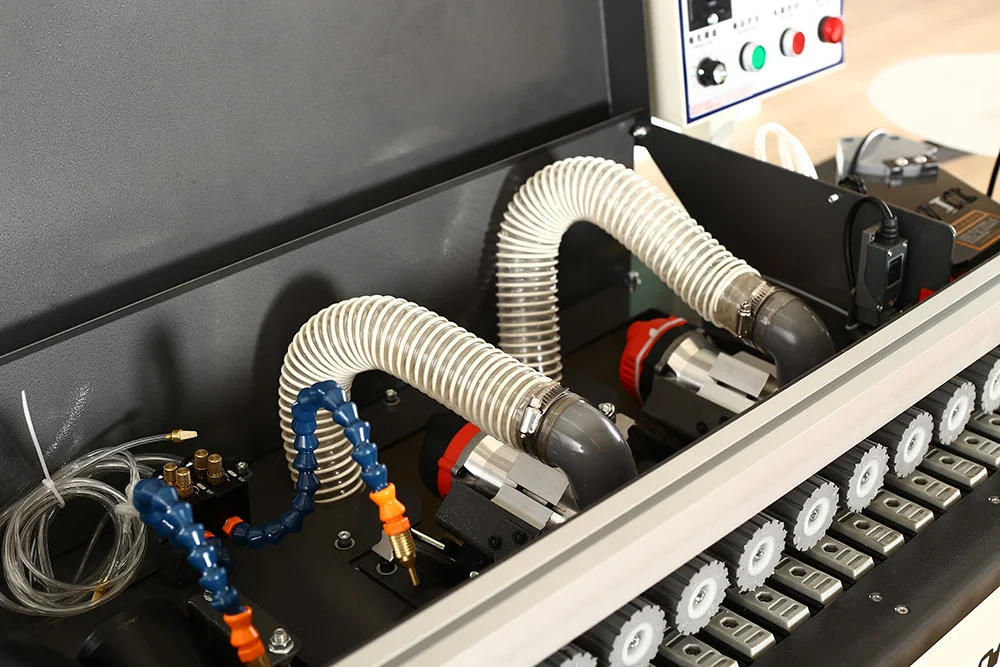
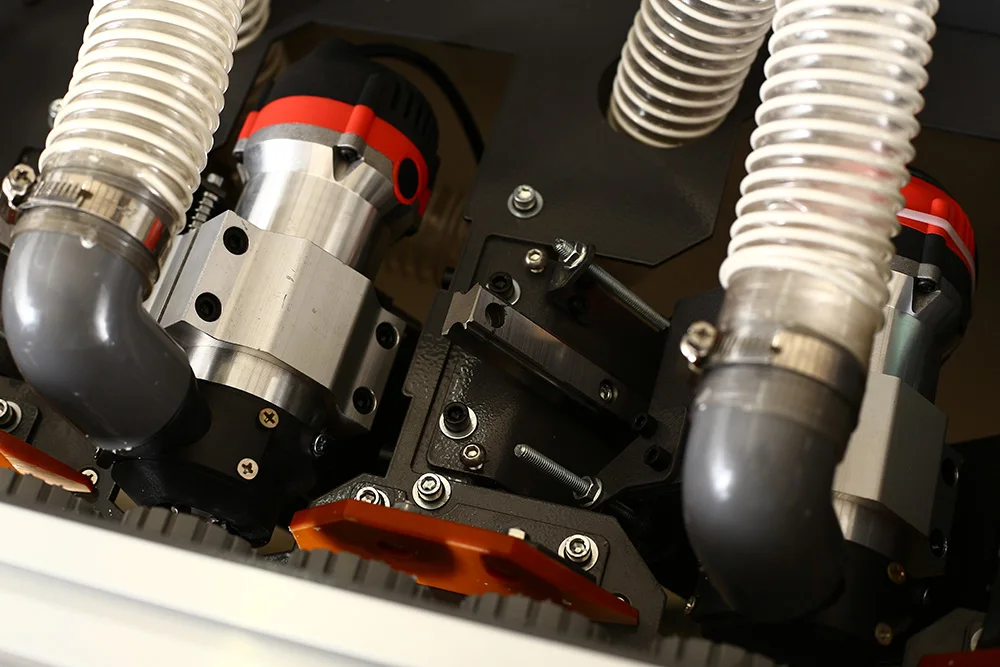
- Two dust collection ports connect to standard 100 mm workshop extraction ducting for PVC and wood particle removal
Requesting a Configuration Proposal
To receive an engineer-prepared quotation for the 910H or to compare it against larger models in the Ruiqi range, provide your panel materials and typical thicknesses, the edge strip types you run most often, your workshop’s available floor space and ceiling height, and your local voltage and frequency standard. If you are planning a phased equipment rollout, include your existing panel saw and boring machine specifications so the proposed edge bander integrates cleanly with upstream and downstream stations.
Frequently Asked Questions
Q: How do I choose between the 910H and larger models in the Ruiqi edge banding range?
A: Selection depends on your panel volume and edge profile mix. The 910H suits workshops processing curved and straight edges at low to medium volume with limited floor space. If your production runs predominantly straight panels at higher throughput, a mid-range or full-function model with pre-milling and additional trimming stations will be more appropriate. Ruiqi’s engineering team provides a configuration comparison based on your daily panel count and edge types.
Q: What voltage and frequency options are available for the 910H?
A: The 910H supports voltage configuration from 110V to 440V with frequency matched to your local grid standard. Voltage and frequency are confirmed during the specification review stage and locked into the order contract before production begins. This prevents the costly commissioning delays that occur when a machine arrives with incompatible electrical specifications for the destination workshop.
Q: Which edge strip materials can the 910H handle compared to larger Ruiqi models?
A: The 910H processes PVC, melamine, and veneer edge strips between 0.5 mm and 2.5 mm thick on panels from 10 mm to 50 mm. Larger models in the range accommodate thicker ABS and solid wood strips and wider panel dimensions. If your product mix includes thick solid wood edging or oversized panels, a higher-tier model will be recommended during the configuration proposal stage.
Q: How does the 910H fit into a phased workshop upgrade toward a full production line?
A: The 910H serves as a first automated edge bander for workshops transitioning from manual processes. As volume grows, you can add a dedicated straight-line edge bander, CNC boring machine, or panel saw from the same Ruiqi family. Shared control logic, compatible feed heights, and unified spare part sourcing across the product range reduce the integration effort at each upgrade step.
Q: What documentation ships with the 910H?
A: Each unit ships with a machine specification sheet, CE declaration of conformity, ISO 9001 certificate, factory test record, operation manual in the agreed language, electrical schematic with confirmed voltage wiring, spare parts list, packing photographs, and customs documentation support. All documents are prepared before dispatch and accompany the machine in the shipping crate.