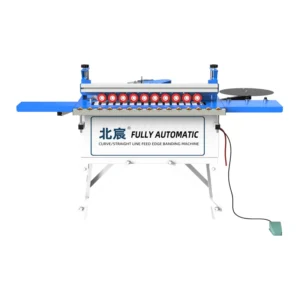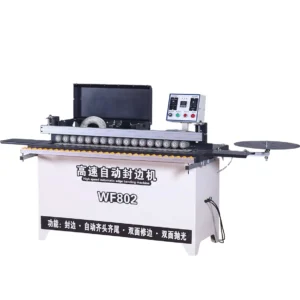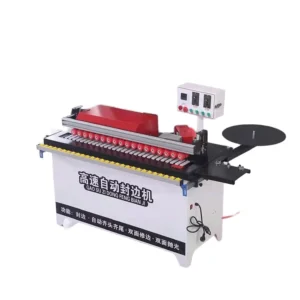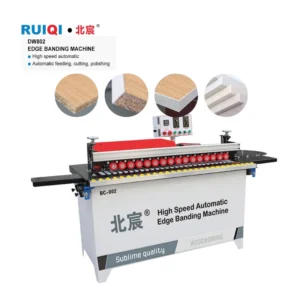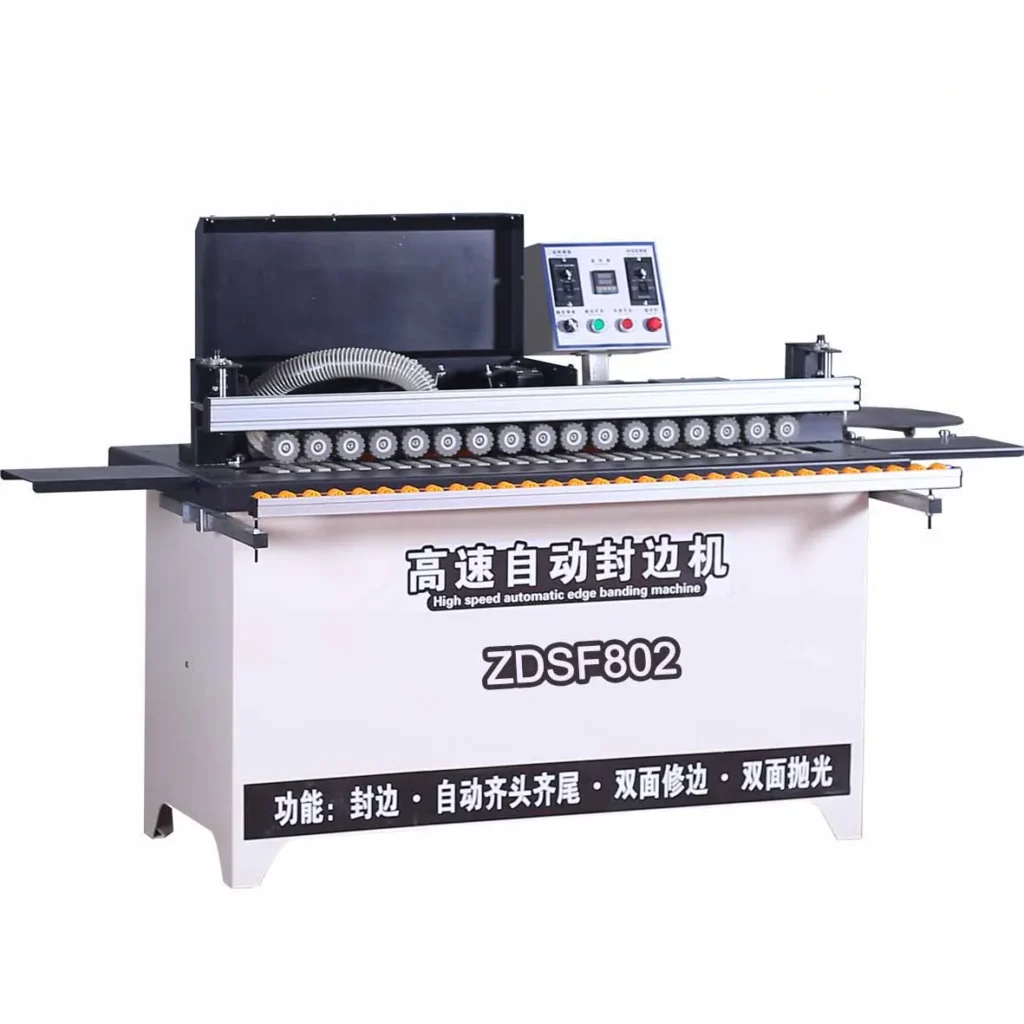

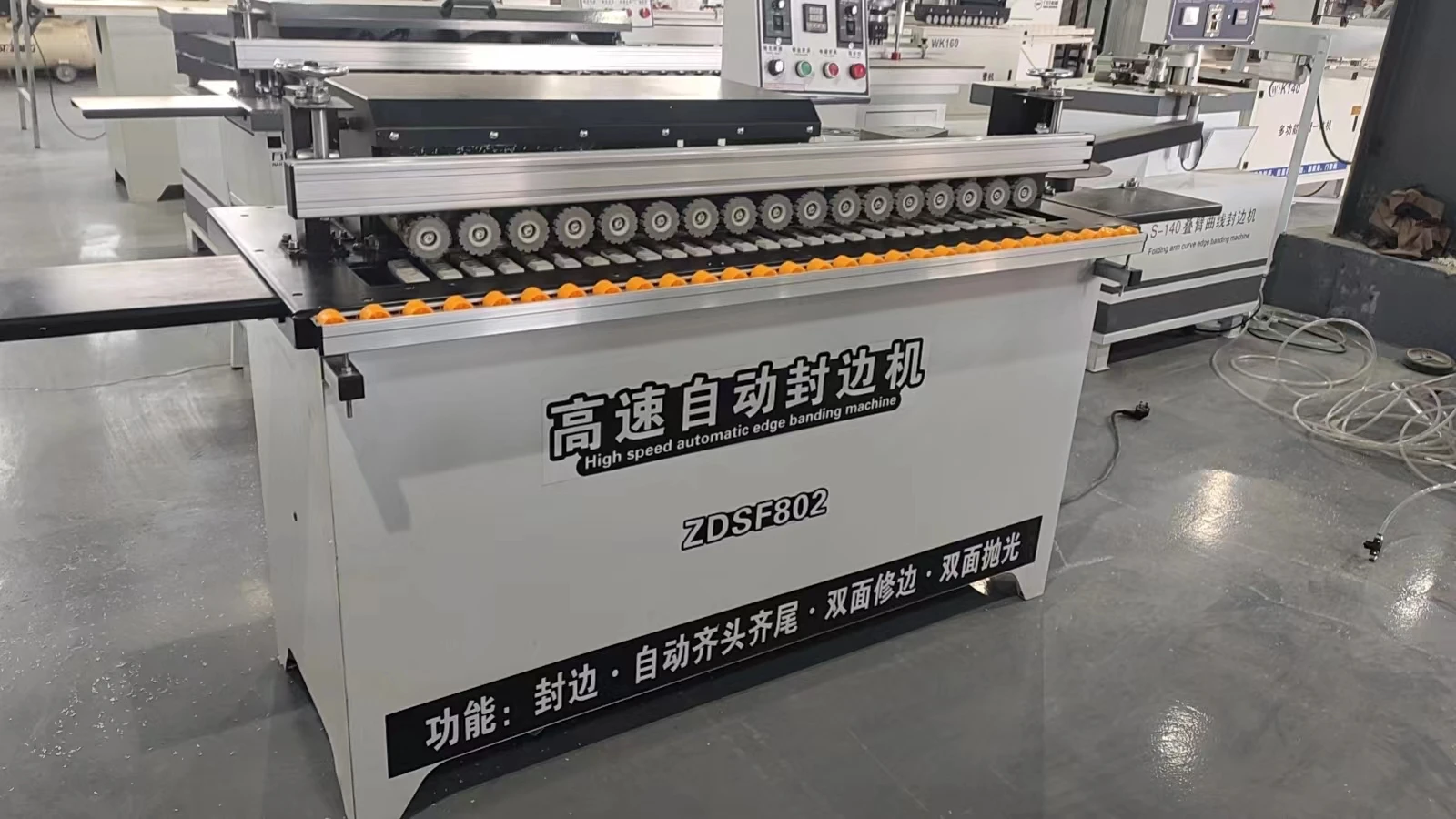
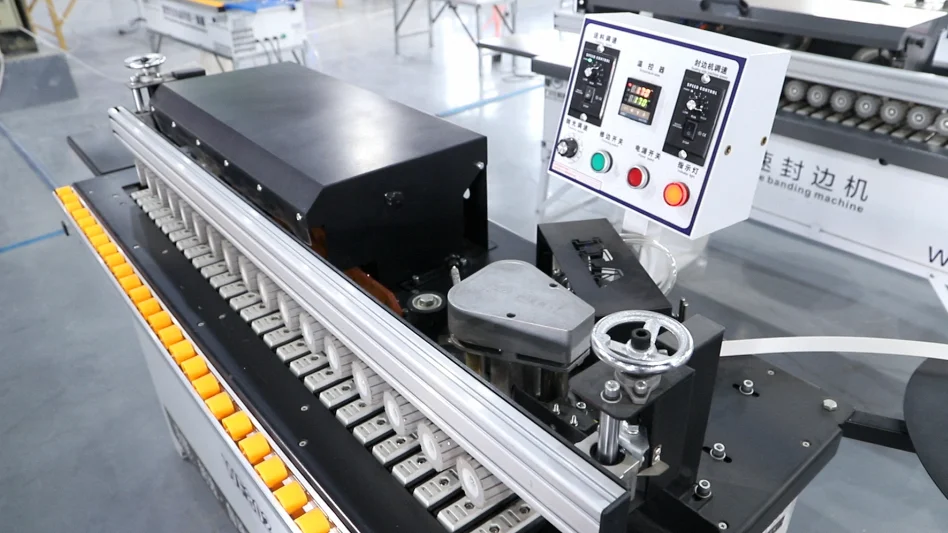
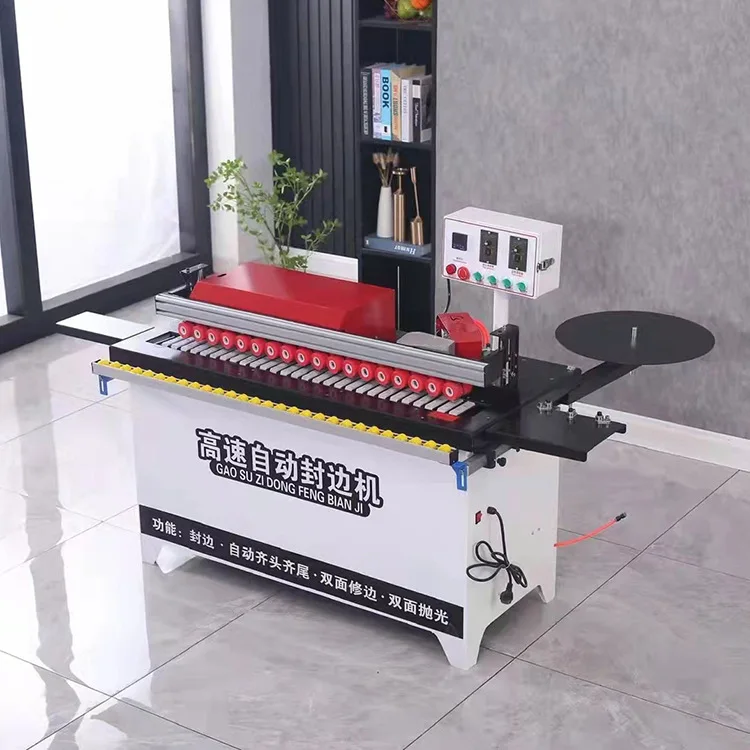

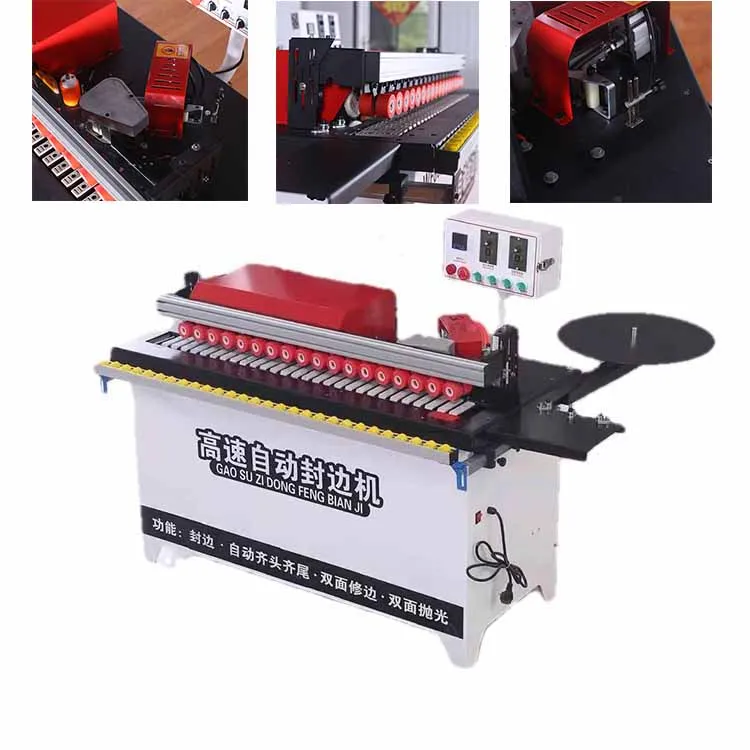
Description
In-House Manufacturing Depth — Every ZDSF802 automatic edge banding machine ships with a factory test record locked to your actual panel substrate and edge strip, not just generic catalog claims.
Technical Specifications
| Parameter | Value |
|---|---|
| Model | ZDSF802 |
| Product Type | Automatic Edge Banding Machine |
| Function | Gluing, End cutting, Trimming, Polishing |
| Edge Type | Straight line |
| Rated Voltage | 220V |
| Rated Power | 4kW |
| Trimming Power | 800W × 2 |
| Polishing Power | 180W × 2 |
| Suction Power | 1200W |
| Heating Power | 1000W |
| Feed Speed | 0–10 m/min |
| Strip Thickness Range | 0.5–2.5 mm |
| Sheet Thickness Range | 10–50 mm |
| Glue Pot Capacity | 4000 ml |
| Air Pressure Requirement | 0.4–0.6 MPa |
| Pressure Beam | One-piece integrated, double rows of pressure wheels |
| Conveyor Belt Material | Silicone |
| Control Panel | Digital display, independent switches |
| Dust Extraction | Built-in vacuum device |
| Machine Weight | 150 kg |
Application Suitability
| Application | Material or Output |
|---|---|
| Cabinet door and carcass edge finishing | MDF and particleboard with PVC edge banding |
| Custom furniture panel production | Plywood and melamine-faced board with 0.5–2.5 mm strips |
| Small-to-medium workshop panel processing | Solid wood panels with veneer edge banding |
| Straight-line edge treatment for shelving | Laminated board with ABS or melamine strips |
Why the Voltage Conversation Must Happen Before the Order
Most edge banding failures on site trace back to a spec mismatch that was never discussed before the machine left the factory.
I once commissioned an automatic edge banding machine at a cabinet plant where the heating element never reached stable glue temperature because the local supply frequency did not match the motor winding configuration. The operator spent two weeks blaming the glue, the strip, and the substrate before anyone checked the nameplate against the panel board [NEED_CITE: voltage and frequency standards by export market]. With the ZDSF802 rated at 220V, confirming your facility’s actual supply — including whether it runs 50 Hz or 60 Hz — avoids discovering the incompatibility after the crate is opened. The manufacturer provides voltage confirmation documentation and electrical schematics before production, so the machine arrives wired correctly for your workshop’s power infrastructure.
Where the ZDSF802 Sits in a Scalable Machine Range
When a workshop surveys the full edge bander catalogue, the ZDSF802 occupies a mid-range position that covers gluing, end cutting, trimming, and polishing in a single pass. Workshops currently running manual or semi-automatic edge banding often move to this configuration as their first fully automatic straight-line station. Because it belongs to a broader product family, a factory that later needs pre-milling or corner rounding can step up within the same supplier ecosystem without requalifying a new vendor.
Matching Feed Speed to Your Panel Mix and Operator Skill
The variable feed speed from 0 to 10 m/min gives operators room to slow down on difficult substrates and accelerate on straightforward PVC runs. Thicker strips in the 2.0–2.5 mm range typically require a reduced feed rate to allow the trimming motors clean contact time, while thinner 0.5 mm veneer strips can run closer to the upper limit without edge chipping [NEED_CITE: edge banding feed rate best practices for veneer vs PVC]. A digital control panel with independent switches means the operator adjusts individual station engagement without stopping the entire line, which matters during changeovers between panel batches with different edge specifications.
Reading the Spec Sheet Against Real Workshop Conditions
The 10–50 mm sheet thickness range covers standard furniture panel dimensions, but the lower limit matters if your workshop processes thin shelving or back panels around 10–12 mm. At these thinner gauges, the one-piece integrated pressure beam with double-row pressure wheels keeps the board flat against the conveyor without localized deflection that causes uneven glue transfer. The 4000 ml glue pot capacity means a continuous run of several hundred linear meters before a refill is needed, which directly affects whether a single-operator workstation can keep up with upstream panel saw output. The silicone conveyor belt surface grips coated and uncoated panels alike without leaving marks on pre-finished melamine faces. Meanwhile, the pneumatically controlled belt breaking mechanism cuts the edge strip cleanly at the panel end without requiring a manual lever pull, reducing operator fatigue over long production runs.
The Hidden Cost of Buying a Single Machine Without Line Context
A recurring problem on furniture factory floors is an edge bander that runs perfectly in isolation but bottlenecks the cell because upstream cutting and downstream boring operate at different throughput levels. When the ZDSF802 runs at its upper feed speed, the trimming and polishing stations must keep pace; if a downstream boring machine accepts panels slower than the bander delivers them, work-in-progress piles up and panels risk edge damage from stacking [NEED_CITE: production line throughput balancing in panel furniture manufacturing]. Evaluating this model means looking at the entire cell — panel saw output rate, edge bander feed capacity, and boring machine cycle time — rather than treating the edge bander as a standalone purchase.
Why Procurement Through This Channel Works
The ZDSF802 is manufactured in-house with proprietary cutting mechanisms and verified tolerance standards, not assembled from third-party sub-contracted modules. Each unit goes through four-stage quality control covering incoming material inspection, in-process checks, finished product testing, and pre-shipment verification against declared specifications. Voltage, control panel language, and mechanical specifications can be confirmed and customized before production begins, rather than discovering a mismatch at commissioning. The full product range — from entry-level manual feed machines to full-function pre-milling configurations — means a distributor or workshop can source multiple tiers from a single supplier with consistent documentation and spare parts compatibility. Engineer-led configuration recommendations arrive with a formal quotation so that technical decisions are recorded before the purchase order is issued.
Documentation & Verification
- CE declaration of conformity covering the ZDSF802 automatic edge banding machine
- Factory test record verifying trimming tolerance on your specified panel thickness range
- Electrical schematic with voltage and frequency confirmation matched to your local supply
- Operation and maintenance manual provided in your operator’s agreed language
- Spare parts list cross-referenced to the ZDSF802 trimming and polishing motor assemblies
Installation, Commissioning & Support
- Requires a dedicated 220V circuit rated for the 4kW total draw plus startup surge
- Pneumatic supply must deliver stable 0.4–0.6 MPa to the belt breaking and pressure systems
- Machine footprint of approximately 190×65 cm allows placement against a workshop wall with rear access clearance
- Glue pot heat-up time of 5–10 minutes should be factored into morning shift startup procedures
- Silicone conveyor belt and pressure wheel alignment verified during on-site commissioning guidance
- Built-in 1200W vacuum device connects to workshop dust extraction or operates with internal collection
What to Prepare Before Requesting a Quotation
Share the specific panel substrates you process — MDF, particleboard, plywood, or solid wood — along with the edge banding strip materials and thicknesses you run most frequently. Confirm your facility voltage and frequency, the language your operators need on the control panel, and whether this machine will feed into an existing line with upstream and downstream equipment already in place.
Frequently Asked Questions
Q: Where does the ZDSF802 sit within the full edge bander range, and which tier should my workshop choose?
A: The ZDSF802 covers gluing, end cutting, trimming, and polishing as a fully automatic straight-line station. It suits workshops moving beyond manual edge banding but not yet requiring pre-milling or corner rounding. If your panels show visible glue lines or edge chipping at higher volumes, stepping up to a full-function pre-milling model in the same product family is the logical next move.
Q: How do I confirm the voltage and frequency match my local power supply before ordering?
A: Provide your facility’s exact voltage and frequency on the inquiry. The manufacturer supplies an electrical schematic and voltage confirmation document before production begins, so the motor windings, heating element, and control transformer are configured correctly for your site before the machine ships.
Q: Can the control panel language be customized to my operator’s language?
A: Yes. The digital display and switch labels can be configured in the language your operators read, preventing commissioning delays caused by unreadable menus. Specify the required language during the inquiry stage so the panel is prepared before assembly.
Q: What panel materials and edge strip types is the ZDSF802 verified to handle?
A: The machine handles MDF, particleboard, plywood, and similar panel substrates with PVC, ABS, melamine, or veneer edge banding strips from 0.5 to 2.5 mm thick. Sheet thickness from 10 to 50 mm covers standard furniture panels as well as thinner shelving stock.
Q: How does feed speed and throughput match with upstream panel saws and downstream boring machines?
A: The 0–10 m/min variable feed speed allows alignment with your existing line speed. Share your panel saw output rate and boring machine cycle time during inquiry so the engineer can confirm whether the ZDSF802 throughput creates a balanced cell or requires buffer staging between stations.