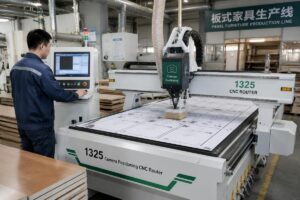
Stop relying on static spec sheets when you compare panel saw suppliers China for wooden window production. True precision depends on dynamic structural rigidity and thermal stability under heavy HDF loads, not just no-load tolerance claims. Verify casting stress-relief processes and demand real-world material tests to prevent costly joint gaps and ensure long-term geometric accuracy.
China Panel Saw Supplier for Wooden Window Mfrs
Precision on a datasheet is meaningless if the frame flexes under the weight of high-density MDF.
To reliably compare panel saw suppliers in China, you must ignore static tolerance claims and instead verify dynamic structural rigidity. The critical differentiator is not the CNC controller’s resolution, but the cast iron frame’s stress-relief process and the spindle bearing’s thermal stability under continuous load with dense materials.
I still remember the silence in the assembly workshop in Dezhou when we realized the test boards were lying to us. We had just finished assembling a sliding table saw destined for a window manufacturer in Saudi Arabia. On paper, the machine was perfect. The digital readout showed a blade tilt accuracy of ±0.1mm. We ran the standard acceptance test using domestic E1 particleboard, a material that is relatively soft and forgiving. The cuts were clean, the edges were square, and the team signed off on the shipment.
Weeks later, the phone rang. It wasn’t a complaint about delivery; it was a crisis about fitment. The client was producing high-end wooden windows using imported high-density fiberboard (HDF) and moisture-resistant MDF. These materials are significantly denser and harder than the particleboard we used for testing. Under the increased resistance of the HDF, the spindle bearings heated up faster than anticipated, causing microscopic thermal expansion. The cast iron frame, which hadn’t undergone a prolonged natural aging process to relieve internal casting stresses, shifted slightly under the vibration of heavy cutting. The result was a consistent gap in the miter joints of the window frames. The entire batch had to be reworked. [NEED_CITE: impact of material density on spindle thermal deformation]
That failure changed how I evaluate machinery. It taught me that when you look for a panel saw supplier in China, you are not buying a spec sheet. You are buying the ability of that machine to maintain its geometry when it is pushed to its limits by your specific raw materials.
Why Standard Spec Sheets Mislead Window Manufacturers?
Most procurement managers start their search by comparing listed tolerances. They see "±0.1mm" from one vendor and "±0.15mm" from another and assume the first is superior. This is a dangerous simplification. Listed accuracy is often measured under no-load conditions or with ideal, low-density test materials. It rarely accounts for the dynamic forces generated during high-volume production of wooden windows.
The core issue is that precision is not a static number; it is a dynamic performance metric. When a saw blade cuts through dense hardwood or high-pressure laminate, the resistance creates lateral force. If the machine’s structure lacks sufficient rigidity, this force causes deflection. The CNC controller might command the blade to move to an exact coordinate, but if the frame flexes, the actual cut will deviate. [NEED_CITE: relationship between structural rigidity and cutting accuracy under load]
Furthermore, thermal expansion plays a silent but destructive role. Spindle bearings generate heat during operation. In cheaper machines, the housing and frame may expand at different rates, altering the perpendicularity of the blade relative to the table. Over an eight-hour shift, this drift can accumulate, leading to noticeable errors in joint tightness. A reliable panel saw supplier in China will provide data on thermal stability, not just cold-start accuracy.
| Performance Indicator | Standard Datasheet Claim | Real-World Production Reality |
|---|---|---|
| Cutting Accuracy | Static ±0.1mm (No-load) | Dynamic variance based on material density and feed rate |
| Frame Stability | Weight-based assessment | Stress-relieved cast iron vs. welded steel construction |
| Bearing Performance | Brand name listing | Thermal rise rate under continuous max load |
| Test Material | Standard Particleboard | Client-specific HDF, MDF, or Hardwood |
When evaluating a panel saw supplier in China, ask for video evidence of the machine cutting your specific material type. If they only show tests with soft pine or light particleboard, the data is irrelevant to your window production needs.
Key Structural Indicators for Long-Term Precision
If accuracy is the goal, structural integrity is the path. Many buyers mistakenly believe that a heavier machine is automatically better. While mass helps dampen vibration, it is not the sole determinant of stability. The design of the rib structure within the cast iron frame matters more than raw weight. An optimized rib structure distributes stress evenly, preventing localized deformation during heavy cuts.
The quality of the casting itself is paramount. High-grade cast iron must undergo a lengthy natural aging process or artificial vibration treatment to relieve internal stresses. Without this step, the frame will continue to settle and shift long after installation, causing precision to drift over time. [NEED_CITE: methods for stress relief in cast iron machine bases]
Another critical component is the spindle assembly. For wooden window manufacturers, who often work with hard woods and composites, the bearing preload and lubrication system are vital. Cheap bearings may perform adequately for short bursts but will fail to maintain precision during continuous operation. Look for suppliers who use branded, high-precision bearings and provide details on the lubrication method. Automatic, timed lubrication systems are far superior to manual grease points for maintaining consistent bearing temperature.
At Ningjin Ruiqi Woodworking Machinery, for instance, the focus is on heavy-duty cast iron frames that have undergone rigorous stress-relief protocols. The core components are machined to tight tolerances using CNC equipment, ensuring that the sliding table guides and spindle housings remain perfectly aligned even after years of use. This approach prioritizes long-term geometric stability over initial cost savings. When you vet a panel saw supplier in China, inquire about their casting source and aging process. A supplier that can explain these details is likely investing in genuine quality.
How to Validate Cutting Performance Before Shipment?
Verifying performance before the machine leaves the factory is the most effective way to avoid costly surprises. Do not accept standard test reports as proof of capability. Instead, require a customized validation test that mimics your actual production environment.
Start by defining the "worst-case" material you will process. If you produce wooden windows, this might be dense oak or high-pressure laminated MDF. Send a sample of this material to the supplier, or agree on a locally sourced equivalent with similar density and hardness. Request a video recording of the machine cutting this material at maximum feed rate. Pay close attention to the sound of the motor and the smoothness of the cut edge. [NEED_CITE: industry standards for full-load testing protocols]
Next, check the main motor power reserve. A machine that struggles with dense materials will experience voltage drops and torque fluctuations, leading to inconsistent cuts. Ensure the motor has sufficient power headroom to handle your hardest materials without bogging down.
Finally, inspect the sliding table guide rail system. Steel rails are common, but high-quality alloy rails with precise lubrication channels offer better long-term wear resistance. Ask the supplier to demonstrate the smoothness of the table movement after several hours of simulated use. A panel saw supplier in China who is confident in their product will welcome these specific requests. They understand that transparency builds trust and reduces the risk of post-installation issues.
Evaluating Supplier’s Technical Support Capability
Buying a machine is only the beginning of the relationship. Technical support becomes critical when precision issues arise. For international buyers, the ability of the supplier to diagnose problems remotely is invaluable. Time zones and language barriers can delay on-site visits, so robust remote diagnostic tools are essential.
Look for suppliers who offer PLC panels with multilingual support and remote access capabilities. This allows their engineers to view error logs and adjust parameters without flying to your factory. Additionally, consider their experience with export voltage adaptation. Machines designed for 380V/50Hz may need significant modifications to operate safely on 440V/60Hz or other local standards. A competent panel saw supplier in China will have a proven track record of adapting electrical systems to meet global requirements. [NEED_CITE: importance of voltage adaptation in exported machinery]
After-sales response time is another key metric. Ask for case studies where the supplier resolved alignment or precision issues for overseas clients. Did they send an engineer immediately, or did they solve it via video call and parameter adjustment? The latter is often faster and more cost-effective for minor adjustments. Suppliers with extensive export experience, such as those serving markets in the Middle East or Southeast Asia, will have refined these processes to minimize downtime for their clients.
Conclusion
True precision is verified under load, not on paper.
Selecting the right panel saw supplier in China requires looking beyond marketing claims to assess structural rigidity, thermal stability, and technical support capabilities. By focusing on dynamic performance and demanding real-world validation tests, wooden window manufacturers can secure machinery that delivers consistent, high-quality results for years to come.
Tags

Written by
author
Editor covering global sourcing, supplier verification, and industrial product knowledge. Content is compiled from manufacturer specifications, industry standards, and hands-on experience with international B2B buyers. Every article is fact-checked before publishing to help procurement professionals make informed decisions.
View all posts