Description
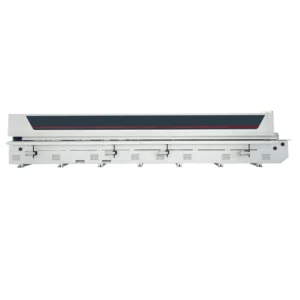
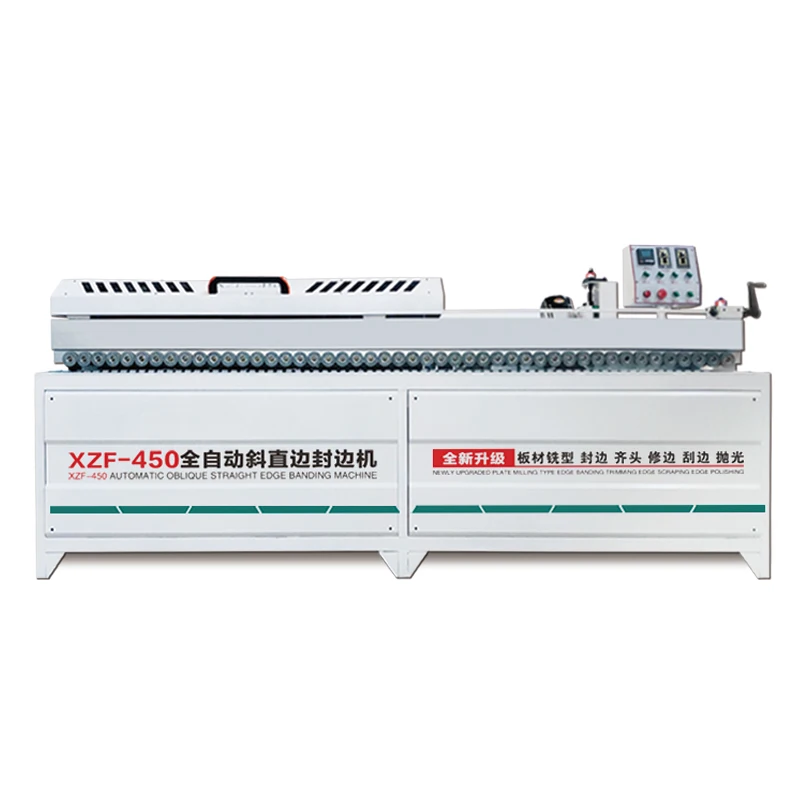
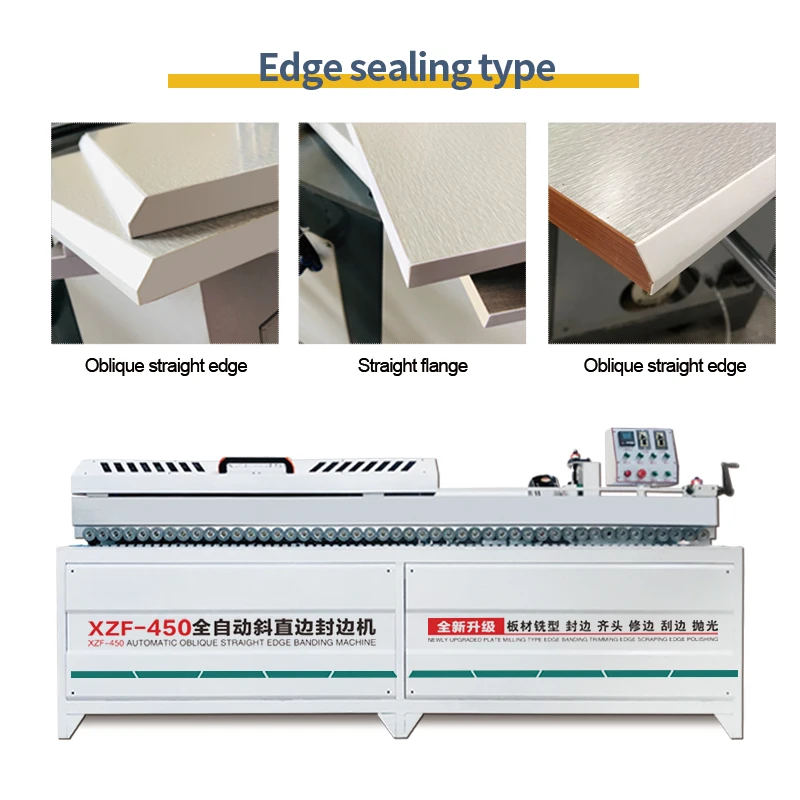
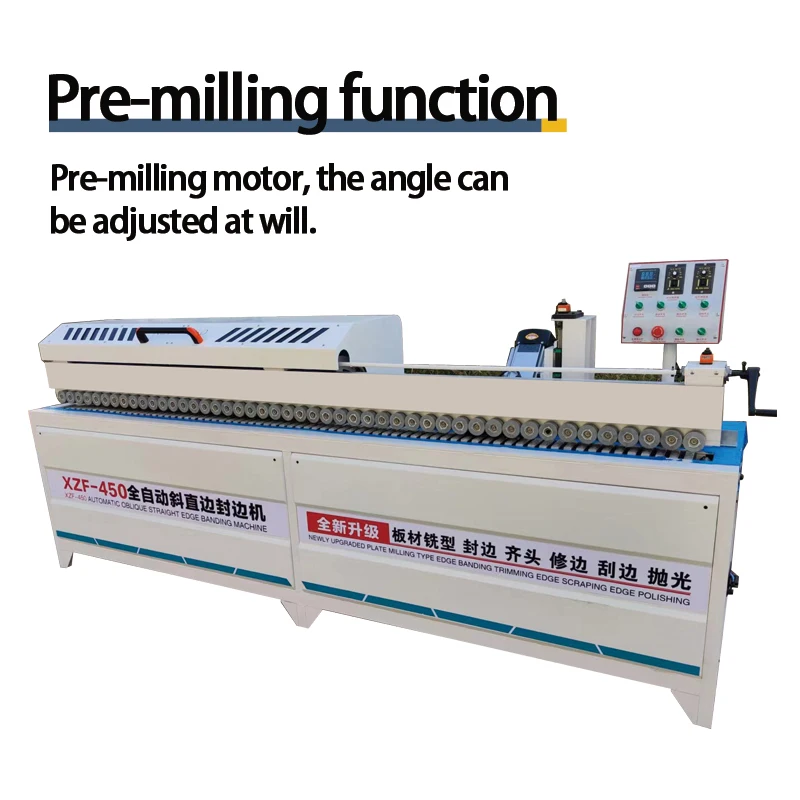
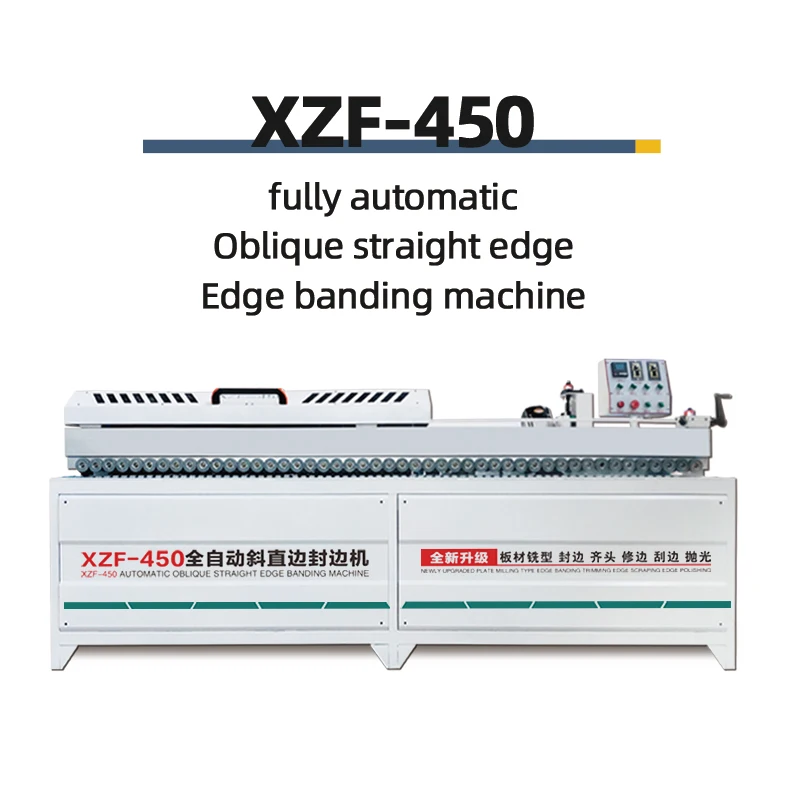
Patented cutting mechanisms — The XZF450 brings a 4KW pre-milling station and seven integrated work functions into a single-pass 45-degree bevel edge banding workflow, addressing substrate variance before the edge is applied.
Technical Specifications
| Parameter | Value |
|---|---|
| Model | XZF-450 |
| Product Type | 45 Degree Bevel Edge Banding Machine |
| Total Power | 9.5 kW |
| Pre-milled Motor | 4 kW |
| Trimming Power | 2.2 kW × 2 |
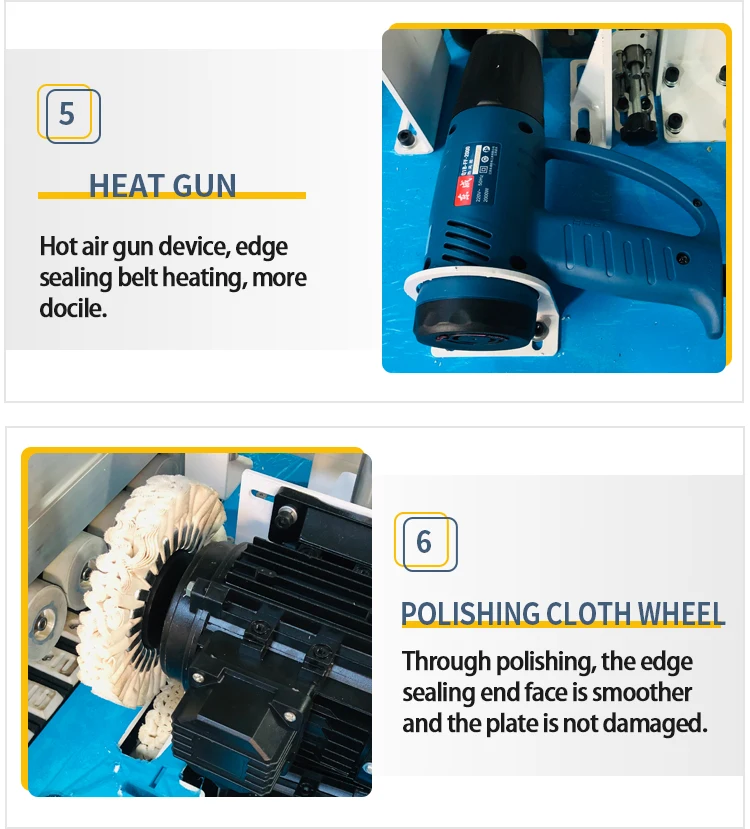
| Polishing Power | 0.4 kW × 2 |
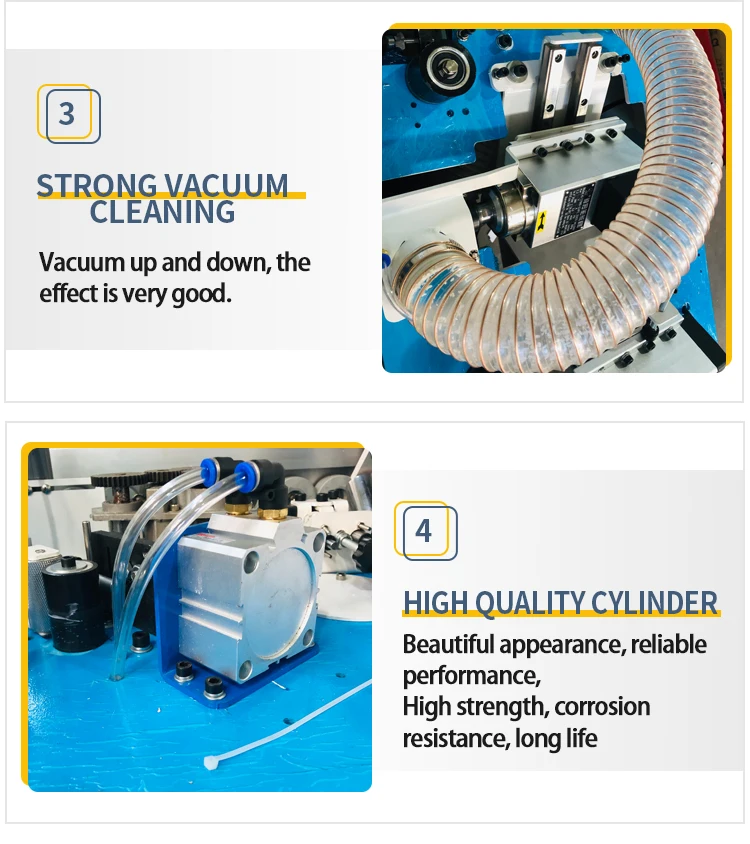
| Vacuum Power | 550 W |
| Transmission Power | 180 W |
| Voltage | 380V / 415V (frequency to be confirmed: 50Hz or 60Hz) |
| Feed Speed | 0–12 m/min |
| Edge Banding Height | 0–50 mm |
| Edge Banding Thickness | 0.3–3 mm |
| Minimum Sheet Length | 30 cm |
| Minimum Sheet Width | 15 cm |
| Glue Pot Capacity | 4000 ml |
| Air Source Pressure | 0.5–0.7 MPa |
| Standard Functions | Plate milling, 30/45/60° bevel banding, trimming, scraping, polishing, high-power vacuuming |
| Overall Dimensions (L×W×H) | 300 × 65 × 135 cm |
| Net Weight | 430 kg |
| Language Options | Chinese, English (customizable to Spanish or other languages) |
| Plug Options | EU, USA, AU, UK |
Application Suitability
| Application | Material or Output |
|---|---|
| Angled-profile cabinet doors | MDF and melamine-faced board with PVC or veneer edge banding |
| Beveled furniture components | Plywood and blockboard up to 50 mm edge height |
| Polymer door edge finishing | Polymer panels with 0.3–3 mm banding thickness |
| Large-format panel processing | Particleboard and solid wood board in cabinet and furniture production |
| Mid-to-high volume workshop lines | Continuous feed at up to 12 m/min across mixed panel substrates |
Why Voltage Confirmation Must Happen Before the Quotation
A machine wired for the wrong frequency will run, but it will not run correctly — and the damage shows up first on the edge.
I once worked with a buyer in the Middle East who tested PVC edge banding on a sample panel and got clean results. When the machine arrived at his workshop and he switched to real veneer stock, the glue temperature curve and feed rate no longer matched the material. Visible glue lines appeared on every panel. The root cause traced back to a voltage and frequency mismatch that shifted motor behavior just enough to throw off the thermal balance in the glue pot [NEED_CITE: voltage and frequency standards by export market]. The XZF450 supports 380V and 415V configurations, but the 50Hz or 60Hz question must be answered before production begins, not after the crate is opened.
When a 45 degree bevel edge banding machine manufacturer ships equipment without locking down local electrical standards, the operator ends up compensating on the shop floor — adjusting feed speed, swapping glue types, reworking panels — all of which erode the throughput advantage the machine was supposed to deliver.
Where the XZF-450 Fits in a Growing Workshop
Workshops that start with straight-edge banding eventually take on projects requiring angled profiles — beveled cabinet doors, decorative furniture fronts, angled shelving units. The XZF-450 occupies the mid-to-upper tier of the Ruiqi catalogue precisely because it handles 30, 45, and 60-degree bevels alongside standard 90-degree work. Rather than adding a second dedicated machine, a production manager can route both profile types through a single unit, simplifying floor layout and operator training.
This matters for buyers surveying the full range before committing to a specific tier. If your current order book is mostly straight-edge work but angled profiles are appearing in inquiries, the XZF-450 provides the bridge without requiring a separate capital line item.
The Seven-Function Sequence and What Each Station Solves
The station sequence — pre-mill, glue application, end trim, rough trim, fine trim, scrape, polish — is not simply a list of features. Each stage addresses a specific failure mode in the edge banding process [NEED_CITE: common edge banding defects in panel furniture manufacturing]. The 4KW pre-milling motor removes surface irregularities from the panel edge before glue contact, which is particularly important when working with particleboard or MDF that may have micro-chipping from upstream saws. Without this step, those irregularities transfer directly into the glue line.
The scraping and polishing stages that close the sequence deal with residual adhesive and surface marks that trimming alone cannot remove. For veneer edge banding, this final pass is what separates a visible glue line from a clean, finished edge that passes inspection without manual touch-up.
Reading the Specs Against Your Production Reality
The 0–12 m/min feed speed range gives operators room to slow down for difficult substrates — solid wood with grain variation, for instance — while maintaining pace on uniform MDF runs. The 4KW pre-milling motor is sized to handle the higher resistance that dense particleboard presents compared to lighter substrates, preventing bog-down at the infeed stage.
Edge banding thickness from 0.3 to 3 mm covers the full spectrum from thin PVC foil through standard ABS up to thicker solid wood strips. The 0–50 mm height range accommodates most cabinet and furniture panel thicknesses encountered in production. The 4000 ml glue pot capacity supports continuous runs without frequent refill interruptions, though actual consumption depends on banding width and glue type selected for the substrate.
Air source pressure at 0.5–0.7 MPa is consistent with standard workshop compressor output, but confirming stable supply at the machine inlet — not just at the compressor gauge — prevents pressure drop issues that manifest as inconsistent trimming force [NEED_CITE: compressed air system sizing for woodworking machinery].
The Cost of Skipping the Configuration Conversation
Buyers who select a machine based on catalogue photos and price alone often discover mismatches only during commissioning. A control panel in a language the operator cannot read stalls the entire startup process while translated documentation is sourced. A plug that does not match local socket standards means the machine sits idle while an electrician sources adapters or rewires the connection.
These are not catastrophic failures, but they consume time and create friction at exactly the moment when a workshop needs the new equipment running [NEED_CITE: machinery commissioning delays and their cost impact]. The XZF-450 is configurable across language, plug type, and voltage — but only if the buyer provides that information before the order enters production.
What Manufacturing Depth Means for This Machine
In-house production with patented cutting mechanisms means the pre-milling station on the XZF-450 is not a sourced component bolted onto a frame — it is designed and built within the same facility that handles assembly and testing. The four-stage quality control process covers incoming material inspection, in-process checks, finished product verification, and pre-shipment testing, so the machine that arrives at your dock has been run under load before crating.
Voltage and language customization are treated as standard configuration steps rather than special requests. The engineering team provides a formal configuration proposal within 24 hours of receiving your production requirements, which means the specification conversation happens early enough to catch mismatches before metal is cut.
Documentation & Verification
- CE declaration of conformity covering the XZF-450 bevel banding configuration
- ISO 9001 certificate tied to the manufacturing facility and quality management system
- Electrical schematic with confirmed voltage and frequency for your local supply
- Factory test record using your specified panel material and edge banding type
- Operation and maintenance manual in your operator’s agreed language
- Spare parts list with part numbers matching the as-built configuration
Installation, Commissioning & Support
- Requires a level concrete floor capable of supporting 430 kg concentrated load across the 300 cm footprint
- Dedicated 380V/415V circuit with appropriate breaker sizing for 9.5 kW total draw
- Compressed air supply at 0.5–0.7 MPa with filtration to protect pneumatic trim and scrape cylinders
- Initial glue pot calibration for your specific adhesive type and edge banding material combination
- Feed speed and trimming pressure setup matched to your primary panel substrate
- Operator training on control panel functions in the configured display language
- Scheduled inspection intervals for trimming blades, scraper blades, and polishing wheels
Starting the Specification Conversation
To move from general inquiry to a firm configuration proposal, the most useful information you can provide up front includes your primary panel substrates and their thickness range, the edge banding materials you run most frequently, and your local voltage and frequency standard. If your workshop already has upstream saws or downstream boring equipment, sharing those models helps the engineering team confirm feed height compatibility and throughput alignment across your line.
Frequently Asked Questions
Q: Where does the XZF-450 sit in the Ruiqi edge banding range?
A: The XZF-450 occupies the mid-to-upper tier, designed for workshops that need multi-angle capability alongside standard straight-edge banding. It includes pre-milling through polishing in one pass. Entry-level models in the range omit the pre-mill station and some trimming stages, while the full-function tier adds additional automation for higher-volume environments.
Q: How does the 45-degree bevel station compare to dedicated 90-degree models?
A: The bevel station handles 30, 45, and 60-degree profiles in addition to standard straight edges, giving a single machine broader profile coverage. Throughput on pure 90-degree work may be slightly lower than a dedicated straight-edge model, but the trade-off is eliminating the need for a second machine when angled profiles enter the order book.
Q: What voltage and plug configurations are available?
A: The XZF-450 supports 380V and 415V supplies with plug options for EU, USA, AU, and UK standards. Frequency must be confirmed as 50Hz or 60Hz based on your local grid. This confirmation happens during the specification stage before production begins, ensuring the motor and control systems match your electrical infrastructure.
Q: Can this machine integrate into a phased production line investment?
A: Yes. The XZF-450 pairs with upstream panel saws and downstream boring or drilling stations. When planning a phased line, confirming feed height and throughput compatibility at the configuration stage ensures each addition slots into the existing workflow without bottlenecks or material handling gaps between stations.
Q: Is a factory visit or sample test available before ordering?
A: Factory visits are welcomed, and sample processing tests can be arranged using your own panel material and edge banding stock. This allows you to verify edge quality, glue line appearance, and trimming accuracy on the substrates you will actually run in production before committing to an order.