Description
Full family scalability — Start with the JL-1 and expand into multi-head boring configurations without re-engineering your factory workflow or changing equipment supplier.
Technical Specifications
| Parameter | Value |
|---|---|
| Model | JL-1 |
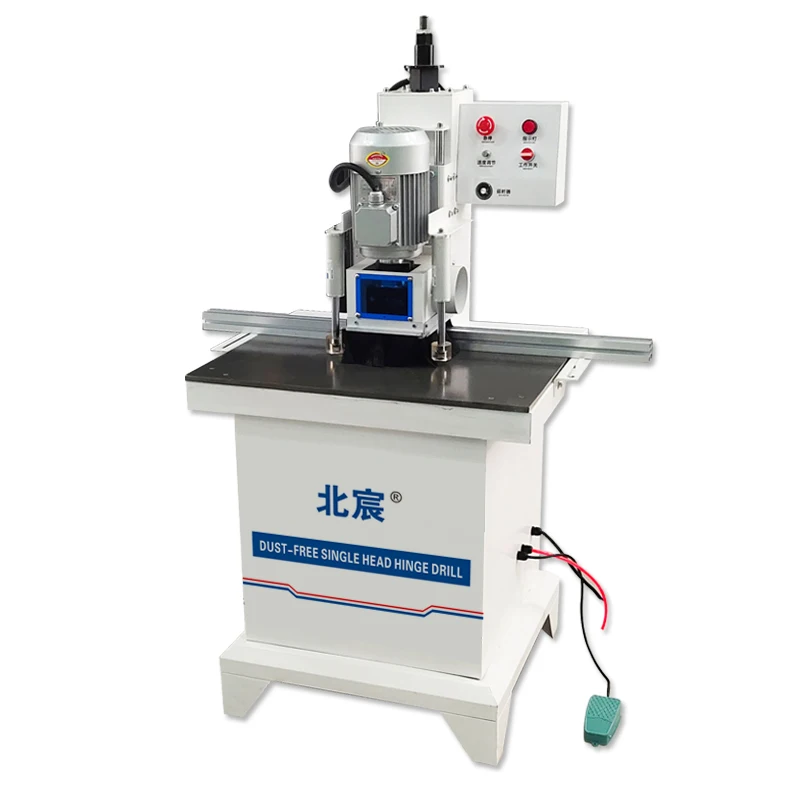
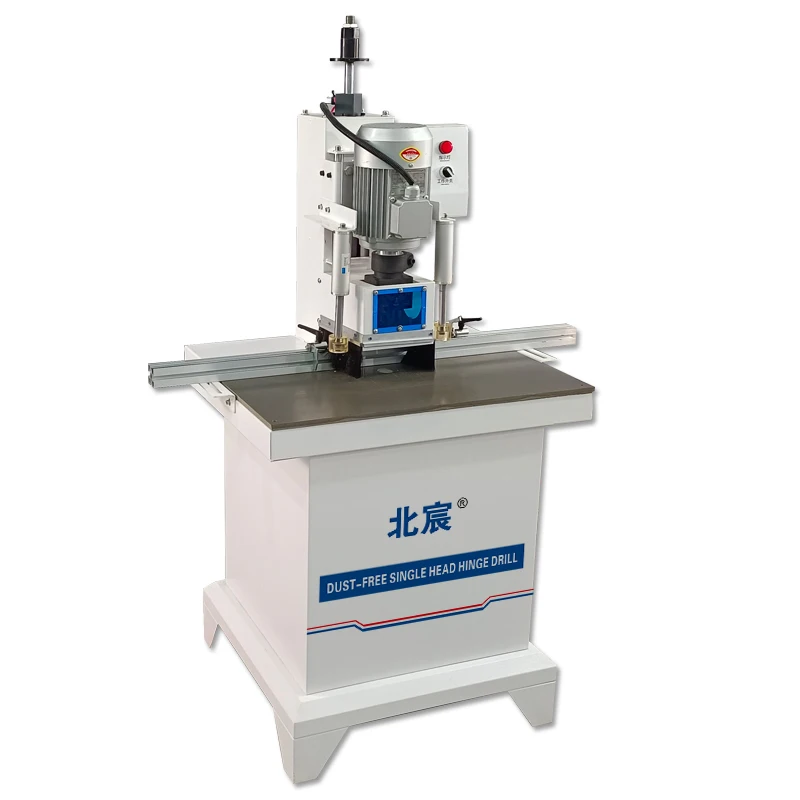
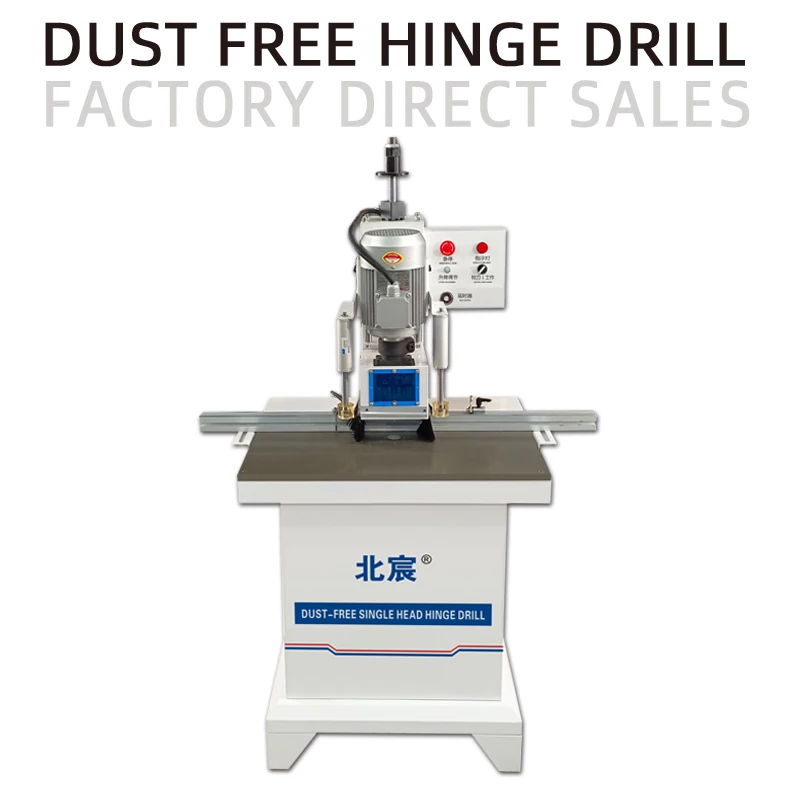
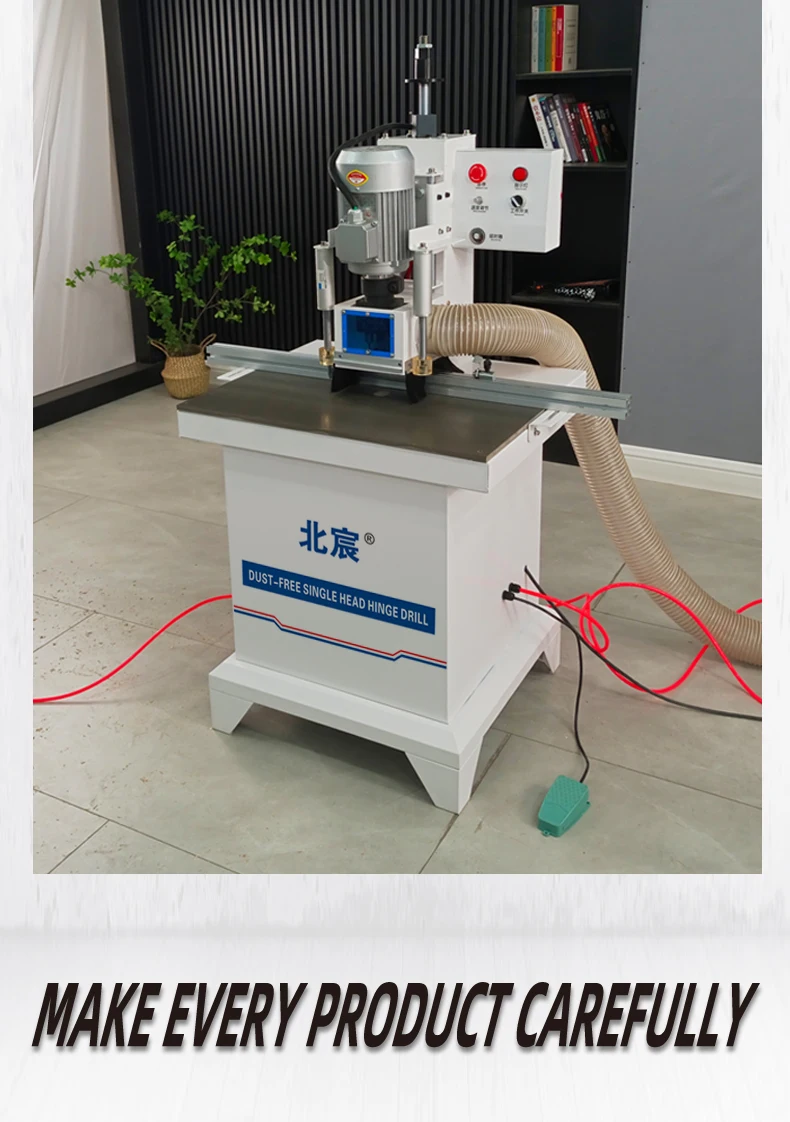
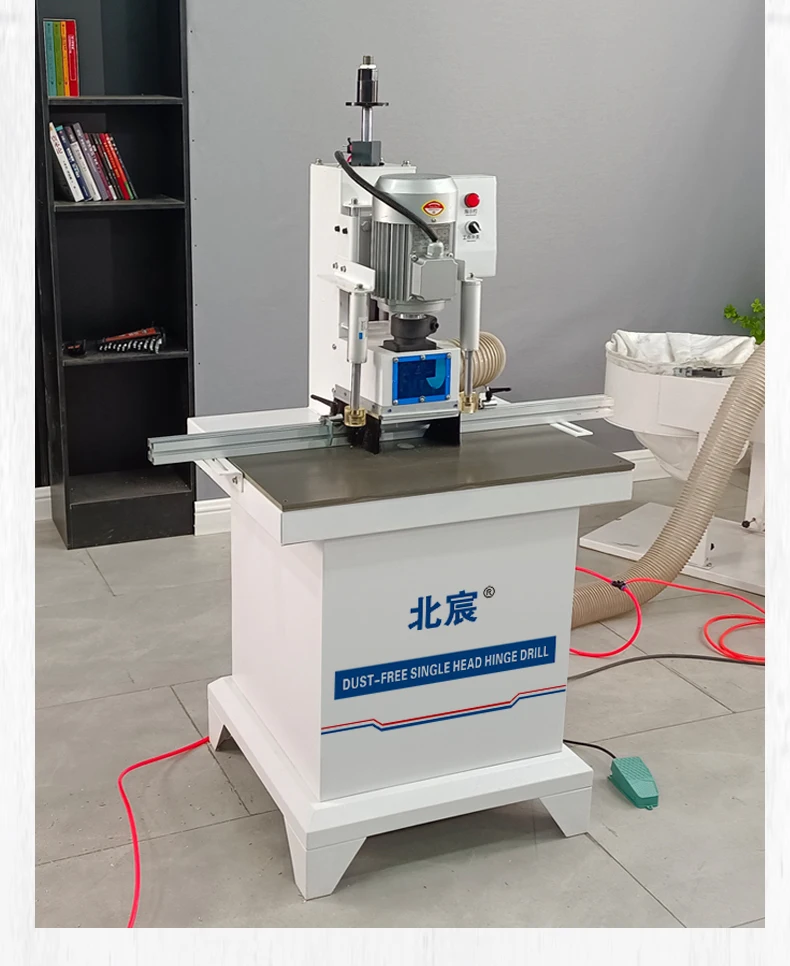
| Product Type | Single Row Hinge Boring Machine |
| Rated Power | 1.5 kW |
| Voltage & Frequency | 380V / 415V three-phase four-wire (frequency configurable) |
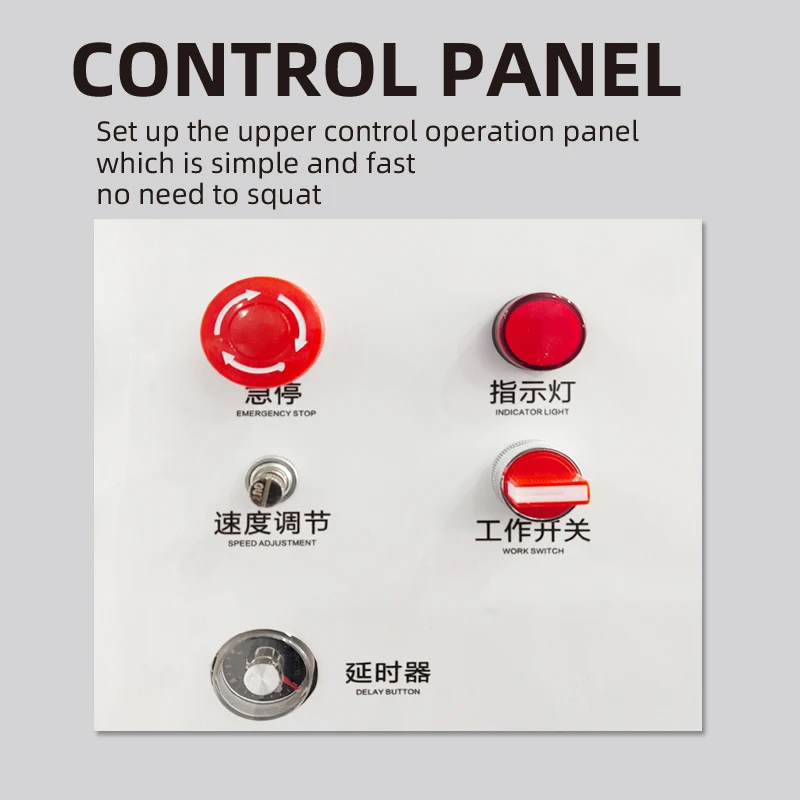
| Control System | Foot switch control |
| Overall Dimensions (L×W×H) | 70 × 56 × 145 cm |
| Net Weight | 55 kg |
| Drill Head Configuration | Large drill 35 mm, small drill 3 mm |
| Drilling Position Adjustment | Vertical and horizontal adjustable |
| Motor Type | Pure copper motor |
| Guide Rail | Precision guide rails |
| Vacuum Connection | External vacuum port |
| Standard Application | Cabinet door hinge hole opening |
| Plug Options | EU, USA, AU, UK |
| Control Panel Language | Chinese and English (other languages customizable) |
Application Suitability
| Application | Material or Output |
|---|---|
| Custom cabinet and wardrobe factories | MDF, particleboard, and plywood panel processing for hinge cup and dowel holes |
| Door industry manufacturing | Solid wood panels and composite door blanks requiring consistent hinge placement |
| Woodworking workshops upgrading from manual fitting | PVC and veneer-faced boards transitioning to machine-assisted drilling |
| Furniture assembly lines | Pre-drilled panels requiring precise 35 mm hinge bore and 3 mm alignment holes |
Why Voltage Verification Matters More Than You Think for a Single Row Hinge Boring Machine Manufacturer
Most electrical incompatibilities are discovered after the machine arrives, not before it ships.
I once watched a cabinet factory lose two full weeks of production because a multi-boring unit arrived wired for 380V when the workshop ran on 415V. The local electrician had to reconfigure the entire distribution board while every upstream panel saw and downstream edge bander sat idle waiting for the drilling station to come online [NEED_CITE: voltage and frequency standards by export market]. With the JL-1, the voltage and plug configuration are confirmed during the quotation stage, not assumed from a catalog default. This is exactly the kind of detail that separates a smooth commissioning from a costly stall on the factory floor.
Where the JL-1 Sits in the Complete Boring Machine Catalogue
The JL-1 single row hinge boring machine manufacturer range is designed so that a workshop can begin with this compact single-row unit and scale into multi-boring stations without changing supplier. Every model in the family shares common interface logic, meaning the drilling techniques and maintenance routines your operators learn on the JL-1 carry directly into higher-throughput configurations.
Scaling Without Rebuilding Your Production Flow
When a custom furniture factory outgrows a single-row borer, the usual problem is not the machine itself but the incompatibility with the next unit they add. Feed heights differ, control languages change, and spare parts come from a completely different supply chain. The JL-1 is positioned as the entry point into a coordinated boring machine family, so your next step up does not require retraining operators or sourcing new tooling [NEED_CITE: CE machinery directive requirements for industrial equipment].
Reading the Specifications That Actually Affect Panel Quality
The 1.5 kW pure copper motor is sized for continuous drilling cycles in MDF and particleboard without thermal drift that would shift bore alignment over a long shift. Precision guide rails govern the slide mechanism, keeping the drill head square to the panel face so that 35 mm hinge cup holes remain concentric even after thousands of cycles. The dual drill head — 35 mm large and 3 mm small — lets you complete both the hinge bore and the dowel alignment hole in a single clamping, eliminating the repositioning error that causes misaligned doors at assembly. Vertical and horizontal adjustment means the operator can shift drilling position across different panel widths without swapping fixtures, which matters when a batch includes both standard cabinet sides and narrow drawer fronts.
The Hidden Cost of Buying Drilling Stations in Isolation
Workshops that source a hinge borer from one supplier and a panel saw from another frequently discover that feed heights and material flow directions do not align. Panels come off the saw and need reorientation before they can enter the borer, adding handling time and introducing edge damage risk. When both machines sit within one coordinated catalogue, these interface mismatches are resolved at the specification stage rather than on the workshop floor [NEED_CITE: common causes of production line downtime in panel furniture manufacturing].
What Manufacturing Depth Means for Your JL-1 Order
In-house manufacturing with patented precision mechanisms ensures the drilling tolerance is built into the machine, not adjusted away during assembly. Four-stage quality control — covering incoming material, in-process checks, finished product inspection, and pre-shipment verification — means every JL-1 is tested against its stated specifications before crating. Voltage, plug type, and control panel language are treated as standard customization points, not special requests that add lead time. Engineer-led configuration recommendations ensure the machine you receive matches your actual workshop voltage and operator language, not a generic export default.
Documentation & Verification
- CE declaration of conformity included with JL-1 shipment documentation package
- Factory test record confirming drilling accuracy on your specified panel thickness before dispatch
- Electrical schematic with voltage and frequency confirmation matching your local supply
- Operation and maintenance manual provided in your operator’s agreed language
- Spare parts list with part numbers for drill bits, guide rail components, and motor brushes
Installation, Commissioning & Support
- Footprint of 70 × 56 cm requires a level concrete pad with clearance for panel infeed and outfeed
- Three-phase 380V/415V dedicated circuit with confirmed plug type before machine dispatch
- Arrives partially assembled; guide rail and drill head alignment verified during factory pre-shipment test
- First commissioning includes drill depth and position calibration on your actual panel stock
- External vacuum port connects to your existing dust extraction system for chip-free hinge boring
- Pure copper motor and precision guide rails follow a scheduled lubrication and inspection cycle
Preparing Your JL-1 Inquiry
To get an accurate configuration recommendation, share your panel material types, the hinge bore patterns you run most frequently, and your local voltage and frequency supply. Let us know the control panel language your operators need and whether this unit will work standalone or integrate into an existing line.
Frequently Asked Questions
Q: How does the JL-1 fit within the broader boring machine range, and what is the upgrade path?
A: The JL-1 is the single-row entry point in a coordinated boring machine family. As production volume grows, you can move to multi-head configurations that share common interfaces, spare parts, and control logic — so operators trained on the JL-1 transition without relearning the equipment.
Q: What voltage and frequency options are available, and how is compatibility confirmed?
A: The JL-1 is configurable for 380V or 415V three-phase supply with EU, USA, AU, or UK plug types. Your local voltage and frequency are confirmed during the quotation stage, and the electrical schematic is included in the shipment documentation for your electrician’s reference.
Q: Can the control panel language and plug type be customized for my market?
A: Yes. Chinese and English are standard, with additional languages available on request. Plug type is matched to your destination market, and the control interface — including the foot switch operation — is verified before dispatch to ensure immediate usability on arrival.
Q: How does this single-row borer integrate with other machines in a cabinet production line?
A: The JL-1 is designed within a full catalogue where feed heights and material flow directions are coordinated across panel saws, edge banders, and boring stations. This prevents the reorientation and handling bottlenecks that occur when machines are sourced from unrelated suppliers.