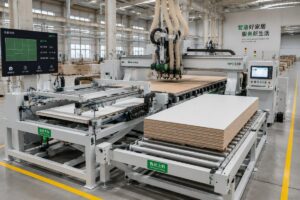
Discover the realistic kitchen cabinet manufacturing line timeline, breaking down the 90 to 150 day delivery window into five critical stages. Learn how custom specifications impact lead times and why rigorous in-house integration testing prevents costly on-site failures for your production launch.
Kitchen Cabinet Manufacturing Line Supplier | OEM Turnkey Factory Direct
Most buyers assume a longer lead time means a safer delivery — the real reason delays happen is insufficient parameter confirmation upfront, not factory backlog.
A complete kitchen cabinet manufacturing line typically takes 90 to 150 days from contract signing to first-panel output, broken into five stages: technical confirmation, production scheduling, in-house integration testing, ocean freight, and on-site installation with trial runs. The single biggest variable is configuration complexity — standard machines move fast, while custom voltage, PLC language, or non-standard dimensions add weeks of rework if not locked early.
I still remember a full kitchen cabinet manufacturing line we shipped to a Middle East client a few years back. The pre-milling unit arrived at their port, got unloaded, wired up, and fired — only to produce edge-broken panels that looked chewed up within the first hour. The spindle runout was out of tolerance. Nobody caught it because the factory-side integration test had been rushed. That client lost weeks of production, and we had to fly an engineer out at a cost that dwarfed any shipping savings. Since then, I have become obsessive about horizontal parameter checks before any kitchen cabinet manufacturing line leaves the floor — spindle speed consistency, feed rate stability, tool holder geometry, and repeat positioning accuracy. If the numbers do not line up, the line does not ship. Period. [NEED_CITE: root cause distribution of panel furniture line installation failures per industry field reports]
Let me walk you through what actually happens between signing a contract and cutting your first cabinet panel — and where the time really goes.
What Is the Realistic Timeline for a Complete Kitchen Cabinet Manufacturing Line?
The entire process splits into five sequential stages, and skipping or compressing any one of them creates downstream bottlenecks that cost far more than the time you think you saved.
| Stage | Typical Duration | Key Activities | Risk if Rushed |
|---|---|---|---|
| Technical Confirmation | Noticeably short to moderate | Spec lock, voltage/PLC language, layout review | Rework at port |
| Production Scheduling | Moderate | Material procurement, machining, assembly | Component mismatch |
| In-House Integration Testing | Noticeably long | Full-line dry run, parameter verification, first-panel test | Undetected defects |
| Ocean Freight & Customs | Moderate | Crating, loading, transit, clearance | Documentation gaps |
| On-Site Installation & Trial | Noticeably long | Wiring, leveling, calibration, production ramp-up | Extended downtime |
The in-house integration testing stage is where most timelines quietly expand. A standard kitchen cabinet manufacturing line with matched configurations can move through production and testing relatively quickly. But the moment you introduce custom voltage adaptation — say, a non-standard frequency for a specific African grid — or require a PLC interface in a less common language, the production scheduling stage stretches noticeably. [NEED_CITE: typical lead time variance between standard and custom-configured woodworking machinery per trade association guidelines]
I worked with a startup cabinet workshop in West Africa ordering their very first kitchen cabinet manufacturing line. They chose a fully standard configuration: matched voltage, English-language PLC, off-the-shelf table dimensions. The line moved through production and testing without a hitch, and they were cutting panels within a reasonable window after arrival. Contrast that with a neighboring buyer who wanted the same line but with a localized voltage transformer package and a French-language HMI — that order took noticeably longer to clear the production floor because every electrical sub-assembly had to be re-verified against the custom spec.
The takeaway is straightforward: if your kitchen cabinet manufacturing line specification is standard, expect the faster end of the delivery window. If you need custom adaptations, build that extra time into your production planning from day one — not after the contract is signed.
Which Stage Takes the Longest and Why?
In-house integration testing and pre-shipment verification consistently consume more time than buyers expect, yet this is the exact stage that determines whether your line runs on day one or week three after arrival.
Here is what a proper integration test on a kitchen cabinet manufacturing line actually involves. The edge bander runs through a full cycle: pre-milling, gluing, end trimming, edge trimming, buffing — at production feed rates, not slow-motion debug speeds. The CNC nesting center cuts a batch of cabinet carcass panels, and the multi-boring machine drills the hinge and shelf pin holes on those same panels. Then the assembled components are checked for fit. If the boring pattern is off by even a fraction, the hinges will not seat, and the entire cabinet box fails assembly. [NEED_CITE: integration testing protocol for panel furniture production lines per ISO woodworking machinery standards]
This stage is long because it is not a single-machine check — it is a system-level verification. Every transfer point between machines must be validated. Every parameter must be logged. And if any single unit in the kitchen cabinet manufacturing line fails its check, the entire sequence restarts until the root cause is found and corrected.
A distributor in Southeast Asia once ordered a mixed-container kitchen cabinet manufacturing line — edge bander, panel saw, CNC router, and multi-borer all in one shipment. The factory completed individual machine tests quickly, but the integration test revealed a feed height mismatch between the panel saw output table and the edge bander infeed. That mismatch would have caused panel jamming at production speed. Catching it on the factory floor meant a few extra days of adjustment. Missing it would have meant on-site modification at the customer’s facility, where tooling and spare parts are limited.
The lesson: when a kitchen cabinet manufacturing line supplier tells you the testing phase is taking longer than expected, that is usually a good sign — it means they are actually running the line as a system, not just powering each machine on individually.
How Do Custom Specifications Affect Delivery Time?
Custom voltage, PLC language, and non-standard work dimensions are the three most common factors that extend production timelines, and each one introduces verification steps that simply cannot be skipped.
| Custom Factor | Impact on Timeline | Verification Required |
|---|---|---|
| Non-standard voltage/frequency | Noticeably extended | Full electrical sub-assembly burn-in test |
| Non-standard PLC/HMI language | Noticeably extended | Software localization and functional test |
| Non-standard table/work dimensions | Moderately extended | Mechanical fit check and clearance verification |
| Standard configuration | Baseline | Standard production protocol |
Voltage adaptation is the most impactful. A kitchen cabinet manufacturing line built for a standard industrial voltage can be assembled and tested using the factory’s existing power infrastructure. When the target market requires a different voltage or frequency, every motor, every inverter, every solenoid valve must be matched, and the entire electrical cabinet must undergo a dedicated burn-in cycle to confirm thermal stability under the target specification. [NEED_CITE: electrical compliance testing requirements for woodworking machinery exported to non-standard voltage regions]
PLC language customization sounds simple — just swap the text strings — but it involves re-flashing the HMI, re-testing every alarm message, and confirming that all safety interlocks still display and function correctly in the target language. A mislabeled emergency stop message in the wrong language is not a cosmetic issue; it is a safety liability.
I have seen buyers who assumed these customizations would add only a few days. In reality, each one layers verification steps onto the production schedule. A kitchen cabinet manufacturing line with three custom factors stacked together can take substantially longer than the same line in standard configuration — not because the machines are harder to build, but because every deviation from standard requires its own validation loop.
The practical advice: lock every custom specification in writing before production scheduling begins. Changes requested mid-production reset the verification clock, and that is where the most frustrating delays originate.
What Happens When Pre-Shipment Testing Is Skipped?
Skipping or shortening the factory integration test is the single most expensive shortcut a buyer can make — the cost always shows up at the customer’s facility, where it is multiplied by travel expenses, production downtime, and reputational damage.
Let me go back to that Middle East project I mentioned earlier. The kitchen cabinet manufacturing line included a pre-milling unit on the edge bander — a critical station that trims the panel edge to a precise, clean surface before the glue is applied. During the rushed factory test, the spindle runout was never measured with a dial indicator at operating speed. It looked fine at low speed. It looked fine visually. But once the line was installed at the customer’s site and pushed to production feed rates, the spindle vibration tore the melamine coating off the panel edges. The result was unusable inventory and a production line that sat idle while we arranged an emergency engineer visit.
That single oversight — failing to verify spindle runout under real operating conditions — cost the client weeks of lost output and cost the supplier a mid-five-figure sum in travel, replacement parts, and reputational repair. [NEED_CITE: field failure analysis of edge banding spindle defects in imported woodworking machinery]
This is not an isolated case. Any kitchen cabinet manufacturing line that ships without a documented, parameter-logged integration test is a line that arrives with unknown variables. The CNC router may cut accurately at slow jog speed but drift at production rapids. The multi-boring machine may hold position on the first panel but shift thermally after an hour of continuous operation. These are not theoretical risks — they are routine findings when proper testing is skipped.
A reliable kitchen cabinet manufacturing line supplier will provide a test report with actual measured values — spindle runout, repeat positioning accuracy, edge trimming consistency — not just a checklist with tick marks. If the report does not include numbers, the test did not really happen.
How to Plan Your Timeline to Avoid Production Gaps?
The most effective way to compress your total timeline is not to rush the factory — it is to front-load every decision, every specification, and every verification milestone so that production and logistics flow without interruption.
Start by working backward from your target first-panel date. If you need the kitchen cabinet manufacturing line running by a specific month, count backward through installation time, ocean transit, production, and testing. That gives you the latest possible contract signing date — and it usually lands earlier than buyers expect.
Next, lock every technical specification before the contract is finalized. Voltage, frequency, PLC language, table dimensions, dust collection port sizes, conveyor height — every single parameter. A kitchen cabinet manufacturing line with a complete, frozen specification sheet moves through production predictably. One with open questions at the time of order will encounter delays at every stage where a decision was pending.
Then, schedule your factory acceptance test. Travel to the production facility or hire a third-party inspector to witness the full integration run. Watch the edge bander process panels at production speed. Watch the CNC router cut a nesting file. Watch the multi-borer drill a batch of cabinet components. Verify that the assembled cabinets fit together. [NEED_CITE: factory acceptance test best practices for imported panel furniture production lines]
Finally, prepare your site before the line arrives. Floor leveling, power supply confirmation, compressed air capacity, dust collection ducting — these are all tasks that can be completed during the production and shipping phases. A kitchen cabinet manufacturing line that arrives at a prepared site can begin installation immediately. One that arrives at an unprepared site will sit in crates while the facility catches up.
The buyers who get their lines running fastest are not the ones who demanded the shortest factory lead time. They are the ones who made every decision early, verified every parameter before shipping, and prepared their facility in parallel with production.
Conclusion
A kitchen cabinet manufacturing line delivery is a multi-stage engineering process, not a simple purchase-and-wait transaction — and the timeline is controlled by how thoroughly specifications are locked and verified before production begins. Standard configurations move faster; custom adaptations require layered validation; and skipping factory integration testing guarantees that problems will surface at the most expensive possible moment. Plan backward from your production target, freeze every parameter upfront, and insist on documented test results — and your line will cut its first cabinet panel on schedule.
Tags

Written by
author
Editor covering global sourcing, supplier verification, and industrial product knowledge. Content is compiled from manufacturer specifications, industry standards, and hands-on experience with international B2B buyers. Every article is fact-checked before publishing to help procurement professionals make informed decisions.
View all posts