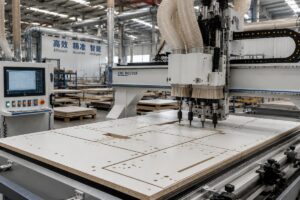
Selecting a reliable solid wood finger joint machine for kitchen cabinets requires prioritizing structural rigidity and CNC precision over raw throughput. Discover why dedicated machines ensure ±0.1mm accuracy, how to validate frame specifications, and strategies to avoid costly assembly gaps in your custom cabinet nesting line.
Wood Door Solid Wood Finger Joint Machine for Custom Cabinet Nesting Manufacturer
Higher feed speed does not equal higher efficiency in solid wood joinery.
To select a reliable solid wood finger joint machine for kitchen cabinets, prioritize structural rigidity and CNC precision over raw throughput. The core requirement is a dedicated machine capable of maintaining ±0.1mm accuracy under load, ensuring seamless assembly in custom cabinet nesting lines without the gap issues common in general-purpose routers.
I still remember the silence in a workshop in Binh Duong last year. It wasn’t the quiet of productivity, but the heavy stillness of a production line that had just ground to a halt. A local manufacturer had invested in a five-axis machining center from a small supplier, betting on its high-speed claims. The result was a batch of solid wood door panels where the finger joints were so misaligned that you could slide a business card into the gaps. Two truckloads of waste later, the owner realized that speed means nothing if the foundation shakes. That incident reshaped how I evaluate equipment. It is not about how fast the cutter moves, but how stable the frame remains when it does. [NEED_CITE: impact of vibration on CNC machining accuracy]
This guide breaks down the technical realities of sourcing these machines, moving beyond marketing brochures to the mechanical truths that determine whether your custom cabinet line succeeds or fails.
Why Do Standard CNC Routers Fail at Precision Finger Jointing?
General-purpose CNC routers lack the specific structural rigidity required for high-torque tenoning operations.
Many buyers assume that a multi-function CNC router can handle all tasks, including finger jointing. This is a costly misconception. While routers are excellent for contouring and drilling, they often fail when subjected to the lateral forces generated during solid wood tenoning. The difference lies in the machine’s design intent. A dedicated solid wood finger joint machine for kitchen cabinets is built with a heavier cast iron frame specifically to dampen vibrations that cause tool deflection. [NEED_CITE: mechanical rigidity requirements for woodworking tenoning]
When a standard router attempts to cut deep finger joints, the spindle may experience slight runout due to insufficient bearing support or frame flex. In panel processing, this might be negligible. In solid wood joinery, it results in visible gaps. These gaps compromise the structural integrity of the cabinet and require extensive manual filling, destroying the efficiency gains of automation.
| Feature | General CNC Router | Dedicated Finger Joint Machine |
|---|---|---|
| Frame Construction | Welded Steel | Heavy Cast Iron |
| Vibration Damping | Basic | High |
| Spindle Rigidity | Standard | Reinforced for Lateral Load |
| Joint Accuracy | Variable | Consistent ±0.1mm |
| Suitability for Solid Wood | Low | High |
The table above illustrates why specialization matters. The cast iron frame of a dedicated machine absorbs the shock of cutting dense hardwoods, ensuring that the tool path remains true. For a custom cabinet nesting line, this consistency is non-negotiable. Without it, the downstream assembly process becomes a bottleneck of manual correction rather than a streamlined flow.
Key Specifications to Validate Before Signing the PO
Focus on frame weight, spindle power, and software compatibility rather than maximum feed rate.
When evaluating a solid wood finger joint machine for kitchen cabinets, the specification sheet can be misleading. High feed rates are often highlighted as a key selling point, but for solid wood, stability is more critical than speed. The glue curing time and the need for precise fitment mean that rushing the cut often leads to rework. [NEED_CITE: optimal feed rates for solid wood finger jointing]
Buyers should verify the weight of the cast iron frame. A heavier frame indicates better vibration damping, which is essential for maintaining precision over long production runs. Additionally, check the spindle power and tool holder compatibility. Systems using HSK or BT tool holders generally offer better rigidity than proprietary systems, ensuring that the cutting tools remain secure under high torque.
Another critical factor is the PLC interface. For factories in emerging markets, language support and remote diagnostic capabilities are vital. A machine that can communicate error codes clearly and allow for remote troubleshooting reduces downtime significantly. This is particularly important for manufacturers who may not have immediate access to specialized service technicians.
| Specification | What to Look For | Why It Matters |
|---|---|---|
| Frame Material | Heavy Cast Iron | Reduces vibration, ensures accuracy |
| Tool Holder | HSK/BT Standard | Better rigidity and tool security |
| PLC Interface | Multilingual Support | Easier operation and troubleshooting |
| Pre-shipment Testing | 100% Full Load Test | Verifies performance before delivery |
| Certification | CE/ISO 9001 | Ensures compliance with safety standards |
These specifications form the backbone of a reliable machine. Ignoring them in favor of lower upfront costs often leads to higher long-term expenses due to maintenance and waste.
How to Vet Suppliers: Beyond the Price Tag
Look for in-house R&D teams, patent holdings, and rigorous testing protocols.
The market is flooded with suppliers offering similar-looking machines at vastly different price points. The difference often lies in what happens behind the factory doors. A reputable manufacturer will have an in-house R&D team capable of customizing solutions for specific production needs. This is not just about branding; it is about engineering depth. [NEED_CITE: importance of R&D in woodworking machinery manufacturing]
For instance, a manufacturer with a large engineering team can adapt voltage requirements and control languages for different regions, ensuring that the machine integrates smoothly into local infrastructure. They will also hold patents for specific design improvements, indicating a commitment to innovation rather than just replication.
Pre-shipment testing is another critical indicator of quality. Reliable suppliers conduct 100% testing on every unit before it leaves the factory. This includes running the machine under full load to verify that all components function correctly. This step prevents the arrival of defective units and reduces the risk of production delays.
A case in point involves an export-oriented manufacturer who switched suppliers after receiving a batch of machines with inconsistent performance. The new supplier, with a strong R&D background, provided detailed test reports and allowed for video inspection before shipment. This transparency built trust and ensured that the machines met the required standards upon arrival.
Integrating Finger Jointing into Your Custom Cabinet Line
Sync finger jointing with edge banding and boring machines for a turnkey solution.
A solid wood finger joint machine for kitchen cabinets should not operate in isolation. It is part of a larger ecosystem that includes edge banders, boring machines, and CNC nesting centers. The key to efficiency is synchronization. Data must flow seamlessly between machines to ensure that each component is processed according to the same digital blueprint. [NEED_CITE: integration of woodworking machinery in automated production lines]
For small workshops upgrading to semi-automatic lines, the focus should be on entry-level models that offer high stability. Even if the speed is moderate, the reduction in waste and rework can lead to a significant return on investment within a short period. The goal is to eliminate the variability of manual work while keeping the initial investment manageable.
Mid-scale factories adding a solid wood door line need to consider machines with five-axis capability and automatic tool changers. These features allow for greater flexibility in handling complex designs and reduce setup time. The lead time for such customized equipment may be longer, but the payoff in production capacity is substantial.
Export-oriented manufacturers must stress the importance of certification and documentation. Machines that meet international standards like CE and ISO 9001 are easier to clear through customs and install in foreign facilities. This compliance also assures buyers of the machine’s safety and reliability.
Conclusion
Precision beats speed in solid wood joinery.
Selecting the right equipment requires a shift in mindset from chasing raw throughput to valuing structural integrity and consistency. By focusing on frame rigidity, verifying supplier credibility through testing protocols, and ensuring seamless line integration, manufacturers can avoid the costly pitfalls of poor joinery. A well-chosen solid wood finger joint machine for kitchen cabinets becomes the backbone of a profitable and efficient production line.
Tags

Written by
author
Editor covering global sourcing, supplier verification, and industrial product knowledge. Content is compiled from manufacturer specifications, industry standards, and hands-on experience with international B2B buyers. Every article is fact-checked before publishing to help procurement professionals make informed decisions.
View all posts