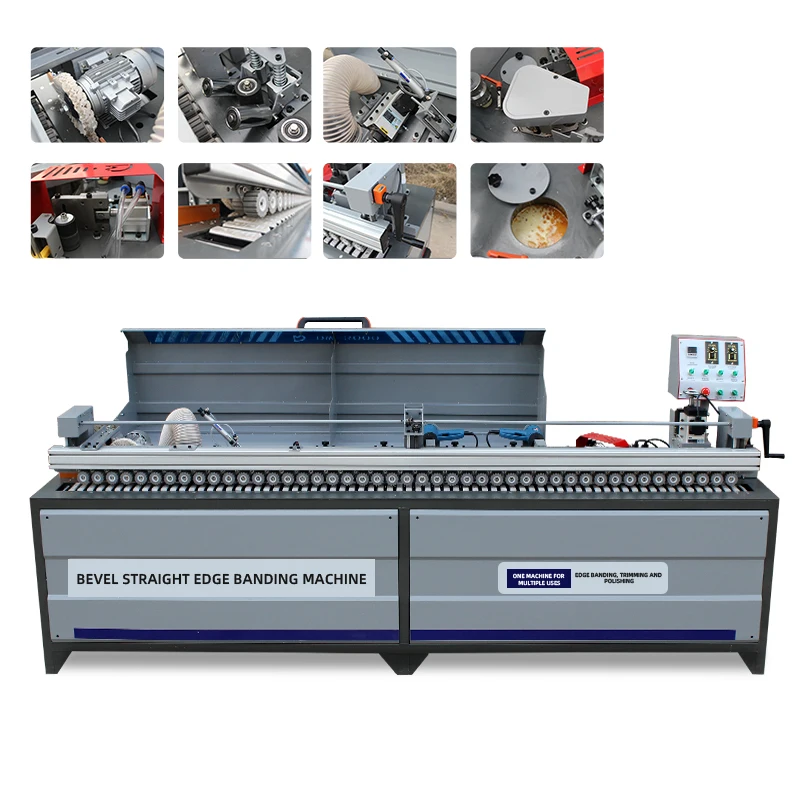
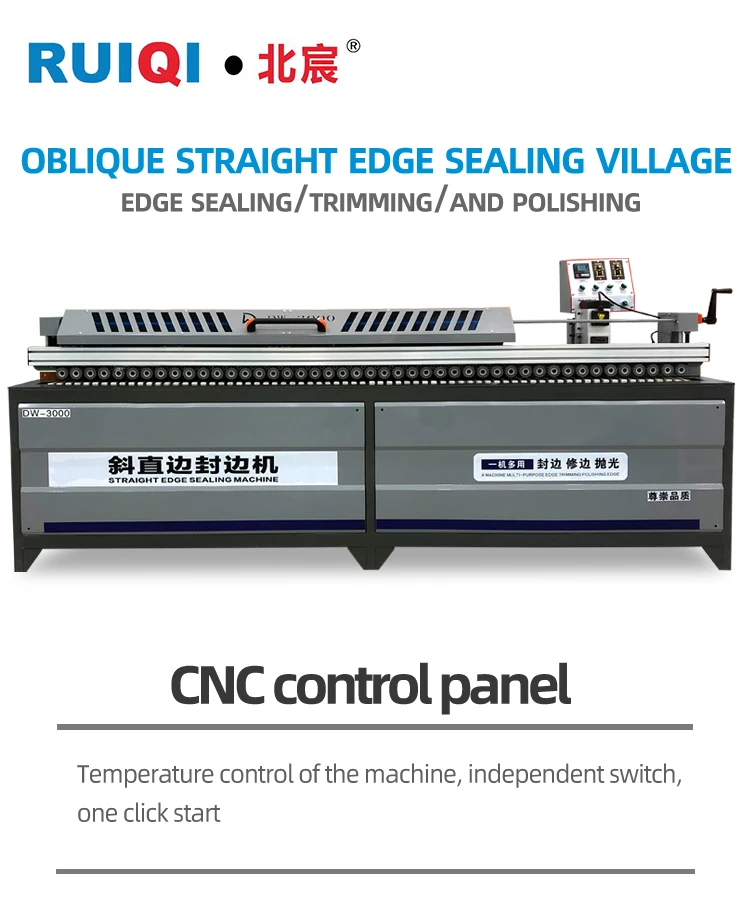
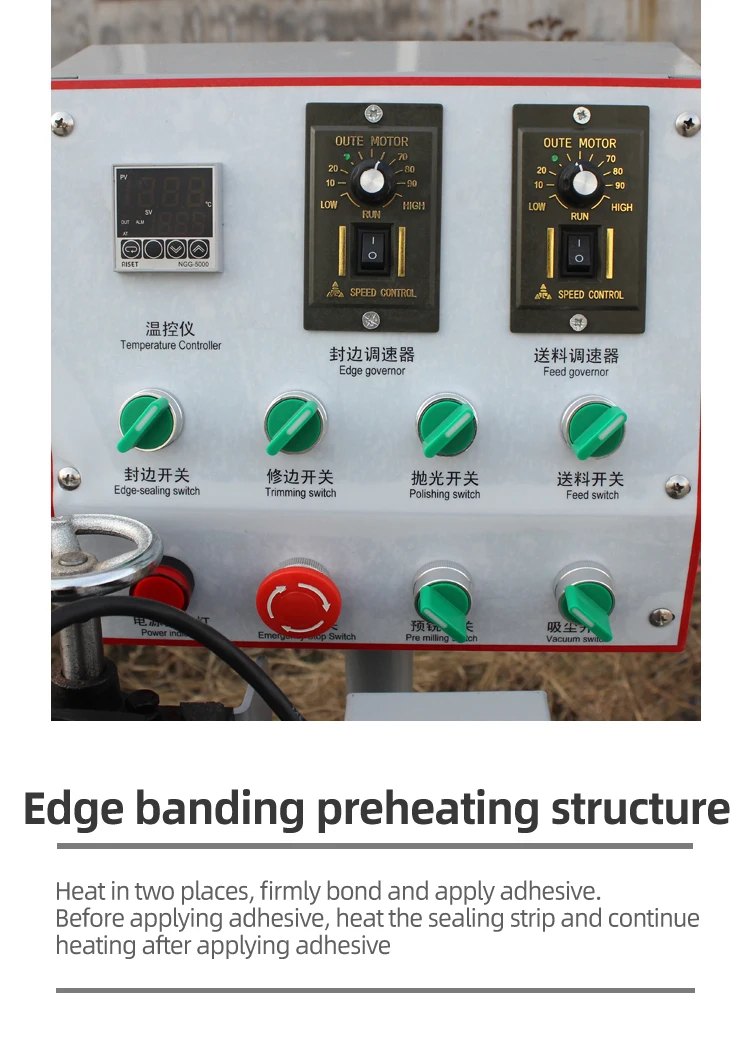
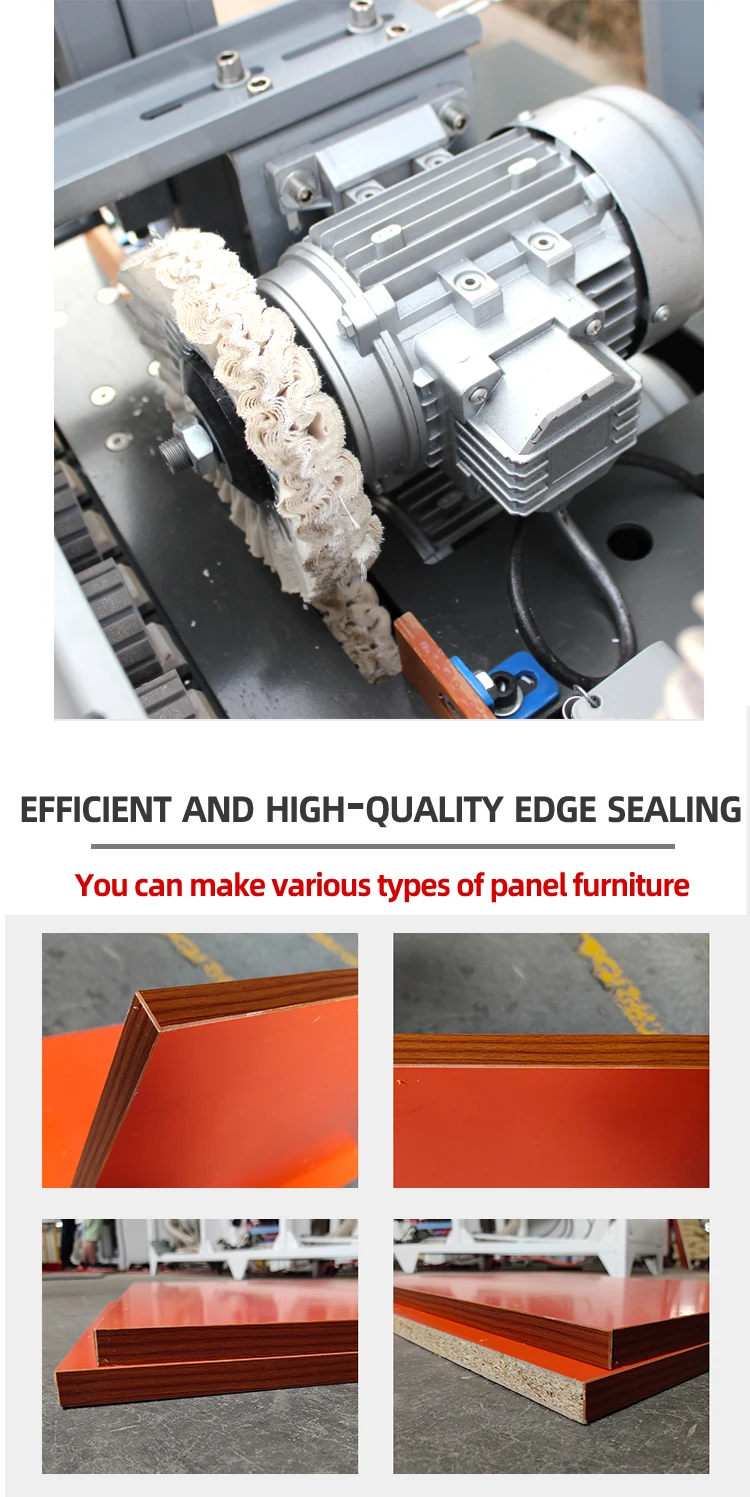
Description
In-House Cutting Mechanism Patents — the DW3000’s pre-milling and spindle trimming units are built on proprietary tooling geometries developed across two decades of edge banding machine manufacturing, verified to tolerance before leaving the factory floor.
Technical Specifications
| Parameter | Value |
|---|---|
| Model | DW3000 |
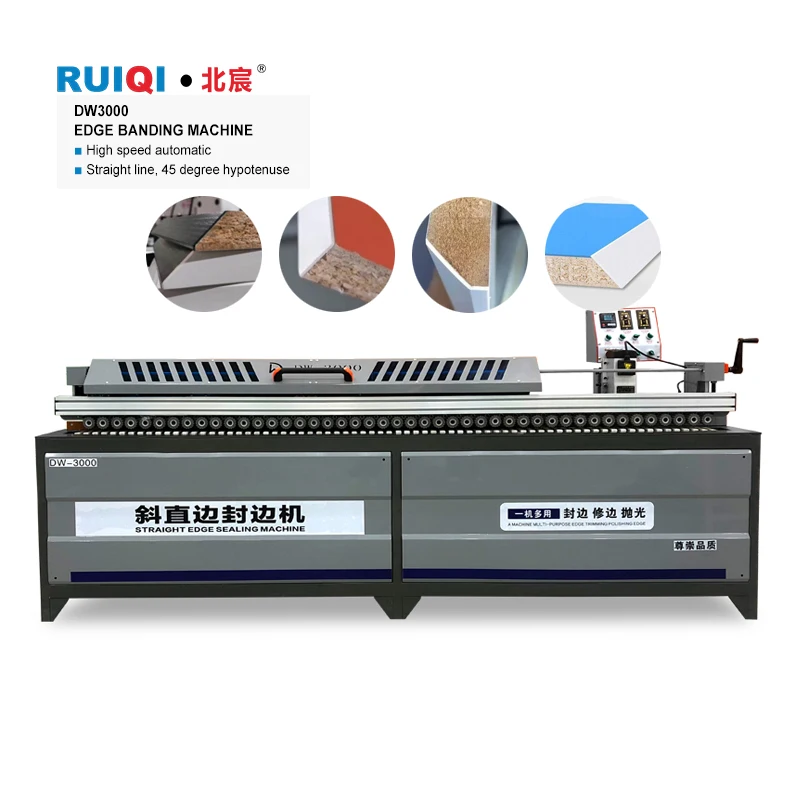
| Product Type | Automatic 45-Degree Oblique and Straight Edge Banding Machine |
| Total Power | 11 kW |
| Voltage | 380V / 415V (frequency 50Hz/60Hz — confirm local supply before build) |
| Feed Speed | 0–12 m/min (160W feed motor) |
| Transmission Speed | 0–12 m/min (180W transmission motor) |
| Pre-milling Motor | 2.2 kW |
| End Trimming Motors | 2.2 kW × 2 (spindle trimming configuration, 3 spindle motors total) |
| Heating System | 2.2 kW × 2 (double heat gun design) |
| Polishing Motors | 0.4 kW × 2 |
| Vacuum Motor | 550 W |
| Glue Pot Capacity | 4000 ml |
| Edge Banding Height Range | 0–50 mm |
| Edge Banding Thickness Range | 0.3–3 mm |
| Minimum Panel Length | 300 mm |
| Minimum Panel Width | 150 mm |
| Oblique Pressure Wheels | 8 groups, adjustable 30–90° |
| Air Source Pressure | 0.5–0.7 MPa |
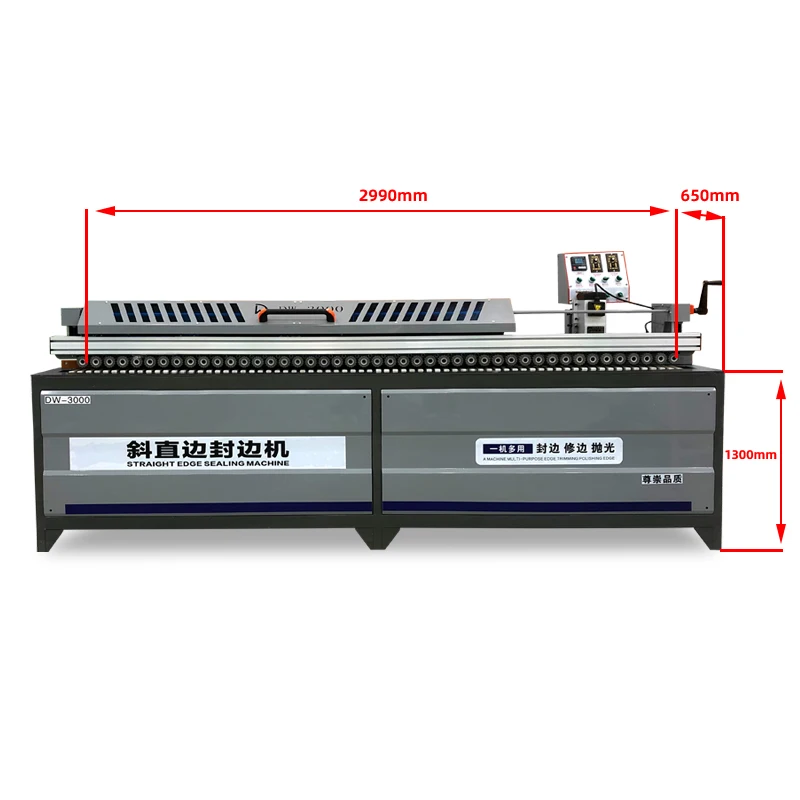
| Overall Dimensions (L×W×H) | 2990 × 650 × 1300 mm |
| Net Weight | 430 kg |
| Language Options | Chinese, English (configurable to Spanish or other languages) |
| Plug Options | EU, USA, AU, UK |
| Key Features | Pre-milling, 30–90° oblique and straight edge banding, end trimming, edge trimming, scraping, polishing, high-power vacuuming |
Application Suitability
| Application | Material or Output |
|---|---|
| Shaped cabinet door edge banding | MDF and plywood panels with 45° bevel profiles |
| Custom furniture component finishing | Particleboard and solid wood panels with PVC or veneer banding |
| Mixed straight and oblique production runs | Switching between standard 90° and angled edge profiles on the same line |
| Drawer front and decorative panel processing | Pre-milled panels requiring adhesive-activated edge application at 0.3–3 mm thickness |
| Small-to-medium batch workshop output | Panels down to 300 × 150 mm fed at variable speeds up to 12 m/min |
Why the Voltage Question Must Come Before the Machine Quote
An edge banding machine that cannot power on in your workshop is a 430 kg paperweight, regardless of its trimming precision.
I spent years doing on-site technical support across Latin America, and one shipment still bothers me. We sent an automatic edge banding machine to a furniture factory without verifying their 220V/60Hz supply against the machine’s rated input. It arrived dead. The factory manager waited three weeks for a transformer retrofit before the main contactor would even close. Every automatic edge banding machine manufacturer worth working with should ask about your local voltage and frequency before generating a quotation — not after the container has sailed [NEED_CITE: voltage and frequency standards by export market].
The DW3000 is configurable from 110V to 440V across common industrial frequencies. That configuration window only matters if the conversation happens during the specification phase, when the control transformer, motor windings, and heating elements can all be matched to your facility’s actual supply.
Where This Model Sits in the Ruiqi Catalogue
Ruiqi’s edge banding range spans from entry-level single-function units to full-station production machines. The DW3000 occupies the mid-to-upper tier as an automatic edge banding machine manufacturer offering within the catalogue, carrying pre-milling, double heat guns, spindle trimming, and the 30–90° oblique system in one frame. Workshops that need to process both standard straight-edge panels and bevel-profile components can cover both requirements without purchasing a second dedicated machine or re-feeding panels through a different station.
Oblique and Straight Banding in a Single Pass
The eight-group oblique pressure wheel assembly adjusts across a 30–90° range, meaning the machine handles standard perpendicular edge application and angled bevel profiles without a mechanical changeover. For furniture factories running shaped cabinet doors one day and flat panel carcasses the next, this eliminates the downtime and alignment errors that come from switching between two dedicated machines. The double heat gun configuration — two 2.2 kW heating elements working in sequence — keeps adhesive activation consistent whether the banding material is thin PVC at 0.3 mm or thicker veneer stock approaching 3 mm [NEED_CITE: adhesive activation temperature ranges for PVC and veneer edge banding].
Reading the Specs That Actually Affect Panel Quality
The pre-milling station at 2.2 kW removes a thin layer from the panel edge before adhesive application. This matters because MDF and particleboard edges often carry micro-chipping from the panel saw cut, and applying banding directly over that damaged surface produces visible telegraph lines once the adhesive cures. The spindle trimming configuration uses three dedicated spindle motors rather than the simpler trimming motors found on entry-level models, which translates to cleaner end cuts on thicker banding materials where a standard blade would leave a ragged break.
Feed speed adjustment from 0–12 m/min through a 160W variable-speed motor lets operators slow the line for difficult substrates — solid wood panels with uneven edges, for instance — without losing tracking accuracy. The 4000 ml glue pot capacity supports sustained production runs without frequent refill stops, and the high-power vacuuming system at 550W pulls trimming debris away from the scraping and polishing stations before it can embed in fresh adhesive.
What Happens When the Specification Conversation Gets Skipped
The most common on-site failures I encountered were not mechanical — they were configuration mismatches discovered after installation. A machine set for 50Hz running on a 60Hz supply spins its motors faster than rated, overheating bearings within weeks. Control panels left in a language the operator cannot read mean that alarm codes go uninterpreted, and minor faults escalate into stopped production. When edge banding thickness range is not matched to the actual PVC or veneer stock a workshop purchases, the pressure wheels either crush thin material or fail to bond thicker stock — and the defect only becomes visible once panels reach the assembly bench [NEED_CITE: common edge banding adhesion failures on mixed substrates].
What Ruiqi Brings to This Purchase
Voltage and frequency are confirmed in writing before the build begins, matched against your facility’s electrical survey — not assumed from the destination country. Language configuration on the control panel is specified at order, so the operator reading the display on day one is reading it in a language they understand. The four-stage quality control process covers incoming material inspection, in-process machining verification, finished-product functional testing, and a pre-shipment run using your specified panel material and edge banding stock. Factory visits are welcomed at the Ningjin facility, where you can watch the DW3000 process your own substrate before it is crated.
Documentation & Verification
- Machine specification sheet listing confirmed motor ratings, feed speed range, and oblique angle adjustment limits
- Electrical schematic with voltage and frequency values locked to your facility’s confirmed supply
- Factory test record run on your actual panel thickness and edge banding material before dispatch
- CE declaration of conformity and ISO 9001 certificate for import clearance compliance
- Operation and maintenance manual produced in the language selected at order confirmation
- Spare parts list with part numbers matching the as-built configuration
Installation, Commissioning & Support
- Floor space of approximately 3.0 × 0.7 m required with clearance on the feed side for panel staging
- Dedicated three-phase circuit matching confirmed voltage and frequency, isolated from welding or compressor loads
- Machine ships as a single frame at 430 kg — forklift unloading and positional leveling required on arrival
- First-run commissioning includes glue pot temperature calibration, pressure wheel angle setting, and feed speed tuning for your substrate
- Operator training covers oblique angle changeover procedure between 30° and 90° jobs
- Scraping and polishing consumables, trimming blades, and spare pressure wheel pads included in the initial parts kit
Before You Request a Quote
To configure the DW3000 correctly for your workshop, share your primary panel materials and their thickness range, the edge banding types and thicknesses you run most often, and your local three-phase voltage and frequency. Let us know the control panel language your operators need, and whether your production mix includes both straight and oblique profiles. If you have upstream panel saws or downstream boring machines already in place, noting their feed heights and throughput rates helps us confirm line compatibility.
Frequently Asked Questions
Q: How does the DW3000 compare to other models in the Ruiqi edge banding range?
A: The DW3000 sits in the upper tier of Ruiqi’s catalogue, carrying pre-milling, double heat guns, and spindle trimming alongside the 30–90° oblique system. Entry-level models omit the oblique pressure wheels and pre-milling station. Your production volume and whether you need bevel-edge capability determine which tier fits. The engineering team provides a configuration comparison within 24 hours of receiving your panel and banding specifications.
Q: Can the oblique angle be adjusted per job or is it fixed?
A: The eight pressure wheel groups adjust across the full 30–90° range, and operators reset the angle between jobs using the adjustment mechanism on each wheel group. Straight 90° banding and angled profiles can alternate on the same production schedule. The changeover takes a few minutes and does not require tools beyond the standard setup kit provided with the machine.
Q: What edge banding materials are compatible within the 0.3–3 mm range?
A: The DW3000 handles PVC, ABS, veneer, and melamine edge banding within its rated thickness range. Thinner PVC at 0.3 mm requires reduced pressure wheel force to avoid crushing, while veneer stock near 3 mm benefits from the double heat gun design for full adhesive activation. Glue pot temperature settings are adjusted per material type during commissioning.
Q: How does this model integrate with upstream and downstream equipment?
A: The feed height and 0–12 m/min feed speed range allow the DW3000 to sit between a panel saw and a boring machine in a furniture production line. Throughput matching between stations depends on your panel sizes and batch mix. Sharing your existing equipment specifications with the engineering team allows a line layout recommendation that avoids bottlenecks at the edge banding station.
Q: What customization options are available before placing an order?
A: Voltage is configurable from 110V to 440V, control panel language is selectable at order, and plug type is matched to your regional standard. Logo placement and private-label branding are available for distributors. All customizations are confirmed in the formal quotation and locked in the electrical schematic before production begins.