

Description
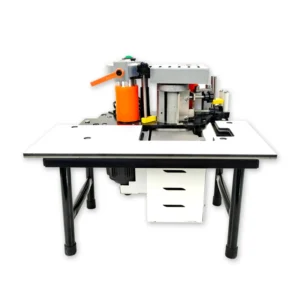
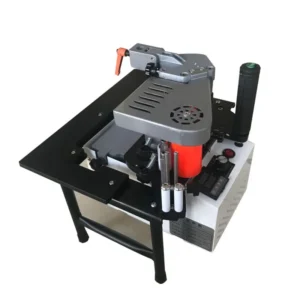
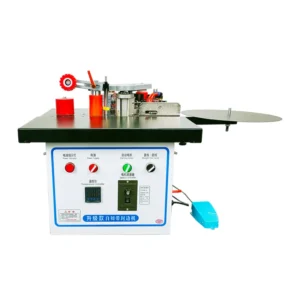
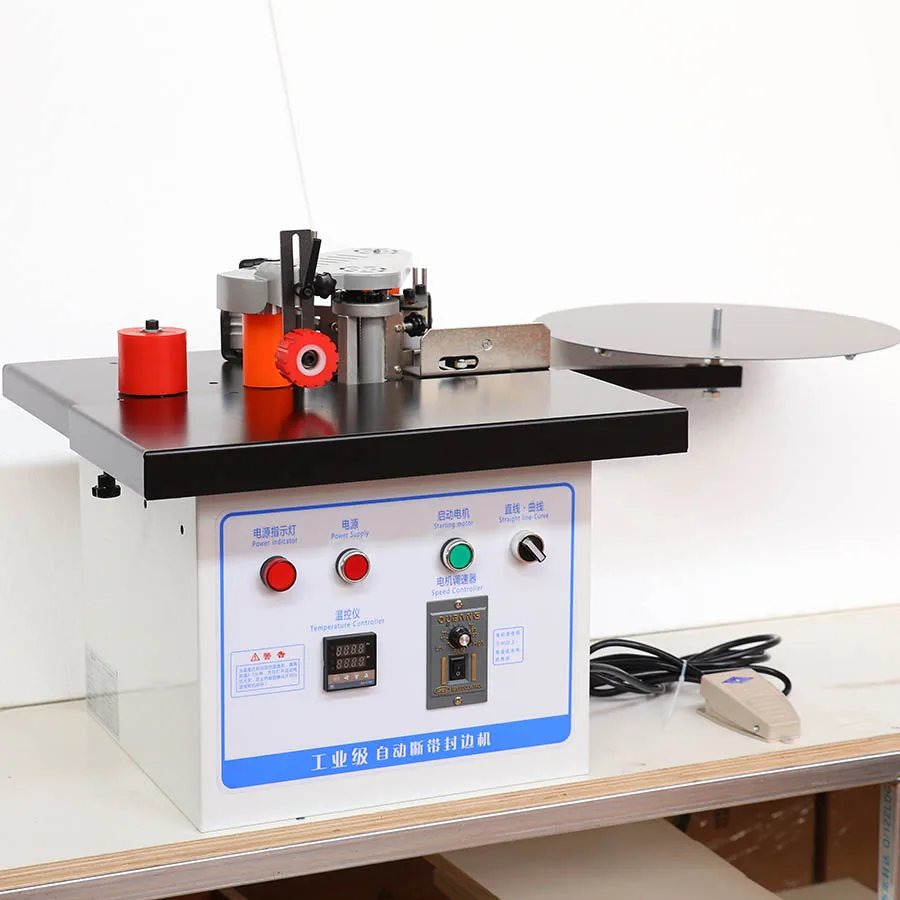
Portable Footprint, Verified Tolerance — the ZDSF50 mini edge banding machine delivers double-sided gluing across straight and curved profiles in a 26 kg unit that fits workshops still mapping out their full production line.
Technical Specifications
| Parameter | Value |
|---|---|
| Model | ZDSF50 Mini Edge Banding Machine |
| Product Type | Mini Edge Banding Machine |
| Function | Double side gluing for Straight, Curved & Shaped Edge |
| Rated Voltage | 220V (configurable from 110V to 440V) |
| Rated Power | 1.2 kW |
| Rated Air Pressure | 0.4–0.6 MPa |
| Edge Strip Thickness Range | 0.5–1.5 mm |
| Panel Thickness Range | 10–60 mm |
| Glue Pot Capacity | 1000 ml |
| Heating Time | 5–10 min |
| Feed Speed | 0–6 m/min |
| Overall Dimensions (L×W×H) | 54×54×56 cm |
| Net Weight | 26 kg |
| Glue Application | Double-sided via glue-coated rollers |
| Glue Pot Heating | 4 heating tubes |
| Edge Strip Breaking | Pneumatically controlled belt breaking device |
| Curve Edge Operation | Foot switch for manual tape breaking |
| Straight Edge Operation | Travel switch for automatic tape breaking |
| Pressure Roller Material | Rubber |
| Pressure Roller Adjustment | Adjustable according to board thickness |
| Edge Strip Transport | Adjustable bayonet according to edge strip height |
Application Suitability
| Application | Material or Output |
|---|---|
| Small workshop edge banding | MDF, plywood, particleboard panels with PVC strips 0.5–1.5 mm |
| Custom furniture joinery | Solid wood panels with veneer edge banding on shaped profiles |
| On-site satellite finishing | Prefabricated cabinet components requiring curved edge treatment |
| Manual-to-machine transition | Low-volume batch production of shelving, desk tops, and door blanks |
Why the Voltage Question Must Precede the Mini Edge Banding Machine Order
Confirming local supply voltage and frequency before dispatch prevents weeks of idle production time.
A few years back I specified a semi-automatic bander for a Vietnamese cabinet factory. The local electrician assumed standard 220V single-phase, but the facility actually ran on a different frequency. The machine tripped on first power-up, and a replacement transformer took three weeks to arrive. The whole line sat idle while we waited. Since that incident I cross-check electrical schematics against destination grid parameters before any quotation goes out [NEED_CITE: voltage and frequency standards by export market]. With a compact unit like the ZDSF50, the risk feels smaller because the power draw is only 1.2 kW — but a mismatch still renders the machine unusable until corrected.
Mapping the ZDSF50 Across a Workshop’s Production Stages
The ZDSF50 occupies the entry-level tier of the edge banding range available from this Mini Edge Banding Machine manufacturer. It handles the transition point where a joinery shop outgrows hand-applied banding but has not yet reached volumes that justify a fully automatic line. Workshops that start here can move to higher-tier models within the same product family as throughput demands increase, keeping operator familiarity and spare parts logistics consistent.
Double-Sided Gluing on Curved and Shaped Profiles
Most portable edge banders apply adhesive to only one surface. The ZDSF50 uses coated rollers to apply glue to both the panel edge and the strip simultaneously, which improves bond strength on porous substrates like particleboard. The pneumatically controlled breaking device pairs with a foot switch for curved work and a travel switch for straight runs, allowing a single operator to manage varied geometries without reconfiguring the machine between jobs [NEED_CITE: adhesive bonding standards for wood panel edge treatment].
Reading the Specs That Matter for Daily Output
Panel thickness range of 10–60 mm and edge strip thickness of 0.5–1.5 mm define the working envelope. When processing 18 mm MDF with 0.8 mm PVC, the adjustable rubber pressure rollers must be set to match the board thickness precisely — too loose and the strip lifts at the ends, too tight and you crush the substrate edge. The 1000 ml glue pot with four heating tubes reaches operating temperature within 5–10 minutes, which means a small batch can be started without long idle heating. Feed speed of 0–6 m/min is manually controlled, giving the operator direct feel for how the strip conforms around curves and radii. The 0.4–0.6 MPa air pressure requirement is modest enough for most small workshop compressors.
The Hidden Cost of Skipping Configuration Verification
Ordering a compact bander without confirming the exact panel thickness range and edge strip materials leads to problems that only surface during production. Operators discover that the pressure rollers cannot close the gap on thicker boards, or that the bayonet transport jams on veneer strips below the tested range. These issues are not machine defects — they are configuration mismatches that could have been resolved during the quotation stage with a clear material sample list and processing requirement sheet [NEED_CITE: common commissioning failures in woodworking machinery imports].
What Distinguishes This Sourcing Point
In-house manufacturing with patented cutting mechanisms means tolerance claims on the ZDSF50 can be verified at the factory before shipment rather than discovered during your first production run. Voltage customization from 110V to 440V is treated as standard procedure, not an afterthought, so the machine arrives wired correctly for your facility. The four-stage QC process includes a pre-shipment test on your specified panel and strip materials, documented with photographs. Control panels and operation manuals are produced in the agreed language, so your operator can read the settings without translation delays. Engineer-led configuration recommendations ensure the ZDSF50 is matched to your actual production scope, with a formal proposal delivered promptly after inquiry.
Documentation & Verification
- CE declaration of conformity covering the ZDSF50 electrical and mechanical safety requirements
- Machine specification sheet confirming rated voltage and frequency for your destination market
- Factory test record showing glue pot heating and feed performance on your panel materials
- Electrical schematic with voltage confirmation matching your facility supply parameters
- Operation and maintenance manual written in your operator’s agreed language
Installation, Commissioning & Support
- Place the 54×54×56 cm unit on a level bench with clearance for curved panel manipulation on all sides
- Connect to a dedicated 220V circuit rated for the 1.2 kW draw to prevent breaker trips during heating cycles
- Unit ships fully assembled; verify pressure roller alignment and bayonet setting on first power-up
- Set glue pot temperature and test feed speed on scrap panels matching your production material before live runs
- Stock spare heating tubes and replacement rubber pressure rollers based on your weekly operating hours
- Clean glue pot and coated rollers after each session to prevent adhesive buildup affecting bond quality
Starting the Configuration Conversation
Share the panel materials, thicknesses, and edge strip types you process most often so we can confirm the ZDSF50 working envelope covers your range. Provide your facility voltage and frequency to ensure the electrical configuration matches on arrival. If you are planning a phased equipment expansion, let us know your projected volume trajectory so the ZDSF50 can be positioned correctly within the broader machine family.
Frequently Asked Questions
Q: What production volume is the ZDSF50 realistically designed for, and when should I consider moving to a full-function model?
A: The ZDSF50 is built for low-volume custom workshops handling frequent shape changes and small batches. When your daily output shifts toward consistent straight-edge panels in larger quantities, a full-function automatic bander with pre-milling and trimming stations becomes more appropriate. The upgrade path stays within the same product family, preserving familiar controls and spare parts compatibility.
Q: Can voltage and control panel language be customized for my local market?
A: Yes. Voltage is configurable from 110V to 440V, and frequency is matched to your destination grid. Control panel labeling and the operation manual are produced in your agreed language. These are treated as standard configuration steps during the quotation stage, not special requests, so the machine arrives ready for immediate commissioning.
Q: What edge strip and panel materials are compatible, and how does glue selection affect the finish?
A: The ZDSF50 handles PVC and veneer strips from 0.5 to 1.5 mm on MDF, plywood, particleboard, and solid wood panels up to 60 mm thick. Glue type and pot temperature must match the strip material — higher temperatures suit PVC while veneer requires lower settings to avoid scorching. Sample testing before shipment confirms the combination.
Q: How does the ZDSF50 fit into a phased equipment investment plan as my workshop scales?
A: The ZDSF50 covers edge banding for small batches and shaped profiles. As volume grows, you can add sliding table saws, boring machines, and eventually a full automatic banding line from the same manufacturer. Keeping all equipment within one product family simplifies training, maintenance, and spare parts sourcing across each expansion phase.