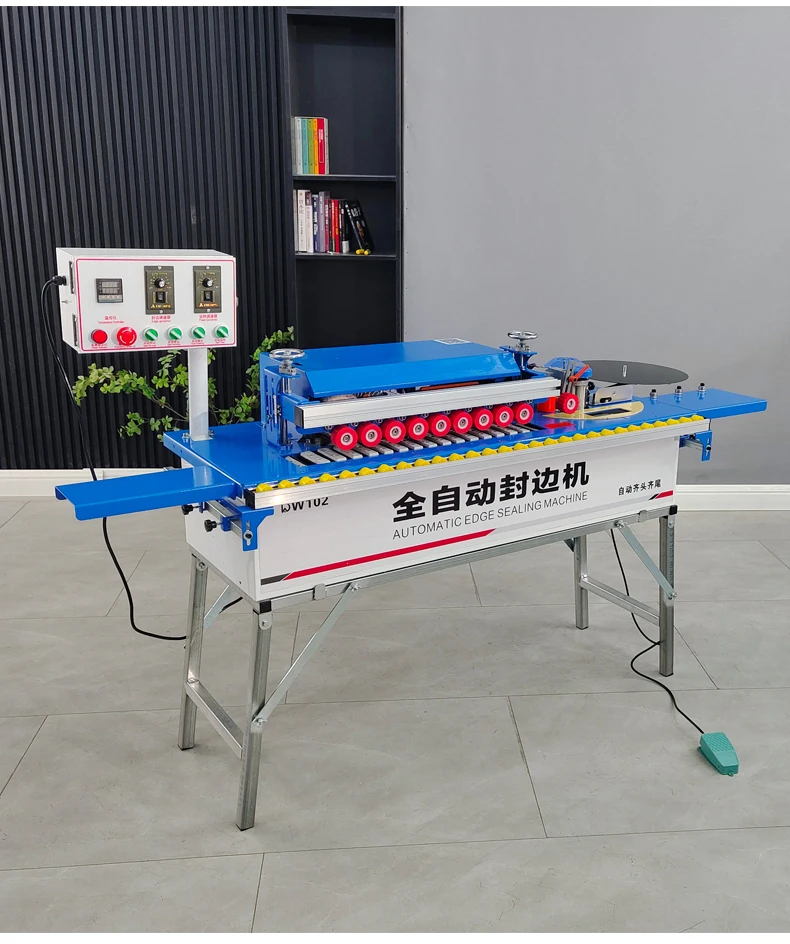
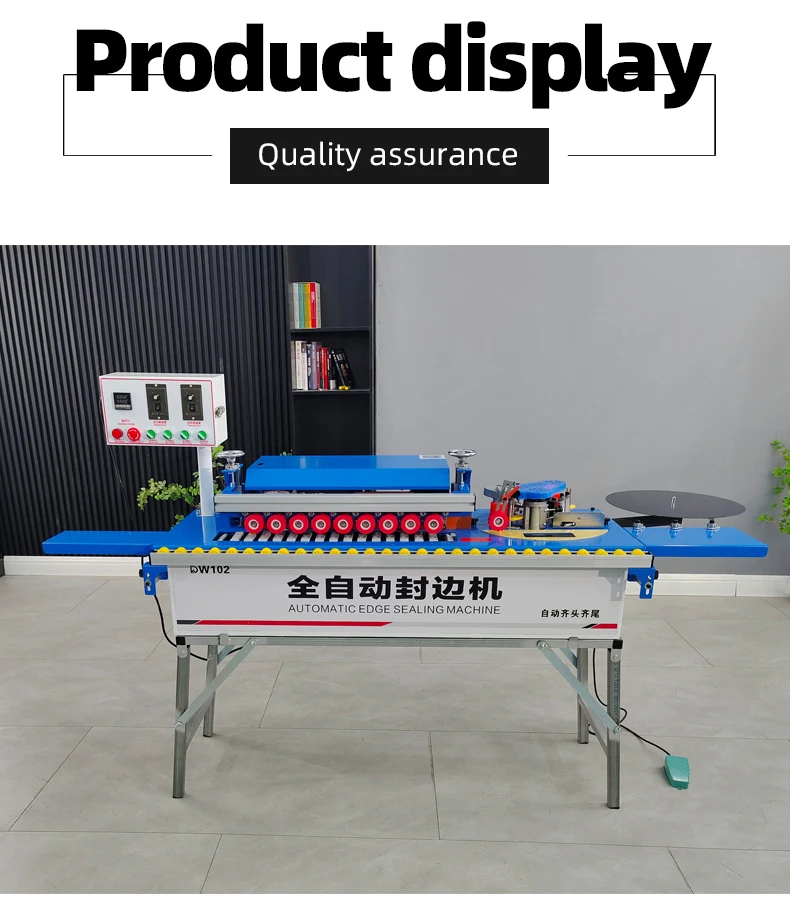
Description
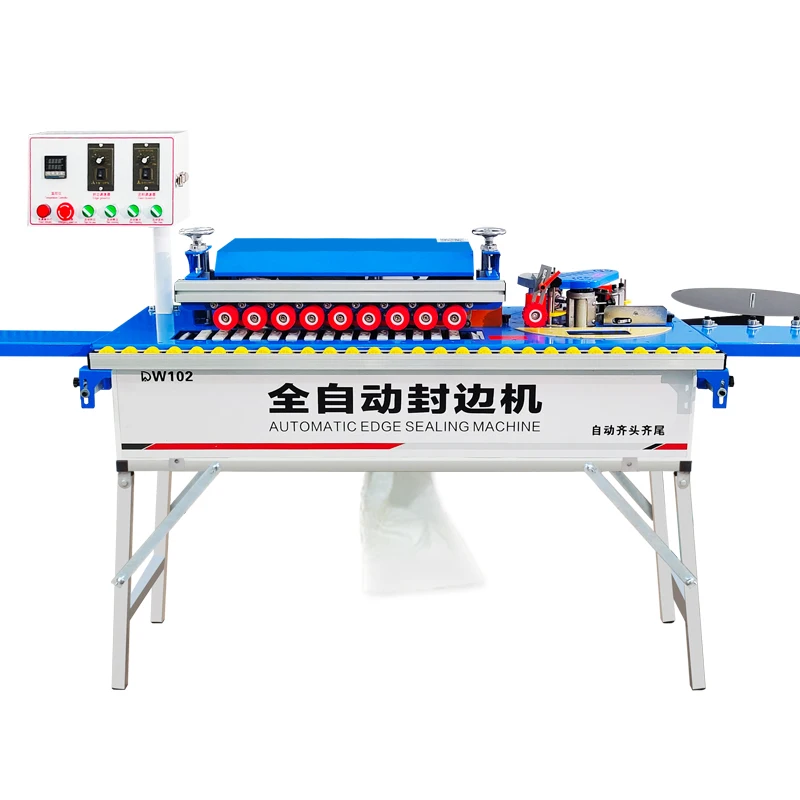
Precision-ground cutting components — the DW102’s pre-milling station holds ±0.02mm tolerance on particleboard and MDF edges, verified through four-stage factory inspection before dispatch.
Technical Specifications
| Parameter | Value |
|---|---|
| Model | DW102 |
| Product Type | Automatic Edge Banding Machine |
| Total Power | 3800W |
| Voltage | 220V / 380V / customization available |
| Edge Power | 20W |
| Transmission Power | 60W |
| Trimming Power | 650W × 2 |
| Polishing Power | 180W × 2 |
| Vacuum Power | 1200W |
| Air Source Pressure | 0.5–0.8 MPa |
| Glue Pot Capacity | 1000 ml |
| Edge Banding Thickness | 0.3–3 mm |
| Edge Banding Height | 0–50 mm |
| Minimum Sheet Length | 25 cm |
| Minimum Sheet Width | 5 cm |
| Product Size | 128 × 47 × 69 cm |
| Product Weight | 75 kg |
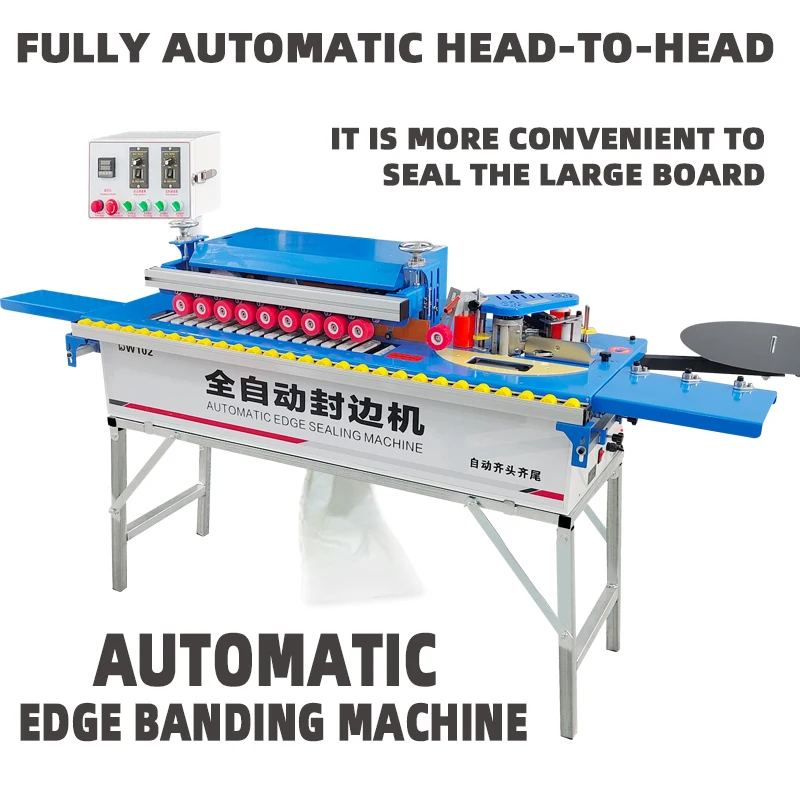
| Key Features | Curved and straight edge banding, edge trimming, polishing, automatic head and tail cutting, integrated vacuum system |
Application Suitability
| Application | Material or Output |
|---|---|
| Cabinet door edge finishing | MDF and melamine-faced particleboard with PVC or veneer banding |
| Custom furniture panel processing | Plywood and blockboard panels requiring curved and straight edge profiles |
| Polymer door frame banding | Polymer substrates with 0.3–3 mm thickness banding material |
| Small-batch workshop production | Mixed substrate runs where quick changeover between panel types is needed |
Why the Glue Line Question Matters More Than Feed Speed
Visible glue lines on particleboard edges trace back to tolerance drift, not operator error. When the pre-milling cutter leaves even a slight deviation on the panel edge, the banding material cannot seat flush against the substrate. The gap fills with excess adhesive, and that bead becomes visible after trimming and polishing — especially on light-colored melamine surfaces. I once spent three days in a Foshan workshop chasing what the owner insisted was a glue temperature problem. The actual cause was a worn pre-milling cutter that had lost its edge geometry on abrasive particleboard, leaving a surface rough enough to prevent proper banding adhesion. An Automatic Edge Banding Machine manufacturer who does not verify pre-milling tolerance at the factory will leave you discovering the problem only after panels reach assembly. [NEED_CITE: edge adhesion failure modes in panel processing]
Curved and Straight Edge Capacity in One Footprint
Most workshops running small to medium batches cannot justify separate machines for curved and straight edge profiles. The DW102 handles both within a single 128 × 47 × 69 cm footprint, which matters when floor space limits how many stations you can fit between the panel saw and the drilling line. The automatic head and tail cutting eliminates the manual snip that often leaves a slight overhang on curved profiles, and the integrated vacuum system pulls trimmings away before they can scratch the next panel in the queue.
Material Range and Banding Thickness Coverage
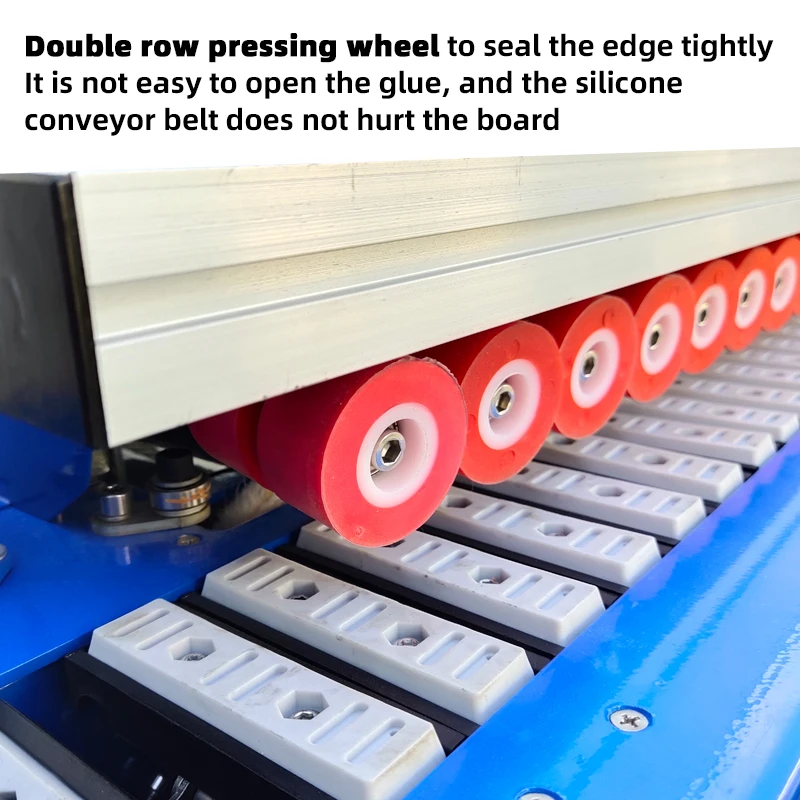
Running 0.3 mm PVC on a cabinet carcase demands different feed pressure and glue volume than applying 3 mm solid wood veneer to a door stile. The DW102’s banding thickness range of 0.3–3 mm and edge height of 0–50 mm covers the full spectrum that a custom furniture factory encounters daily. Switching between materials requires adjusting the pressure rollers and glue application rate rather than swapping hardware, which keeps changeover time short when a batch order calls for mixed substrate runs. [NEED_CITE: banding material selection for wood-based panel substrates]
Reading the Spec Sheet Against Your Actual Panels
The trimming station runs two 650W motors, which provides adequate power for standard MDF and particleboard trimming passes. On denser substrates like high-moisture-resistant board or thick plywood, the operator should reduce feed speed to prevent chatter marks on the trimmed edge. The 1000 ml glue pot capacity suits batch production where the machine runs for several hours before needing a refill — for continuous full-shift operation, monitoring glue level becomes part of the operator’s routine. The minimum sheet dimensions of 25 cm length and 5 cm width mean small offcuts and narrow drawer components can be edged without manual handling, reducing waste on nesting-optimized cut lists. Air source pressure between 0.5 and 0.8 MPa is standard for pneumatic pressure rollers and the head-and-tail cutting mechanism; confirm your compressor can sustain this range at the required flow rate before installation.
What Happens When Voltage Gets Overlooked
I have seen edge banders arrive at a workshop wired for a voltage standard that does not match the local supply, and the motor runs hot within the first hour. The DW102 ships with voltage configurable from 220V to 380V or custom specifications, but this only helps if the buyer confirms their actual supply before production begins. A 3800W total power draw on the wrong voltage will trip breakers or damage the drive motors, and the fault will not show up until the machine is under load with panels in the feed. Confirming voltage and frequency — including whether the site runs 50 Hz or 60 Hz — is a five-minute conversation that prevents a multi-week delay. [NEED_CITE: voltage and frequency standards by export market]
Why This Automatic Edge Banding Machine Manufacturer Configures Before Quoting
The DW102 sits within a full product family that scales from entry-level configurations to full-function pre-milling and corner rounding setups, so a workshop can add capacity later without learning a new control interface or sourcing spare parts from a different supplier. Every unit passes through four-stage quality control — incoming material inspection, in-process verification, finished product testing, and pre-shipment validation — with documented tolerance records specific to the panel material in the buyer’s order. Voltage, control panel language, and machine specifications are confirmed during the quotation stage rather than treated as afterthoughts, and an engineer-led configuration recommendation is provided within 24 hours of receiving the buyer’s production requirements. The patented cutting mechanism maintains edge precision that is verifiable on the buyer’s own substrate, not just claimed on a brochure. Factory visits are welcomed for buyers who want to run their own panel samples through the machine before committing to an order.
Documentation & Verification
- CE declaration of conformity covering the DW102’s electrical and mechanical safety systems
- ISO 9001 certificate for the manufacturing quality management process
- Electrical schematic with confirmed voltage and frequency matching your site supply
- Factory test record run on your specified panel thickness and banding material
- Operation and maintenance manual provided in the language your operators read
Installation, Commissioning & Support
- Confirm a dedicated circuit rated for the DW102’s 3800W total draw at your confirmed voltage before delivery
- Allow floor space of at least 150 × 70 cm including operator clearance around the 128 × 47 × 69 cm machine body
- Connect compressed air at 0.5–0.8 MPa with a dedicated regulator to protect the pneumatic cutting and pressure systems
- First-run parameter setting covers glue temperature, feed speed, and roller pressure calibrated to your specific banding material
- Spare parts list with identified wear items — trimming cutters, polishing wheels, and glue pot seals — shipped with the machine
Sending the Right Details with Your Inquiry
To match the DW102 to your production line, share the panel materials you run most often, the banding thickness and material types in your typical orders, and your local voltage and frequency standard. If you are integrating into an existing line, note the upstream panel saw output rate and any downstream drilling or boring stations so feed speed can be coordinated.
Frequently Asked Questions
Q: How do I choose between the DW102 and a higher-tier model for my production volume?
A: The DW102 suits small to medium batch workshops running mixed panel materials with moderate daily throughput. If your operation runs single-shift continuous production on one substrate type at high volume, a full-function pre-milling model with larger glue pot capacity and additional trimming stations would be more appropriate. Share your daily panel count and material mix so we can recommend the right tier.
Q: Can the voltage be customized for markets with non-standard supply?
A: Yes. The DW102 supports 220V, 380V, or custom voltage configurations. Before production begins, we confirm your exact supply voltage, phase, and frequency to ensure the motor windings and control transformer match your site conditions. This prevents overheating and breaker trips after installation.
Q: What control panel language options are available?
A: The control interface can be configured in multiple languages based on your operator team’s requirements. We confirm the preferred language during the quotation stage so the machine arrives ready for immediate commissioning without translation delays or operator confusion.
Q: Will the DW102 integrate with my existing panel saw and boring machines?
A: Integration depends on matching the feed height and throughput rate between stations. Share your current panel saw model and any downstream boring or drilling equipment so we can verify that the DW102’s panel thickness range and processing speed align with your line layout.