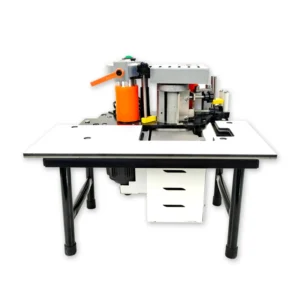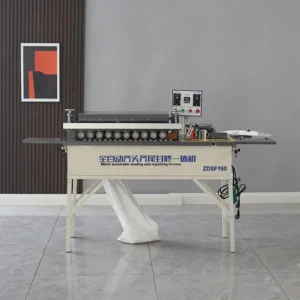

Description
Custom Voltage and Language Setup — every 802 unit ships with confirmed local electrical standards and an operator-readable control interface, eliminating the three-week commissioning stall I once watched a南美 client endure.
Technical Specifications
| Parameter | Value |
|---|---|
| Model | 802 |
| Product Type | Automatic Edge Banding Machine |
| Edge Type | Straight line |
| Rated Voltage | 220V |
| Rated Power | 4 kW |
| Heating Power | 1000W (5–10 min warm-up) |
| Trimming Power | 800W × 2 (double high-speed motors) |
| Polishing Power | 180W × 2 |
| Suction Power | 1200W |
| Feed Speed | 0–10 m/min |
| Conveyor Belt Speed | 0–10 m/min |
| Sheet Thickness | 10–50 mm |
| Strip Thickness | 0.5–2.5 mm |
| Glue Capacity | 4000 ml |
| Rated Air Pressure | 0.4–0.6 MPa |
| Control Panel | Digital display of glue pot temperature, independent switch |
| Pressure Beam | Integrated, double rows of pressure wheels |
| Conveyor Belt Material | Silicone |
| Belt Breaking Method | Pneumatically controlled |
| Extension Support | Extendable fluent strips for large plates |
| Overall Dimensions | 130 × 65 × 75 cm |
| Machine Weight | 150 kg |
Application Suitability
| Application | Material or Output |
|---|---|
| Custom furniture panel edge banding | MDF, particleboard, plywood with PVC or veneer strips |
| Cabinet workshop production runs | Standard 18 mm particleboard with 0.5–2 mm PVC banding |
| Small joinery shop first automation | Plywood and MDF panels up to 50 mm thickness |
| Retrofit replacing manual edge banding | Straight-line workpieces requiring consistent glue-line finish |
Why the Voltage Question Should Come Before the Price
Confirm your facility’s voltage and frequency before any automatic edge banding machine manufacturer sends a quotation.
I configured a PVC edge bander for a workshop in South America years ago and failed to double-check whether the local grid was 220V/60Hz or a split-phase arrangement. The machine arrived, the operator plugged it in, and nothing happened. Three weeks of idle floor space while a transformer was sourced locally — that is a cost no quotation line item covers. The Model 802 rated at 220V must match your actual supply, and I now treat that confirmation as non-negotiable for every export order [NEED_CITE: voltage and frequency standards by export market].
Navigating the Ruiqi Catalogue for Your Production Stage
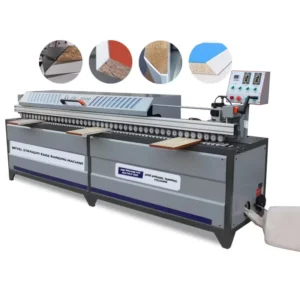
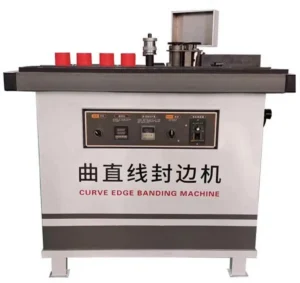
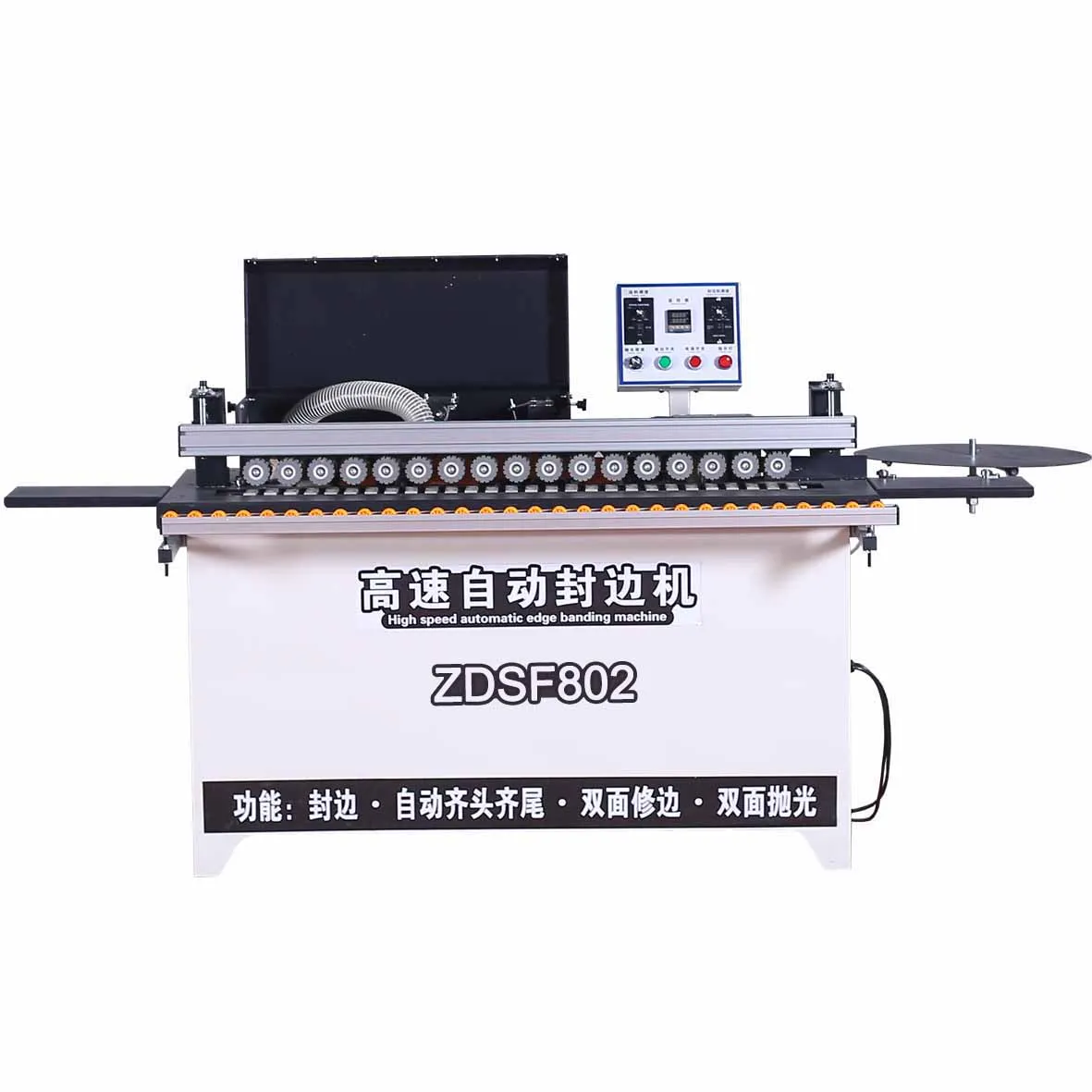
The Model 802 sits at the compact, workshop-friendly end of the range. It handles straight-line edge banding with integrated trimming and polishing, suited to shops that have outgrown manual application but do not yet need pre-milling or corner rounding. When you survey the full lineup, the deciding factor is rarely a single spec — it is whether the machine’s feed speed and station count match your daily panel volume and material mix.
Scaling Without Changing Supplier
A joinery workshop might start with the 802 for basic PVC work on particleboard cabinets, then add a multi-boring machine from the same catalogue as order complexity grows. Keeping one automatic edge banding machine manufacturer across your expansion means electrical layouts, spare parts inventories, and operator training remain consistent. The 802’s 0–10 m/min feed speed and 4000 ml glue pot are designed for this stage — steady output without the footprint or power draw of a full production line [NEED_CITE: CE machinery directive requirements for industrial equipment].
How Feed Speed, Glue Temperature, and Trimming Interact on the Shop Floor
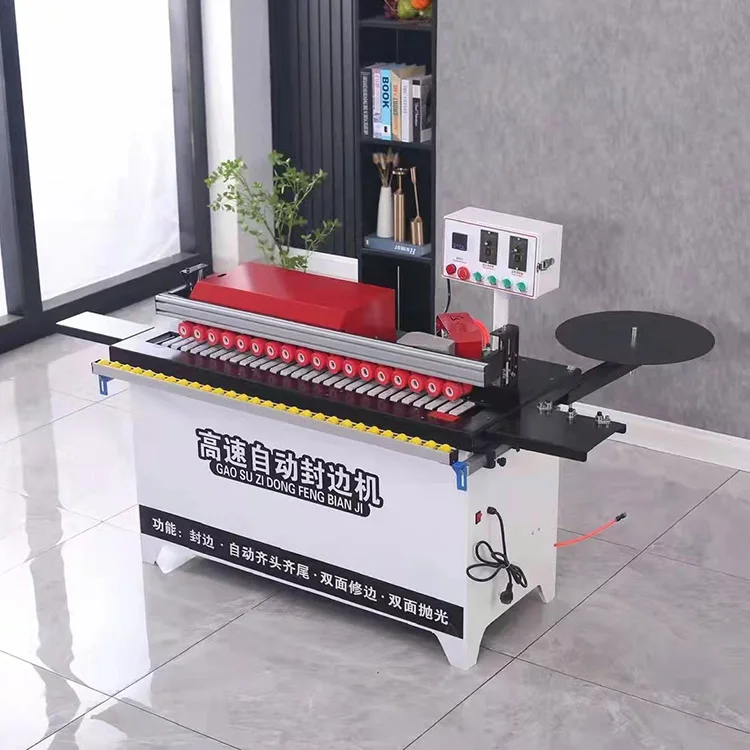
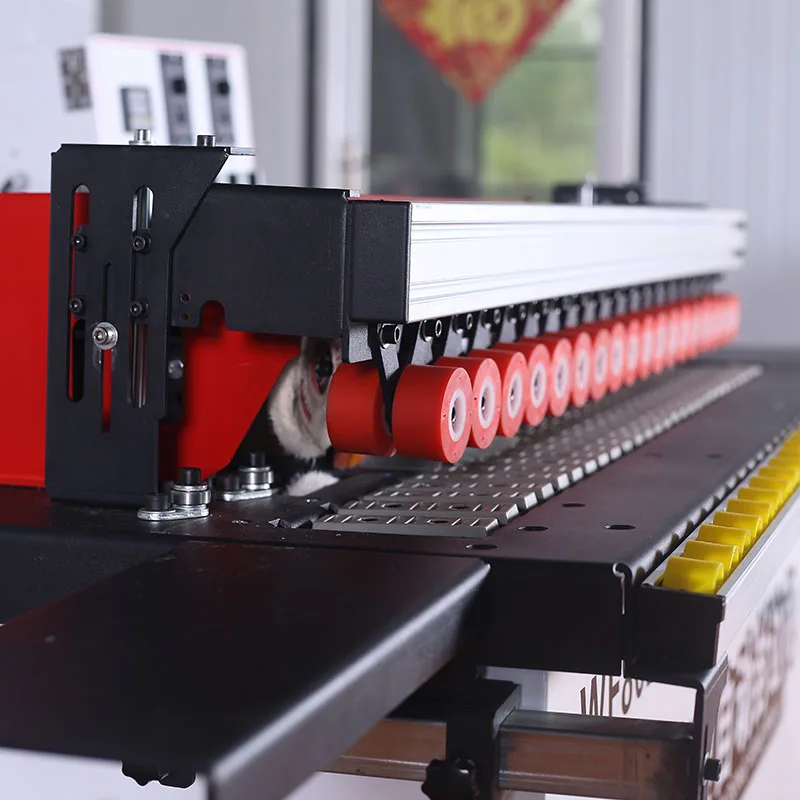
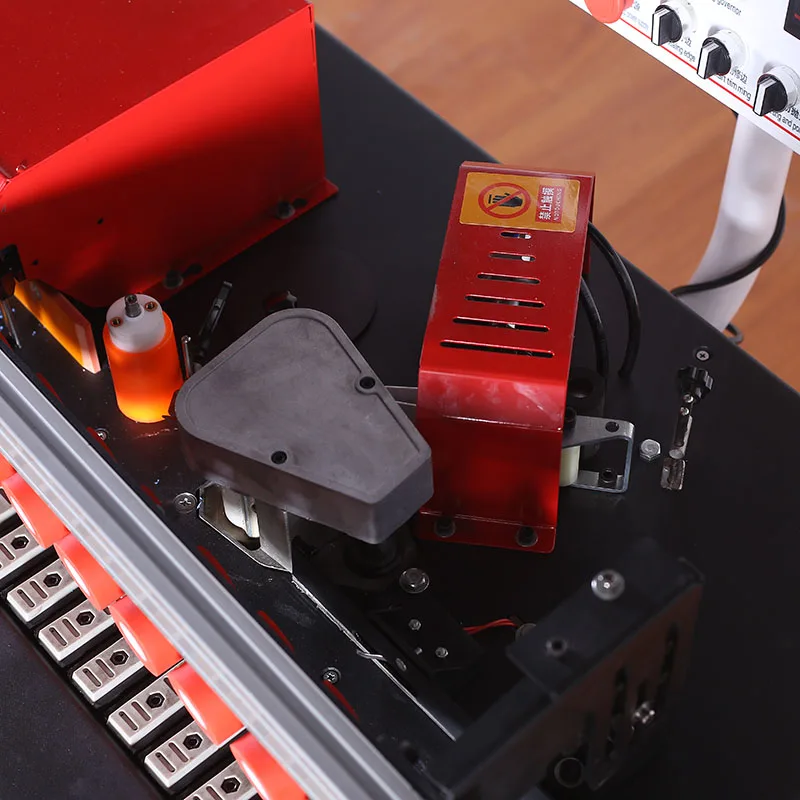
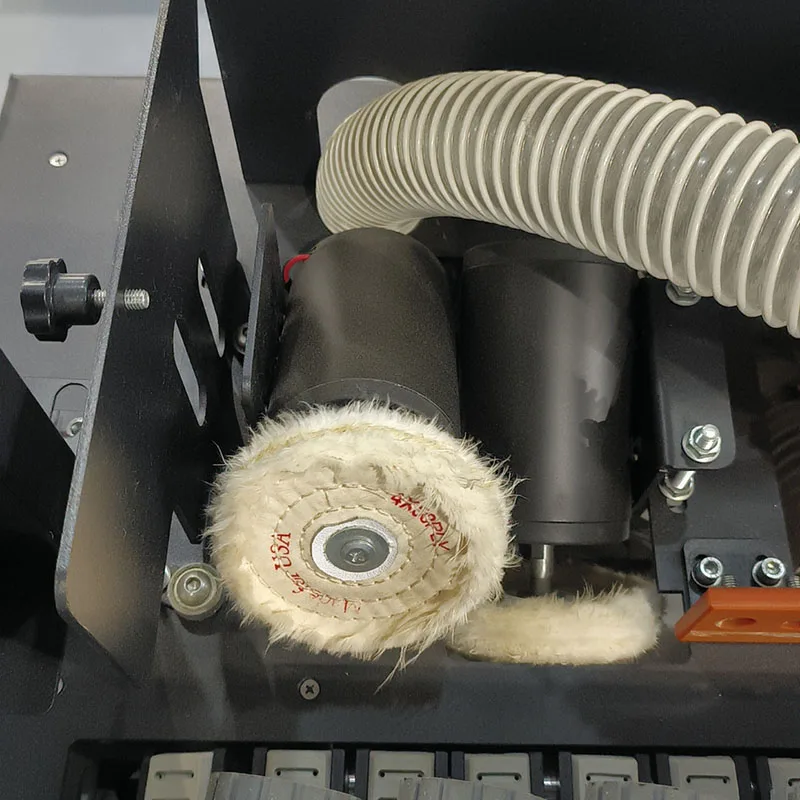
The 0–10 m/min feed speed is adjustable, which matters because PVC and veneer strips behave differently under pressure. Veneer is brittle at high feed rates; slowing the conveyor reduces chipping at the trimming station. The 1000W heating element brings the 4000 ml glue pot to working temperature in roughly 5–10 minutes, and the digital display lets the operator hold a consistent melt point — critical when switching between EVA and PUR-compatible hot melts. The double high-speed trimming motors (800W each) cut head and tail waste cleanly, while the up-and-down polishing motors smooth the edge surface on both PVC and wood-veneer banding. The silicone conveyor belt and double-row pressure beam prevent surface scratches on laminated panels, and the extendable fluent strips support oversized workpieces that would otherwise sag and introduce feed-angle errors.
The Hidden Cost of Buying a Single Machine Without Line Context
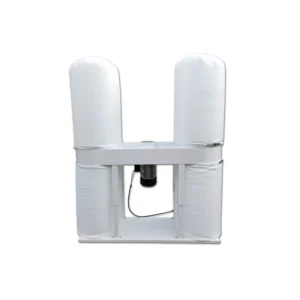
Purchasing one edge bander in isolation often leads to mismatches downstream. A workshop running the 802 at its 10 m/min ceiling may find that a single operator cannot keep up with manual panel loading, creating a bottleneck that feels like a machine fault but is actually a workflow problem. Similarly, specifying a machine without confirming your dust extraction capacity means the 1200W suction unit may pull fine MDF dust into the glue pot over time, degrading bond quality [NEED_CITE: dust extraction requirements for panel processing machinery]. These issues surface only after installation, when returns and blame-shifting begin.
What You Actually Receive When You Source Here
The 802 is built in-house with precision-ground components inspected across a four-stage quality process covering incoming material, in-process assembly, finished product, and pre-shipment verification. Voltage, control panel language, and specification adjustments are treated as standard configuration, not special requests. A formal engineer-led quotation arrives within 24 hours of your inquiry, and factory visits are open so you can inspect the cutting mechanism and assembly benches before committing.
Documentation & Verification
- CE declaration of conformity matching the 802’s electrical and mechanical safety scope
- ISO 9001 certificate covering the manufacturing process of your specific unit
- Machine specification sheet confirming 220V rating, 4 kW power, and trim/polish motor details
- Electrical schematic and voltage confirmation signed off against your facility supply data
- Factory test record on your specified panel thickness and strip material before dispatch
Installation, Commissioning & Support
- Dedicated 220V circuit with adequate amperage for the 4 kW rated load and 1000W heater draw
- Compressed air supply at 0.4–0.6 MPa for pneumatic belt breaking and trimming actuators
- Flat, level floor space accommodating the 130 × 65 cm footprint with clearance for extension support
- Glue pot warm-up procedure and digital temperature calibration during first commissioning run
- Silicone conveyor belt tension check and double-row pressure beam alignment at installation
- Spare trimming blades and polishing pads included for initial production runs
What to Prepare Before Requesting a Quotation
Send the panel materials you run most often — MDF, particleboard, plywood — along with typical thickness and the edge strip type and width. Confirm your workshop’s available voltage, phase, and frequency so the electrical package is built correctly from the start. Let us know whether the 802 is a standalone purchase or part of a line that includes boring machines or panel saws, so feed height and throughput can be matched.
Frequently Asked Questions
Q: Where does the Model 802 sit in the Ruiqi edge banding range?
A: The 802 is a compact, straight-line unit designed for workshops transitioning from manual to automated edge banding. It covers trimming and polishing but does not include pre-milling or corner rounding. Higher-tier models in the catalogue add those stations for factories running thicker stock or demanding tighter visible-edge tolerances on showroom-grade furniture.
Q: What panel and strip thicknesses does the 802 handle?
A: Sheet thickness ranges from 10 to 50 mm, and strip thickness from 0.5 to 2.5 mm. This covers standard 18 mm particleboard with PVC banding as well as thicker plywood panels with veneer strips. If your material mix falls outside these ranges, a different model in the lineup may be more appropriate.
Q: Is the 220V rating fixed, or configurable for other markets?
A: Voltage is configurable from 110V to 440V across the Ruiqi range. For the 802, confirm your facility’s exact voltage, phase, and frequency before order confirmation so the motor windings, heater element, and control transformer are wound to match. This is verified on the electrical schematic before shipment.
Q: What tolerance is verifiable on a test run?
A: Ruiqi’s proprietary cutting mechanisms achieve tolerances verified at ±0.02 mm during pre-shipment testing. The factory test record documents measurements taken on your specified panel material and thickness. You can request witness testing during a factory visit or review the record remotely before authorizing dispatch.
Q: Can I start with the 802 and move to a larger model later?
A: Yes. Because the 802 belongs to the same product family as Ruiqi’s full-function pre-milling edge banders, upgrading later means your operator training, spare parts approach, and control panel familiarity carry over. The supplier relationship and documentation standards remain consistent across the transition.