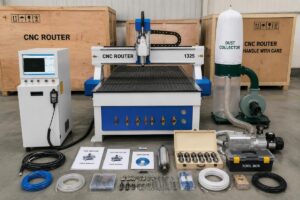
Avoid costly integration failures when sourcing a Kitchen Cabinet Manufacturing Line Turnkey Package by prioritizing system-level compatibility over individual machine specs. This guide details critical voltage standardization, PLC unification, and throughput balancing strategies to ensure your automated line produces cabinets from day one.
Kitchen Cabinet Manufacturing Line Turnkey Package | OEM Factory Supplier
A true turnkey kitchen cabinet line isn’t a bundle of machines — it’s a fully integrated system where voltage standardization, PLC language unification, and material flow logic determine whether you can plug in and produce on day one.
A complete Kitchen Cabinet Manufacturing Line Turnkey Package covers CNC nesting, automated edge banding, multi-row boring, wide-belt sanding, and final assembly — unified by shared CAD/CAM data, matched throughput speeds, and factory-ready electrical compliance for the destination country.
Years ago at the KBS show in Chicago, I helped a US cabinet brand piece together a two-line setup — German edge banders, Italian second-hand CNCs, domestic boring machines. The voltage configurations didn’t align, the PLC interfaces spoke different languages, and the data format between nesting and edge banding was incompatible. Commissioning dragged on for months, and the buyer nearly withheld final payment. That failure wasn’t about individual machine quality; it was about the absence of system-level integration. Since then, whether walking the floor at LIGNA Hannover or negotiating with Middle East distributors, the single question I hear most often is: can you deliver a Kitchen Cabinet Manufacturing Line Turnkey Package where I only connect power and start cutting on arrival? [NEED_CITE: common integration failure points in multi-vendor woodworking lines per industry commissioning reports]
The answer depends on understanding what "turnkey" actually means beyond the marketing brochure. Let’s break it down machine by machine, standard by standard, and integration point by integration point.
What Exactly Is Included in a Kitchen Cabinet Manufacturing Line Turnkey Package?
A genuine Kitchen Cabinet Manufacturing Line Turnkey Package integrates five core processing stages — panel storage and optimization, CNC nesting and cutting, automatic edge banding, multi-spindle boring, and assembly — linked by shared software and matched material handling.
Most buyers assume a turnkey package is simply a shopping list of machines shipped in the same container. The reality is far more complex. A functional line requires that the nesting software generates cutting files compatible with the edge bander’s barcode reader, that the boring machine receives drilling patterns from the same CAD/CAM platform, and that conveyor lengths between stations match the panel dimensions being processed.
| Processing Stage | Core Equipment | Integration Requirement |
|---|---|---|
| Panel Storage & Optimization | Automatic panel storage system, optimization software | Shared nesting database with downstream machines |
| CNC Nesting & Cutting | ATC CNC machining center with vacuum table | Barcode label output compatible with edge bander reader |
| Edge Banding | Fully automatic edge bander with pre-milling | Barcode-driven parameter auto-adjustment |
| Multi-Row Boring | Multi-spindle boring machine or CNC drilling center | Drilling pattern data imported from same CAM system |
| Sanding & Finishing | Wide-belt sander, cleaning station | Speed matched to upstream feed rate |
| Assembly | Hinge drilling, drawer slide mounting, packing | Final QC station with line-integrated tracking |
A Southeast Asian buyer once ordered what they believed was a complete Kitchen Cabinet Manufacturing Line Turnkey Package from three separate suppliers. Each machine worked perfectly in isolation. But the edge bander couldn’t read the barcode labels printed by the nesting software, the boring machine required manual parameter input for every panel, and the conveyor heights didn’t align between stations. The result was a line that performed no better than standalone machines — with the added cost of integration headaches. [NEED_CITE: integration compatibility checklist for panel furniture production lines]
The lesson: a Kitchen Cabinet Manufacturing Line Turnkey Package is only "turnkey" when data flows as smoothly as panels.
How Do You Match Machine Speeds Across the Entire Line?
The bottleneck in any Kitchen Cabinet Manufacturing Line Turnkey Package is never the fastest machine — it’s the imbalance between nesting cycle time and edge banding feed rate that determines real daily output.
Capacity balancing is the most overlooked aspect of line design. A CNC nesting center might process a panel every ninety seconds, but if the edge bander requires forty seconds per panel for pre-milling, gluing, trimming, and buffing, panels will queue up between stations. Conversely, an edge bander running at high feed speed will sit idle if the CNC cannot keep up.
| Speed Factor | Typical Range | Balancing Consideration |
|---|---|---|
| CNC Nesting Cycle | Panel-dependent; tool change frequency critical | ATC tool magazine capacity reduces changeover time |
| Edge Banding Feed Rate | Varies by configuration complexity | Pre-milling unit adds cycle time but improves glue adhesion |
| Boring Machine Cycle | Spindle count determines passes needed | More spindles reduce passes but increase footprint |
| Conveyor Transfer Time | Often underestimated in line planning | Accumulation zones prevent upstream starvation |
A European distributor assembling a Kitchen Cabinet Manufacturing Line Turnkey Package for a North African client specified a high-speed edge bander without verifying that the nesting center’s tool change frequency would create a bottleneck. The edge bander spent significant time waiting for panels. The fix required adding an accumulation conveyor — an unplanned expense that could have been avoided with proper throughput calculation during the specification phase. [NEED_CITE: throughput balancing methodology for automated panel furniture lines]
When sourcing a Kitchen Cabinet Manufacturing Line Turnkey Package, insist that the supplier provides a throughput simulation based on your specific panel mix and edge banding configuration — not just individual machine spec sheets.
What Voltage, PLC Language, and Safety Standards Must You Confirm Before Ordering?
Global buyers must specify voltage adaptation, multilingual HMI panels, and CE or UL compliance upfront — not after machines arrive at the dock.
Electrical compatibility is the single most common cause of commissioning delays in international Kitchen Cabinet Manufacturing Line Turnkey Package installations. Industrial voltage standards vary dramatically: North America uses 460V three-phase, much of Europe runs 400V, Southeast Asia frequently uses 380V or 220V, and the Middle East has mixed configurations. Motors, inverters, and contactors must all match the destination grid — and this specification must be locked before production begins, not discovered during installation.
| Electrical Parameter | Common Standards | Verification Point |
|---|---|---|
| Main Supply Voltage | 220V / 380V / 400V / 440V / 460V | Confirm with local utility before ordering |
| Control Voltage | 24V DC standard; verify transformer specs | PLC and HMI power supply compatibility |
| Frequency | 50Hz / 60Hz | Motor nameplate and inverter parameter match |
| Safety Standard | CE (Europe) / UL (North America) | Certification valid for destination country |
| HMI Language | EN / ES / FR / AR / others | Operator training efficiency depends on native language |
A Middle East distributor once received a full Kitchen Cabinet Manufacturing Line Turnkey Package where the edge bander arrived configured for 380V/50Hz while the facility supplied 440V/60Hz. Every motor and inverter on that machine had to be replaced on-site — a cost several times the original savings from buying direct. The PLC panel was in a language the local operators couldn’t read, requiring a translator for every troubleshooting session. [NEED_CITE: international industrial voltage standards comparison for woodworking machinery]
Reputable suppliers of a Kitchen Cabinet Manufacturing Line Turnkey Package will confirm voltage, frequency, safety certification, and HMI language requirements in the purchase contract — and will factory-test every machine under the destination country’s electrical parameters before shipment.
How Should You Plan Factory Layout for a Complete Cabinet Line?
Material flow from panel storage through cutting, edge banding, drilling, and assembly requires logical sequencing to minimize handling — and the layout must be finalized before the Kitchen Cabinet Manufacturing Line Turnkey Package is ordered, not after machines arrive.
The physical arrangement of machines determines labor efficiency, work-in-process inventory, and ultimately profitability. A poorly planned layout forces panels to travel backward, creates congestion at bottleneck stations, and requires excessive manual handling between operations.
Key layout principles for a Kitchen Cabinet Manufacturing Line Turnkey Package:
- Linear or U-shaped flow: Panels enter at one end and exit as finished cabinets at the other, with minimal reverse movement.
- Accumulation zones between stations: Short conveyors or roller tables buffer panels when downstream machines are busy, preventing upstream starvation.
- Edge bander placement: Position the edge bander immediately after the CNC nesting station — this is the highest-traffic transfer point and must minimize distance.
- Boring machine orientation: Multi-spindle boring machines should align with the conveyor direction to allow continuous flow without panel rotation.
- Dust collection integration: Centralized dust collection ductwork must be routed during factory construction, not retrofitted after machine installation.
- Utility access points: Compressed air, electrical panels, and dust collection drops must align with machine positions — confirmed during the layout phase.
A South American cabinet manufacturer built their new facility and then ordered a Kitchen Cabinet Manufacturing Line Turnkey Package. The building columns were positioned directly in the planned conveyor path, forcing a redesign that added manual transfer stations and reduced throughput. The lesson: layout and building design must proceed in parallel, with machine footprint drawings finalized before construction begins. [NEED_CITE: factory layout optimization principles for panel furniture manufacturing]
What After-Sales Support Structure Makes a Turnkey Package Truly Work?
Remote diagnostics, video-guided installation, and on-site engineer dispatch are what separate a genuine Kitchen Cabinet Manufacturing Line Turnkey Package from a machine dump.
The difference between a successful installation and a prolonged commissioning nightmare often comes down to after-sales support. A line with dozens of machines, hundreds of sensors, and complex PLC logic will inevitably encounter issues during startup. The speed and quality of technical response determines whether those issues become days of downtime or weeks.
A robust after-sales framework for a Kitchen Cabinet Manufacturing Line Turnkey Package should include:
- Pre-shipment factory testing: Every machine run under destination voltage and with sample panels, with video documentation provided to the buyer.
- Multilingual installation guidance: Step-by-step video calls in the buyer’s language, covering mechanical assembly, electrical connection, and software configuration.
- Remote diagnostics capability: PLC remote access allowing the supplier’s engineers to troubleshoot software issues without waiting for visa processing and travel.
- On-site engineer dispatch: For complex lines, a commissioning engineer physically present during startup to calibrate edge banding parameters, verify boring accuracy, and train operators.
- Spare parts availability: Critical wear parts — edge banding trim blades, boring spindle bearings, CNC vacuum pumps — stocked and shippable within days, not weeks.
A Central American buyer purchasing a Kitchen Cabinet Manufacturing Line Turnkey Package insisted on two weeks of on-site engineer support during commissioning. The engineer identified a misaligned pre-milling unit on the edge bander that would have caused edge delamination within weeks — a problem invisible during factory testing but obvious during live production. That single adjustment prevented a quality crisis that would have cost the buyer significantly in warranty claims. [NEED_CITE: after-sales support best practices for international woodworking machinery installation]
Conclusion
A Kitchen Cabinet Manufacturing Line Turnkey Package succeeds or fails based on system integration, not individual machine specs. Throughput balancing, electrical compliance, factory layout, and after-sales support structure determine whether a line produces cabinets on day one or drags through months of commissioning. Specify the complete system — data flow, voltage, language, and support — before signing the purchase order.
Tags

Written by
author
Editor covering global sourcing, supplier verification, and industrial product knowledge. Content is compiled from manufacturer specifications, industry standards, and hands-on experience with international B2B buyers. Every article is fact-checked before publishing to help procurement professionals make informed decisions.
View all posts